
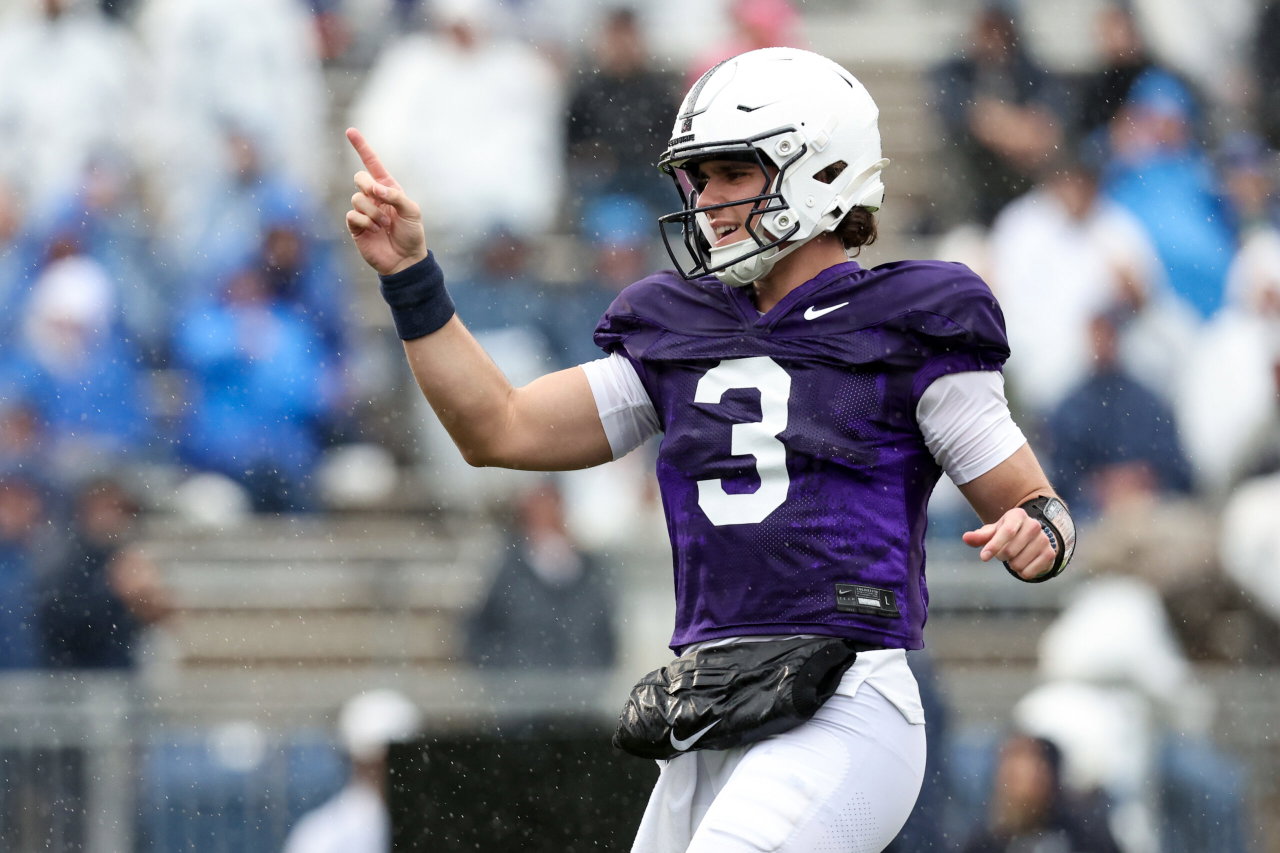
Rocco Becht graduated from Iowa State with a degree in communication studies in December 2025 before following Matt Campbell to Penn State for his final season of eligibility. Now, instead of taking a normal college schedule, Becht is taking a specialized ‘online’ course that potentially gives him greater flexibility to focus on football.
Watch What’s Trending Now!
“I graduated with a communications degree from Iowa State, and I came over here. I’m in a grad program, an organizational development and change program. Leadership classes, working in small-group classes. I’m doing that right now,” Becht said in an August 20 media availability. “In the fall, I’ll have a class online. After that, I’ll get a certificate, and then I’m able to pursue my master’s with those 12 credits.”
It is not quite the typical college schedule. But Becht is not a typical fifth-year student-athlete either. He spent four seasons at Iowa State, started 39 straight games, and finished his Cyclones career with 9,274 passing yards, 64 touchdown passes, and 19 rushing touchdowns. Those numbers put him among Iowa State’s statistical leaders in several categories. Now his attention is almost entirely on football. That’s the reason he didn’t even know about his next class when a reporter asked him about it.
“I don’t know what [class this fall], we haven’t picked it yet,” Becht said. “We have to do that this coming week, with school starting next week. I’m in one class. I guess it’s the perks of being graduated and being in a fifth year.”
Becht becomes the first transfer quarterback to start for the Nittany Lions after the program had used multi-year starters at the position for the previous five seasons. He also reunites with Campbell, the coach who recruited him out of high school and turned him into a three-year starter at Iowa State. Becht has been clear about why he followed Campbell.
“When Campbell took this job, this was probably the number one priority, that I wanted to come here and play for him for my fifth year,” he said earlier this year.
Becht also has something to prove after what happened in 2025. He dealt with a torn labrum in his non-throwing shoulder and an AC joint injury in his throwing arm. He still finished with 2,584 passing yards and 16 touchdowns, but those numbers were a step down from 2024, when he threw for 3,505 yards and 25 touchdowns.
The college game has changed a lot, too. Transferring used to mean worrying about whether your credits would follow you and whether you would have to start over. Now players can enter the portal, find another school, and be back on the field without missing a season if they meet the academic requirements. NIL has only made staying in college more attractive, especially for players who can make serious money while they play.
The NCAA requires Division I athletes to make progress toward a degree, but the bar is not the same as carrying a normal college workload. Athletes must earn at least six credits each term and hit 40%, 60%, and 80% degree-progress benchmarks before their third, fourth, and fifth years. Once a player has finished most of his degree requirements, there is a lot more room to make football the priority.
Carson Beck was a good example. He graduated from Georgia before transferring to Miami, and during the 2025 season, he said he was not taking classes. He had already finished his degree, so there was little left on the academic side while he focused on football. Then some players move repeatedly.
Dan Lanning raised concerns about players deprioritizing their degrees
Former Texas, USC, and Arizona State player Jake Smith once said 35% to 40% of his credits did not transfer when he changed schools. That is one of the uglier parts of the portal. A player can move for playing time, money, or a better situation, only to discover that his academic progress does not move with him. Oregon coach Dan Lanning has openly worried about that problem.
“One of the questions we have to ask ourselves is, at what point does the degree still matter?” Lanning said to ESPN in 2024. “I think it’s going to make it harder and harder if guys become multi-year transfer guys, actually, to have a college degree. If you graduate, there are a lot of times when it makes sense — change schools as many times as you want. But on the same note, if somebody’s changing schools three times, I’m wondering what their progress towards a degree really looks like.”
Rocco Becht’s situation is different. He graduated from Iowa State before following Matt Campbell to Penn State. Now he is enrolled in Penn State’s Organization Development and Change graduate program and says he will take one online class this fall. The program itself is legitimate, with Penn State describing it as a 30-credit master’s program aimed at organization development and workforce-related careers.
But his situation shows where college football is heading. He has already finished his undergraduate degree, has one class on his fall schedule, and is spending the vast majority of his time preparing to quarterback Penn State. The larger problem is the incentive structure.