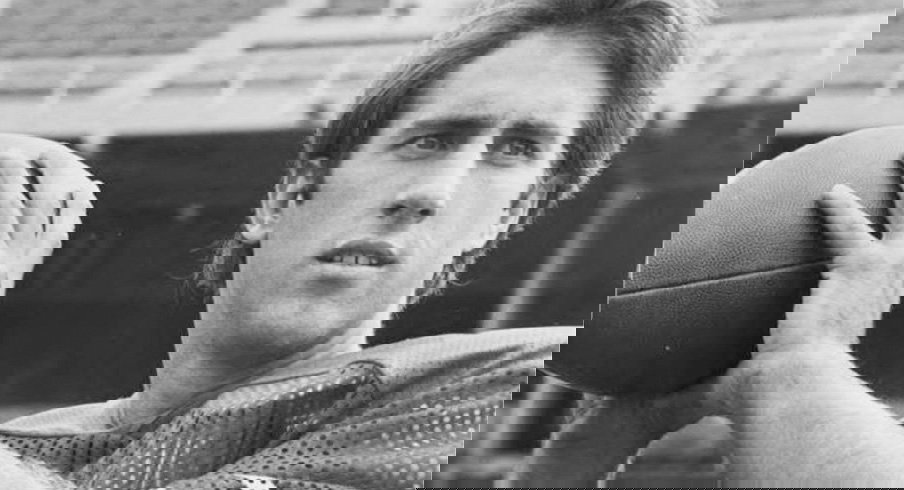
The history of Ohio State is filled with legends that fans still rave about. One of them holds a special place in the hearts of every Buckeye faithful because he could do it all. Bob Atha passed away on March 31 after a prolonged struggle with cancer. The preferred walk-on who played three positions left behind a legacy that will always echo in Columbus.
Watch What’s Trending Now!
Atha joined the Buckeyes as a kicker. However, Vlade Janakievski held the starting kicker position, and Ohio State was unwilling to take any risks during this storied yet transitional period. OSU had come off defeats against Michigan and Alabama in 1977, needing dire changes. Woody Hayes was turning every page toward success.
“You always hear about him punching his hand through a chalkboard, and it happened in the Michigan game my freshman year,” Atha said to Dispatch’s Rob Oller. “One time, he brought in POWs who had escaped during Vietnam. They had learned to talk to each other by tapping on the walls. Woody thought it was the greatest and had them speak; the whole message was that no one was going to decode our cadence.”
Atha continued to be a backup kicker but saw some snaps at other positions as well. Despite the limited appearances, this was the start of Atha’s exceptional career. The ‘utility man’ tag that he would eventually earn at Ohio State. That year, Atha managed to connect on six field goals (out of nine) and established himself as a reliable kicker. But then came Woody Hayes’ unexpected firing.
Atha had been preparing for a game-winning field goal since childhood. He would mentally visualize two tall trees as goalposts and imagine himself being the game’s hero. Against Clemson in 1978, he had that chance in the Gator Bowl. But Woody Hayes’ infamous temper prevented that from happening. Hayes punched Clemson noseguard Charlie Bauman, stalling the drive, with just 2:01 remaining, and the Buckeyes lost 17-15. Ohio State fired Hayes within hours of the game.
Despite Hayes’ firing, Atha persisted with the team and proved himself when new head coach Earl Bruce arrived in 1979. That year, he wasn’t looking for heroism as he envisioned against Clemson, but just gradual progression. Atha served as the backup QB behind Art Schlichter and was also the reserve kicker. In the 1980 season, he completed 15 of 28 passes for 190 yards and rushed for 179 yards, scoring 5 touchdowns. It wasn’t spectacular, but when OSU played Michigan State, Atha showed his prowess.
He broke off a 63-yard touchdown run, the longest play from scrimmage for the Buckeyes that season. Not just that, he handled kickoff duties and converted an extra point in the Fiesta Bowl win over Penn State. The 1981 senior season became his breakout year, and everyone in the country knew about the little-known walk-on player who arrived in Columbus in 1978. While doing that, Atha showed unrelenting, selfless resolve, too, when OSU was playing in the Liberty Bowl and was up 31-20 in the fourth quarter.
“Bob was ready to come in and finish up at quarterback,” Bob’s teammate and backup kicker Bill Andrews recounted. “He went to our kicking coach, Steve Szabo, and said, ‘Let Billy kick the extra point and kick off if we score.’ Szabo turns to me and says, ‘Get ready.’ Unfortunately, it couldn’t have been two minutes later, and Art (Schlichter) throws an interception, and we end up being in a dog fight. But I’ll never forget the unselfishness. That was Bob.”
In his final year at Ohio State, Atha became the ultimate utility player as the starting placekicker, punter, and backup QB. His impact was undeniable; he led the Big 10 in scoring with 88 points and guided the Buckeyes to a conference title, a season highlighted by a record-tying performance against Indiana, where he made five field goals. Though Atha faced health struggles post his career, he found faith and remained positive throughout.
Bob Atha’s life after leaving Ohio State
The St. Louis Cardinals drafted Atha, but after two years in the NFL, he returned to his family’s business in Ohio. Atha’s four generations had worked in oil and gas, and that’s where he dedicated his life, being the entrepreneurial pillar of his family. Life had been tough for Atha when Rob Oller interviewed him in 2012. He had lost two brothers and his mother over 11 weeks and was battling emotional trauma. On top of it, a mysterious illness was bugging him.
“There was a period of time, the first five or six months, not knowing what I was going through, where I had this defeatist dejection,” Atha recounted. “And I knew it wasn’t right.”
Gradually, the doctors diagnosed Atha’s illness as Lyme Disease. It was a non-fatal illness caused by tick bites, but Atha remained negative about it and, to cope with it, leaned into his Christian faith. Finally, his wife, Carol, reached him and showed him the “good in his life,” including his three children. The pessimism faded, and Atha started living fully. Late in his years, though, cancer caught him, and Bob lost that battle at 65.
Atha’s career and legacy will not be only that of an Ohio State player but also of a human being who had “natural warmth” that drew people in. “Conversations with him were easy, genuine, and memorable.” What else was memorable was his unselfish outlook towards everything. That’s why he holds a special place in Ohio State football history.
Written by

Edited by

Amit