
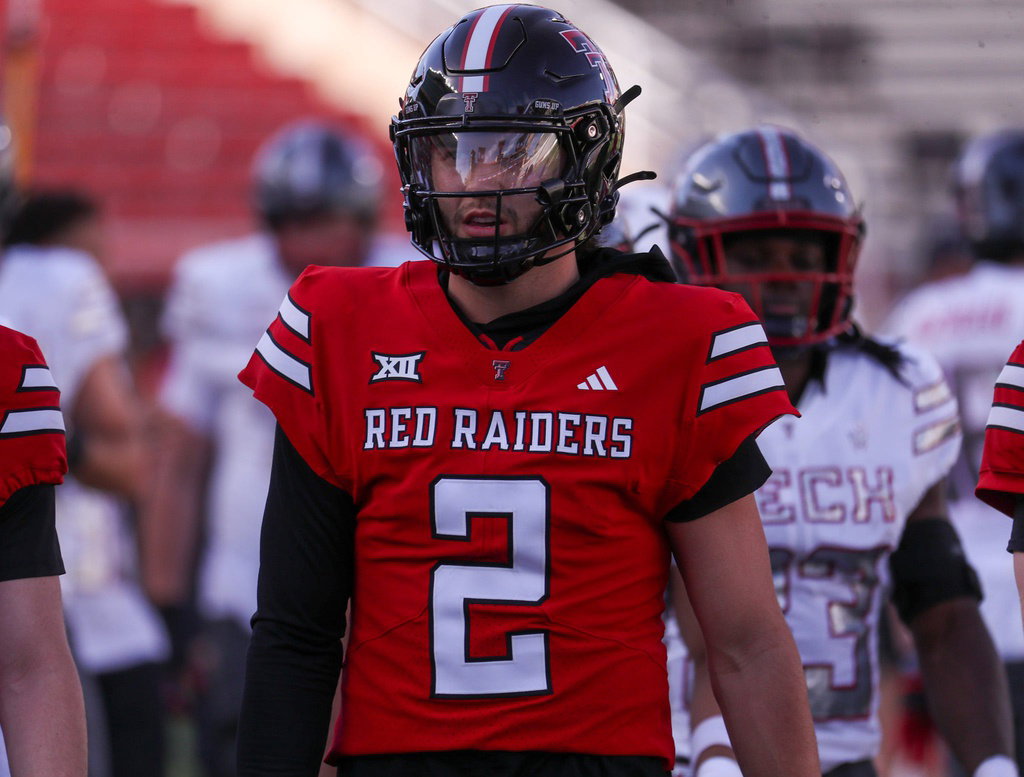
There’s a saying that every major court ruling creates new arguments. Brendan Sorsby’s eligibility fight is proving that theory right. The former Cincinnati QB recently scored a big win when a Texas judge blocked the NCAA from declaring him ineligible. That decision caused an uproar. But while everyone is debating the eligibility ruling, another legal battle involving the Texas Tech QB may carry even bigger consequences for the future of NIL itself.
Watch What’s Trending Now!
“The University of Cincinnati is suing to collect $1 million in N.I.L. damages after Sorsby defected to Texas Tech,” Puck’s Eriq Gardner reported, adding a warning. “A ticking time bomb case that could imperil player contracts across all of college sports.”
While it may appear like a contract dispute, further digging shows it may impact NIL agreements. The case stems back to when Cincinnati sat down with Sorsby’s representatives in June 2025. At that time, the school agreed to pay him $875,800 through an NIL arrangement.
Months later, after the QB entered the transfer portal and landed at Texas Tech, his former program claimed that his departure deprived the Bearcats of one of their most valuable promotional assets. The school’s lawsuit, filed in February, seeks to enforce a $1 million liquidated damages clause included in the agreement. But Sorsby’s attorney, Joseph Braun, sees things differently.
He has argued that Cincinnati’s position amounts to a “legal fiction.” He claimed that the NIL rights themselves held little independent value because the license was nonexclusive and excluded broadcast uses. He argued that the school paid Brendan Sorsby to play QB, and he did that for two seasons. That argument strikes at the core of modern college sports.

The University of Cincinnati is suing to collect $1 million in N.I.L. damages after Sorsby defected to Texas Tech—a ticking time bomb case that could imperil player contracts across all of college sports. More from @eriqgardner: puck.news/could-brendan-…
Under the post-House settlement landscape, schools can compensate athletes for NIL activities, appearances, and licensing opportunities. What schools cannot officially do is pay athletes simply to play football. So Cincinnati has carefully maintained that this was never a pay-for-play agreement. The university has also defended the $1 million clause as reasonable, citing reports that Texas Tech offered Sorsby somewhere between $4 million and $6 million after he entered the portal.
In court filings in April, Sorsby argued that Cincinnati is attempting to punish him for exercising what he describes as his right to transfer. He has even alleged that the school offered to waive the $1 million penalty if he entered the NFL Draft instead of accepting Texas Tech’s offer.
If true, that detail adds another fascinating update to an already explosive case. Because suddenly the question isn’t just whether Sorsby breached a contract. The question becomes whether NIL agreements are being used as transfer deterrents. For now, the case is still in court, where a federal judge will decide whether Cincinnati’s lawsuit can move forward or should be struck out.
The outcome could have major consequences across college sports. If Sorsby comes out on top, schools may find it much harder to use NIL agreements to keep athletes tied to a program for multiple years. If Cincinnati wins, universities could gain a stronger way to discourage players from transferring after taking NIL money. And while that legal fight is still happening, Sorsby is already at the center of another controversy.
Brendan Sorsby’s court win ignites debate
When a Texas court gave Sorsby the opportunity to play in 2026 despite betting on his own school, it enraged college sports people. The NCAA quickly filed an appeal after Judge Ken Curry blocked them from declaring the former Cincinnati QB ineligible. The case is now scheduled for trial in February 2027, just weeks after the CFP National Championship Game. The reaction from fellow ADs has been swift, too.
According to reports from Yahoo Sports and The Athletic, multiple schools are now reconsidering scheduling relationships with Texas Tech. Most notably, Georgia AD Josh Brooks instructed their programs not to schedule future contests against Texas Tech, as reported in a memo obtained by the Athens Banner-Herald.
“Based on recent developments, Georgia Athletics will not schedule future contests against Texas Tech until further notice,” the statement read. “If you have any contests currently scheduled against Texas Tech, or are actively engaged in scheduling discussions with Texas Tech, please notify your sports administrator as soon as possible so we can evaluate the situation and determine next steps.”
That’s a huge action considering the case stems from one player’s eligibility. But it shows how much anxiety exists across college sports right now.