
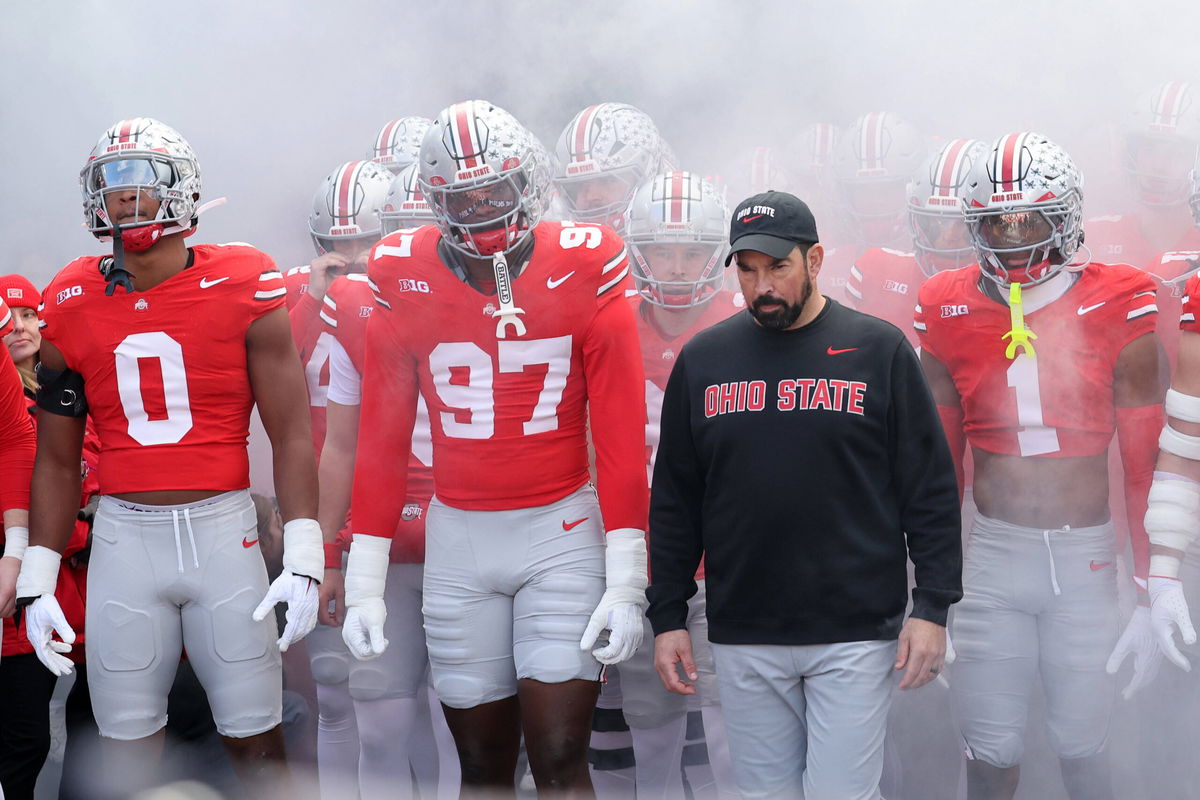
There was a time when Ohio State fans would have laughed at the idea of Ryan Day being on the hot seat. A national championship will do that. But football has a short memory, and one bad season can quickly change the mood.
Watch What’s Trending Now!
Saturday’s 31-28 defeat to Nebraska contributed to that. The Huskers ended a 31-game losing streak against ranked opponents, while Ohio State watched its College Football Playoff hopes disappear as they suffered their fourth loss of the season. Now fans are asking a much bigger question. Could Ohio State actually afford to move on from Ryan Day?
Former Ohio State beat writer Andrew Lind offered an interesting perspective on X writing, “An underlying aspect of Ohio State failing to meet expectations in the NIL era is that those who fund the program are less likely to donate if/when there’s continuously no return on their investment. Something to consider when discussing a potential coaching change and the renewed excitement that comes with it.”
That argument struck a nerve with one fan, who questioned whether donors disliked Ryan Day enough to hand him $75 million just to leave. Lind pushed back, saying, “Ohio State would never have to pay Ryan Day $75 million dollars.” So what’s the real buyout number?
Ryan Day agreed to his current contract ahead of the 2025 season. The deal keeps him in Columbus through 2031 and pays him an annual salary of $12.5 million. The figure getting attention, however, is the buyout.
According to CBS Sports’ Brandon Marcello, Ryan Day’s contract includes an $11.5 million payment for every year remaining on the agreement. With five years left on the contract after the 2026 season, Ohio State would be looking at a $57.5 million buyout if it decided to fire him. That’s a staggering amount, even for a program with OSU’s financial muscle.
The $75 million figure floating around comes from earlier reporting by FOX Sports and Fox News, which cited the approximate value of Ryan Day’s remaining guaranteed salary. But that isn’t the same thing as the actual buyout calculation.
Lind pointed out that Ryan Day would be contractually required to seek another coaching job, which could offset part of what Ohio State owes him.
“If fired, he’s contractually obligated to seek another job that would offset a portion of his buyout to $57.5 million,” he wrote. “Ohio State is one of a few programs that could incur that cost, but it would likely be negotiated down even further. If he takes another job, Day would owe Ohio State $6 million. I’d argue it would be best for both parties to negotiate the latter figure.”
There is a recent example of how these situations can play out. Penn State initially faced a $49 million obligation after firing James Franklin. That figure was negotiated down to $9 million when the coach took the Virginia Tech job.
Ohio State wouldn’t necessarily have to write a $57.5 million check and walk away. A negotiated settlement could change the whole calculation. Still, the potential payout would rank among the largest in college football history. Only Texas A&M’s $76 million buyout of Jimbo Fisher would be higher if Ohio State paid the full amount.
The trouble for Ryan Day is that Ohio State has never been particularly patient when it believes the program is falling short.
Ryan Day’s record is impressive, but Ohio State’s standard is lofty
Ohio State hasn’t had a four-loss season since 2011, when Luke Fickell went 6-7 in his only season as head coach. Urban Meyer replaced him in 2012. The program has made similar decisions before. John Cooper was dismissed after an 8-4 season in 2000, with Jim Tressel taking over. Earl Bruce was fired after the Buckeyes finished 6-4-1 in 1987. Even Woody Hayes’ final season in Columbus ended with a 7-4 record.
In Columbus, winning nine or ten games is never enough. Because Ohio State consistently recruits top-five talent and pours massive money into its facilities, fans and leadership view anything less than a Big Ten title and a deep Playoff run as a failed season.
That pressure goes straight to the top. The same boosters funding eight-figure rosters expect immediate results on the field. When the losses pile up, those wealthy donors start withholding checks and quietly pushing the athletic director to make a change, regardless of the buyout price.
Ryan Day’s situation is different, of course. He has an 89-16 record and delivered the national championship in 2024. Still, that title doesn’t erase what has happened since. Ohio State was eliminated in the quarterfinals of the 2025 CFP. This season looked promising at 6-1 until Julian Sayin fractured his right elbow and true freshman Luke Fahey took over as starter.
Ohio State has gone 1-3 since that change, including defeats to unranked USC and Nebraska. Ryan Day is now in a fix. Asked about potential staff changes following the Nebraska defeat, he said the Buckeyes would wait until after next Saturday’s regular-season finale against Michigan. The question is whether those changes will involve assistants, the head coach, or both.