
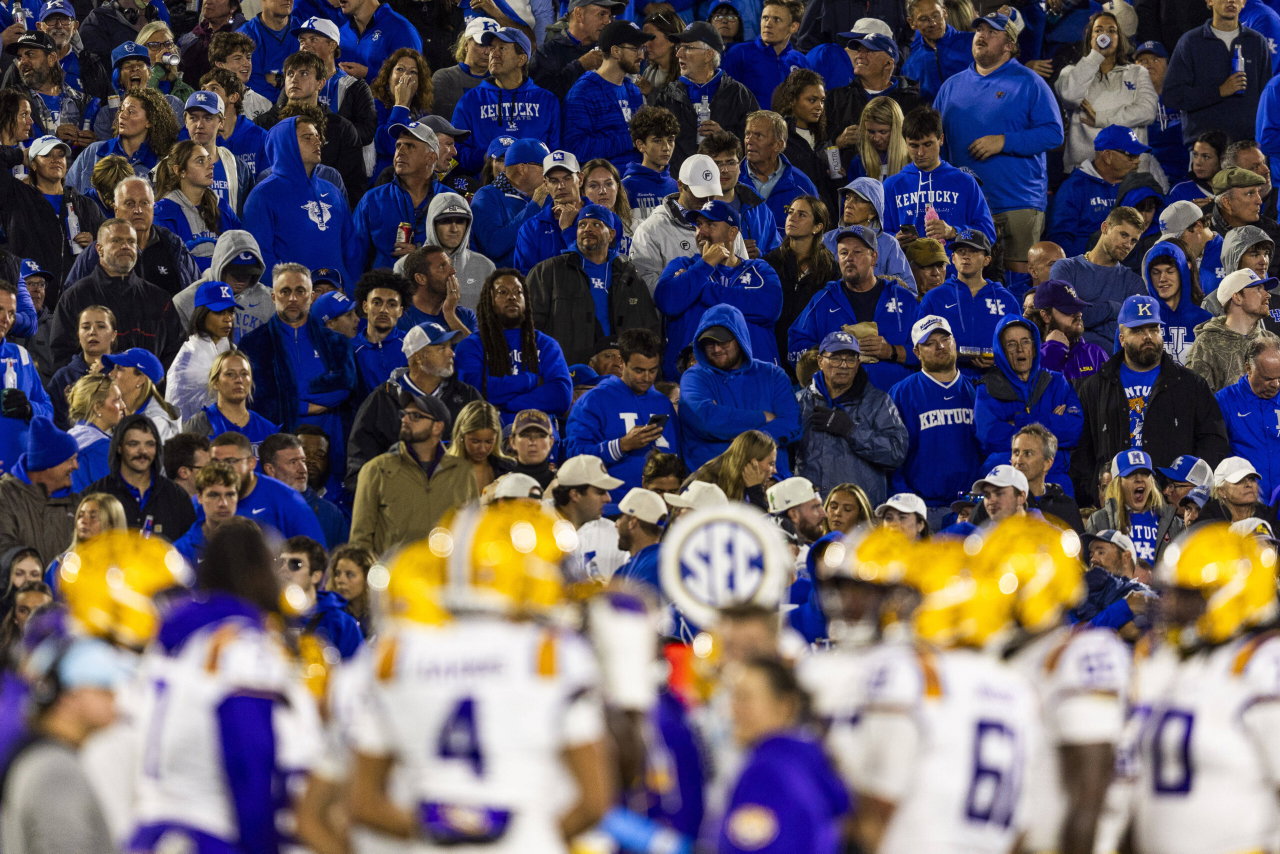
Guess losing hurts a little less when the winning team ends up paying you for it. LSU may have suffered a heartbreaking defeat, but Kentucky’s celebrations came back to haunt the Wildcats. Kentucky stunned No. 10 LSU in a 35-34 overtime thriller on Saturday night. After LSU scored first in overtime, the Wildcats answered with a touchdown to make it 34-33. Rather than settle for an extra point, head coach Will Stein gambled on a two-point conversion, and Kenny Minchey ran untouched into the end zone to seal the upset. Thousands of Kentucky fans then stormed Kroger Field, turning their biggest celebration of the season into an expensive mistake.
Watch What’s Trending Now!
Less than 24 hours later, the SEC slapped Kentucky with a $500,000 fine, with the entire amount going directly to LSU. The league announced the penalty Sunday after determining that the Wildcats had violated its access to competition area policy.
“Kentucky is being fined $500,000 by the SEC for violating the league’s ‘access to competition area’ policy after last night’s field storming,” Ubben wrote on X on October 11.
“For the safety of participants and spectators alike, at no time before, during or after a contest may spectators enter the competition area,” the SEC’s official policy states.
The rule applies across all conference-sponsored sports, restricting field access to athletes, coaches, officials, support staff, and authorized personnel.
“The money from the fine goes directly to LSU, per an SEC rule change enacted in 2025,” Ubben posted.
For conference games, penalties go to the opposing institution, while fines from nonconference matchups are directed to the SEC’s Post-graduate Scholarship Fund.
The policy dates back to 2004, with financial penalties increased in 2015, 2023, and 2025. Previously, schools faced a $100,000 fine for a first offense, $250,000 for a second, and $500,000 for subsequent violations.
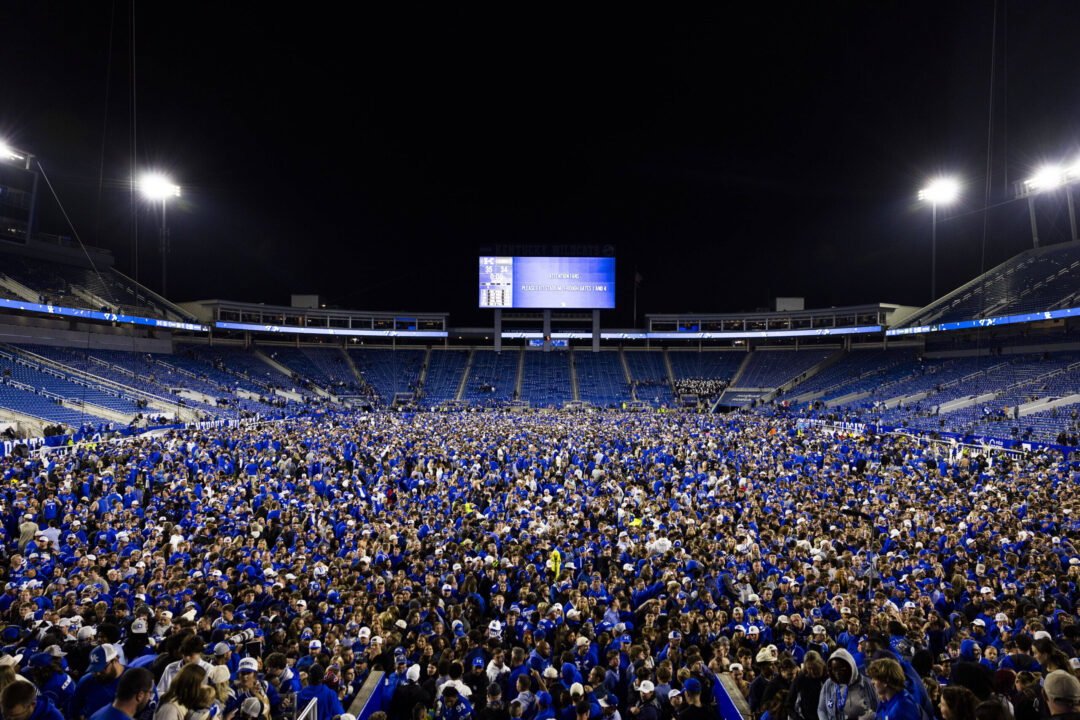
The SEC tightened its rules in May 2025 after field and court storming incidents increased over the previous three years. Commissioner Greg Sankey cited safety concerns for visiting players and officials, prompting the conference to replace escalating fines with a flat $500,000 penalty for every violation.
“The motivation was ‘field rushing is field rushing, the first time or the 18th time,’” Sankey said, arguing that the safety risks remain regardless of how frequently a school violates the rule.
Kentucky isn’t the first SEC program to learn that beating a ranked opponent can come with an expensive celebration. Mississippi State received the same $500,000 punishment in September 2025 after stunning No. 12 Arizona State 24-20. The Bulldogs had just secured their first win over a top-15 nonconference opponent since 1991, and fans celebrated by storming the field and carrying the goalposts out of Davis Wade Stadium. The problem? Arizona State’s players and coaches hadn’t even left the field.
The SEC handed Mississippi State the bill, but unlike Kentucky, the Bulldogs didn’t have to pay the team they had just beaten.
But both schools could have avoided the hefty penalty had their postgame celebrations followed SEC guidelines. The conference allows schools to submit a celebration plan in advance and communicate it to fans. If visiting players, staff, and game officials safely exit the playing surface before spectators enter, the school may avoid the fine.
Kentucky’s postgame celebration did not qualify for that exception. Fans poured onto Kroger Field immediately after Kenny Minchey’s winning two-point conversion, leaving the Wildcats facing a financial penalty despite their upset victory.
Kentucky’s wild finish against LSU
Kentucky improved to 5-1 overall and 3-1 in the SEC, securing its first home victory over a top-10 opponent since beating Florida 20-13 in 2021. But that win comes with an asterisk. In August 2024, the NCAA handed Kentucky two years of probation after an investigation found that 11 football players had received payments for work they never performed during 2021 and 2022. Eight competed while ineligible, forcing the program to vacate affected victories, including its win over Florida. Kentucky’s athletic department was found to have no knowledge of the violations. That leaves the Wildcats’ 31-28 victory over No. 10 South Carolina in 2010 as their last officially recognized home win against a top-10 opponent before LSU.
For first-year head coach Will Stein, it was his second victory over a top-10 opponent this season, following Kentucky’s road win over Texas A&M in Week 3.
Kentucky kicker Adam Zouagui missed two field goals in the fourth quarter, from 42 and 26 yards, before hitting a 33-yarder with 12 seconds left to force overtime. Stein stuck up for him afterward.
“That’s the life of a kicker,” Stein said. “You’ve got everybody watching you on those kicks. It was unfortunate that he missed two, but he hit a really big one. We do pressure kicks all the time in practice. I’ve seen him hit it a million times. He did a great job in that moment.”
Minchey finished 23 of 36 for 246 yards, 206 of them in the second half. C.J. Baxter ran for 123 yards and two touchdowns, including a 77-yard run on Kentucky’s first play. Freshman receiver Kenneth Darby, who had originally committed to LSU, caught four passes for 79 yards, including a 22-yarder in overtime. Kentucky also played without three linebackers, two defensive backs and a defensive lineman.
“People count us out. Keep doing that,” Stein said.
The Wildcats jumped from unranked to No. 15 in Sunday’s AP Poll, their highest ranking since October 2022.
LSU, meanwhile, fell to 4-2 overall. Quarterback Sam Leavitt threw for 275 yards and two touchdowns but also had an interception and a fumble. Jackson Harris connected with Roman Mothershed for a 41-yard touchdown that gave the Tigers a 27-24 lead in the fourth quarter.
Both teams have an SEC game on deck. LSU hosts Mississippi State, while Kentucky travels to Oklahoma on Saturday.
LSU couldn’t leave Lexington with a victory, but it won’t leave empty-handed either. Kentucky got its signature upset, and the SEC made sure the celebration came at a cost.