
College sports betting rules are getting trickier by the day, and Steve Sarkisian’s Texas Longhorns just found themselves right in the middle of it. Between January 1 and August 17, Texas self-reported seven minor NCAA violations linked to sports wagering.
Watch What’s Trending Now!
While most fan bases panic when they hear the word violation, the University of Texas took a transparent approach by reporting these incidents themselves before anyone else could point fingers.
The Good News?
The details came out after Horns247 reviewed public records released on September 3. According to the document, these were all Level III infractions, which are the lowest category on the NCAA’s penalty chart. None of the bets were placed on Texas games, and no single bet went over $1,000.
Out of the seven cases, three involved the football program, two involved general athletic staff, and one each came from women’s soccer and men’s track and field.
“Texas compliance self-reported an incident involving a member of the Longhorns’ football program on April 22, shortly after Texas discovered a player had placed $34.67 worth of wagers on college and pro basketball,” David Eckert of 247 Horns reported.
Imago
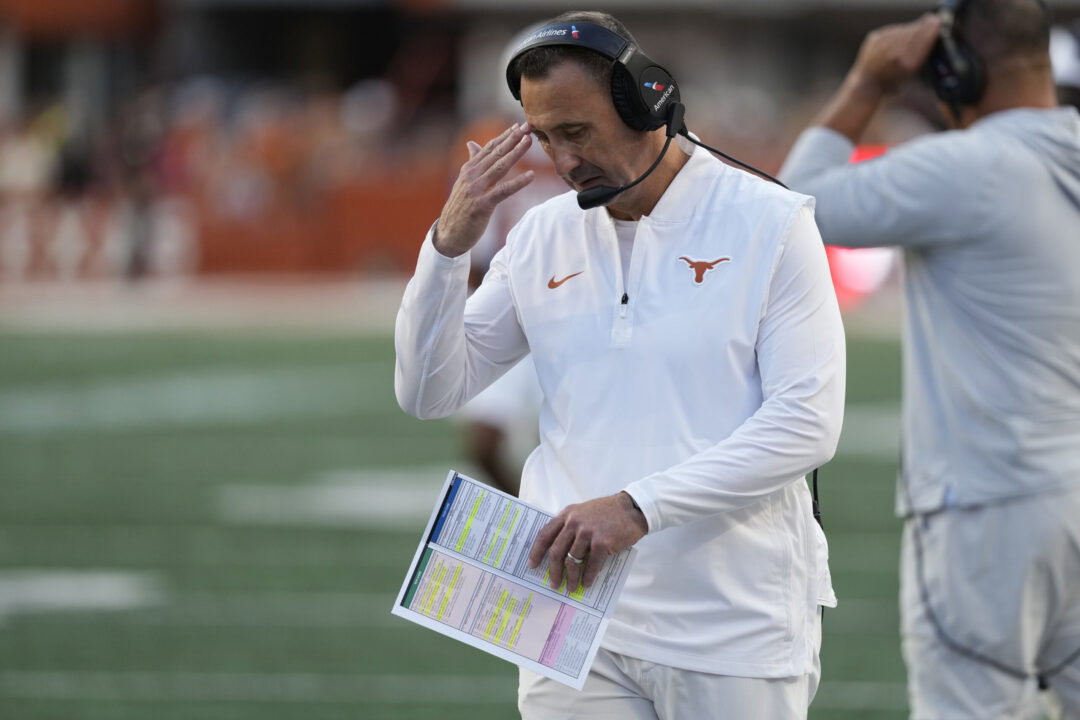
Nov 22, 2025; Austin, Texas, USA; Texas Longhorns head coach Steve Sarkisian pauses during the second half against the Arkansas Razorbacks at Darrell K Royal-Texas Memorial Stadium. Mandatory Credit: Scott Wachter-Imagn Images
Of the two violators from football, one is a player whose status with the Longhorns is unclear. The university has redacted the names of all the offenders from the documents, who are from different disciplines. While women’s soccer and men’s track and field were also involved, the common thread binding them all is the platform on which they placed their bets.
Even A Meal Far Away Could Be A Violation
Several prominent college football programs have self-reported minor Level III NCAA violations during the 2025–2026 athletic calendar. Like the Texas Longhorns, many of these infractions involve the complex landscape of sports wagering, prediction markets, recruiting slip-ups, or minor logistical errors.
Since Level III violations are the lowest tier on the NCAA scale, schools routinely self-report them to ensure compliance.
The Ole Miss athletic department turned in 16 violations. The football program accounted for three of them, including an incident where a recruit impermissibly sold a complimentary ticket.
But one specific incident involved two staff members taking a recruit to eat during an unofficial visit. They made the mistake of choosing a place which was farther than one mile from campus. This made a simple meal into an off-campus contact violation during an evaluation period.
Those two staff members were banned from recruiting for a week and told to stay away from that specific recruit for 30 days.
The Common Thread
Kalshi, a popular prediction market website, was used in six violations. This platform, along with others, is available for use in Texas. On the flip side, the use of traditional sportsbooks is prohibited.
After going through many case studies, Horns 247 found that Kalshi does not use technology to block student-athletes’ and athletic department employees’ access to wagering websites. In response to the growing influence of betting and wagering activities, the SEC mandated the use of ProhiBet since the 2023-2024 academic year.
247 Horns noted that while ProhiBet partners restrict wagering, Kalshi monitors violations but doesn’t block access.
The Longhorns are the third SEC school to report NCAA violations that occurred on Kalshi. Earlier this year, Clarion Ledger reported that two Mississippi State football players were using the betting platform, as Knox News reported multiple minor violations within the athletic department in Tennessee.
The precautions around wagering among student-athletes and members of the athletic department have been under a brighter spotlight ever since the Sorsby fiasco, which took a different turn.
NCAA to not punish Cincinnati for Brendan Sorsby’s gambling violations
In four years, Sorsby placed over 400 bets on college sports, most of which were on football. He wagered actively while being a part of the Cincinnati Bearcats and Indiana Hoosiers squads. However, the NCAA is not holding the Bearcats accountable for the quarterback’s actions.
According to the Cincinnati Enquirer, the NCAA has closed its investigation into the school, as reported on September 2. According to court documents, the probe was set into motion after a program member was denied access because of ProhiBet while Sorsby attempted to enter PrizePicks in 2024.
“Earlier this summer, NCAA enforcement staff completed an inquiry into a former Cincinnati student-athlete’s prohibited betting activity during his time at the university,” a college spokesperson told the Cincinnati Enquirer. “The inquiry is now closed, and the student-athlete was found to have committed a Level III violation.”
Earlier this year, Sorsby was banned from all football activities by the NCAA for violating its rules. He countered by filing a lawsuit against the governing body. A Texas court eventually granted a temporary injunction, making him eligible to play.
As college football moves ahead in the ever-evolving landscape, betting poses a constant threat to the integrity of the game. While some programs chose to cross the NCAA, others are far too cautious.