
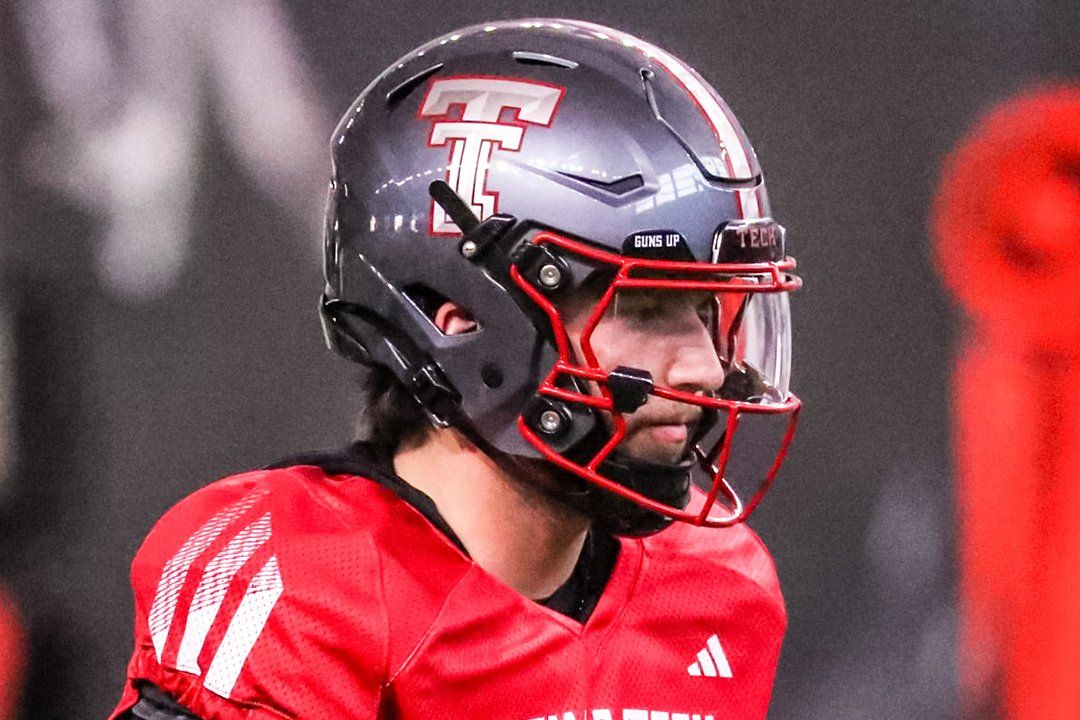
Texas Tech’s ace QB, Brendan Sorsby, now sits in limbo after the NCAA barred him from playing college football. For most folks, it’s a straightforward decision. You just can’t bet on your team while being a part of it; it’s as clear as day. Empathy is running short for the 22-year-old as he appeals in court for an injunction. Despite that, what Sorsby has argued in court should be heard by everyone.
Watch What’s Trending Now!
“This case, I think it has been badly misunderstood by a lot of people,” Sorsby’s attorney, Jeffrey Kessler, said. “What this case is about is when you have no threat to competitive integrity, but you have a mental illness of gambling addiction, which is plaguing student-athletes across the country. The NCAA said in its policies that it would consider supporting the athletes, but instead, they want to punish them. That’s wrong. We think it’s illegal.”
We’re not defending Sorsby here, but we’re pointing out that a gambling problem that’s barely understood in the college football landscape has never gotten much attention, even in Sorsby’s case. Take the Texas Tech QB as an example. He didn’t just place those 40 or so odd bets on Indiana while being a part of their roster. As per reports, he placed 2,900 bets in just two years at Indiana. And those bets weren’t just on football.
From MLB to Tennis to Romanian soccer games, Brendan Sorsby became a compulsive bettor, a behavior that reportedly continued when he transferred to Texas Tech this year. Sorsby bet on everything: Nathan’s Hot Dog Contest, the PGA, the NBA, and Romanian soccer. He couldn’t stop clicking. However, punishing Sorsby alone won’t address the systemic problem.

Spoke with Joey McGuire on addressing his team about the Brendan Sorsby news
“I acknowledge and take responsibility for my years-long struggle with gambling,” Brendan Sorsby wrote in a May 15 letter to the NCAA. “I have been a compulsive gambler since I was 18 years old, when I first logged onto a gambling app and made an initial $5 deposit to take advantage of a promotional offer for a free $100 credit. What began as a seemingly harmless and fun activity gradually developed into a daily habit and compulsion that I could not control.”
That loss of control is precisely what experts like Evan Ozmat, a Ph.D. student in psychology, have begun documenting. When Ozmat started counseling undergraduates about HIV and substance abuse at the University of Albany, she was shocked to hear about the widespread gambling problem plaguing the students (Per Oliver Staley of Time.com). According to an analysis conducted at the University of Buffalo, one in ten college students is currently a ‘pathological’ gambler. That figure is far more than the 2-5% of the United States’ population facing a similar problem. If that estimate is accurate, Brendan Sorsby may be less of an exception than many fans assume.
Why does the problem keep growing?
Another survey, conducted by the NCAA among college students aged 18 to 22, found that nearly 60% reported placing sports bets. According to another study at the University of Mississippi, at least 6% of the students surveyed fulfilled the criteria of being a ‘problem’ gambler as the American Psychiatric Association defines it. What was more striking in that study was that students who participated in sports were more likely to engage in sports betting.
“College campuses need improved prevention efforts—that could include health education, media campaigns, and access to information and resources for students,” Ole Miss’s executive director of the William Magee Institute of Student Wellbeing, Hannah Allen, said. “There also needs to be increased screening and referral to treatment in our campus counseling and health centers.”
The constant exposure to those gambling ads, which scream to bet on things, isn’t making it easier for college athletes. And these are athletes who have just gotten newfound freedom through big-money NIL contracts, without any experience to handle those six- and seven-figure paychecks. Of course, most are adults and have agency, but many still lack guidance throughout their college football journeys. According to the NCAA, 63% of students recalled seeing betting ads while living on campus. That kind of environment only makes things more complicated.
The University of Louisiana, Baton Rouge, for instance, has recently signed a deal with Caesars Sportsbook, indirectly encouraging its students to place bets, including those that aren’t legally allowed. According to USNews.com, some students at the University reported receiving an email prompting them to “place your first bet (and earn your first bonus),” even though many hadn’t reached Louisiana’s legal betting age (21).
On the one hand, athletes can lose eligibility for betting. On the other hand, some universities have actively promoted sportsbook partnerships to students. That contradiction sits at the center of the debate.
Another report by the New York Times pointed out that at least 12 athletic departments and booster clubs have signed agreements with brick-and-mortar casinos. As various schools explore ‘revenue’ avenues, students’ well-being is increasingly neglected. The programs that have signed such partnership deals also encourage their students, using enticing language and sometimes labeling their betting partnerships as “risk-free” to promote them. And it’s not just a few programs.
The NCAA is showing double standards regarding betting while promoting it indirectly
The NCAA, which prohibits gambling ads during game broadcasts, is now actively seeking other revenue streams and hasn’t ruled out partnering with gambling companies. Many of those deals are still in place. For starters, the NCAA has authorized licensed sportsbooks to use its marks and logos and receive official data from championship events, including men’s and women’s basketball.
The governing body had signed an agreement with Genius Sports that runs till 2032, making the company an exclusive distributor of the official NCAA data. Using the data, sportsbooks feature live betting options on their apps, and the company now effortlessly uses the NCAA’s logos inside the apps. After the deal, though, the college sports regulator had promised to put the revenue to good use, funding educational programs and monitoring the harassment of student athletes.
While the NCAA publicly warns athletes about the risks of gambling, its leadership has also discussed the financial opportunities created by the rapidly growing sports betting market.
“That’s a major opportunity, right in front of us,” NCAA president Charlie Baker said in 2023 about monetizing sports betting. “We have a major opportunity to get into the sports betting space… anybody who has a phone (being) able to bet from any place they want and two-thirds to almost three-quarters of all people between the ages of 18 and 22 betting on sports.”

Imago
Sports Gambling Judiciary UNITED STATES – DECEMBER 17: Charlie Baker, president of the National Collegiate Athletic Association, testifies during the Senate Judiciary Committee hearing titled Americas High-Stakes Bet on Legalized Sports Gambling, in Dirksen building on Tuesday, December 17, 2024. Tom Williams/CQ Roll Call Washington DC United States EDITORIAL USE ONLY Copyright: x2024xCQ-RollxCall,xInc.x TomxWilliamsx rollcallpix162421
During the interaction with the media, Baker seemed “taken aback” when a writer asked about the NCAA selling athlete data as part of its gambling and media package deal with companies. In reality, the NCAA requires every player to allow their performance data to be aggregated for gambling contracts. Even when the NCAA strictly bars placing bets on any amateur or professional sporting event. And that’s not even because the NCAA wanted it.
In October last year, the D1 Administration Committee approved a new rule allowing athletes and staff members to bet on professional sports games. Quickly after the decision, the D2 and D3 level management committees approved a similar rule. But that’s when the SEC stepped in, sent a strongly worded letter to Charlie Baker opposing it, and 365 D1 schools immediately voted to rescind the rule. The question? Why didn’t the NCAA acknowledge problems in its backyard, even when several collegiate betting scandals have come to light?
The consequences are already clear as day
In 2023, 35 Iowa and Iowa state athletes and staff members were allegedly involved in sports betting; 16 faced charges, and many lost their eligibility. Not just that, back in 2020, a federal indictment charged several active and former basketball players because of a sports betting scandal. Most recently, in 2025, two separate investigations revealed that around nine student-athletes were involved in manipulating their on-court performance to influence bets.
The scandals have occurred amid an environment in which the NCAA’s marquee event, March Madness, has become a hotbed of betting-related activity. During the 2004 to 2017 period, the total amount of bets on the NCAA basketball tournaments nearly doubled, reaching a whopping $300 million, which is even more than twice what people bet on the Super Bowl.
NCAA mandates betting-risk modules and partners with EPIC Global Solutions for workshops, reaching 260+ schools in 2025. But is that enough?
Why is fixing the betting landscape so difficult?
The NCAA has long defended its “amateurism” stance to restrict athlete compensation while it generated billions in revenue. But after the NIL landscape came in 2021, the whole ecosystem became akin to a pay-for-play scenario, and many wealthy programs reportedly circumvented established safeguards to pay their athletes directly. Instead of paying NIL contracts directly (since the revenue-sharing cap is $20.5 million), programs rope in marketing agencies and sponsors and transfer funds to them. The companies, in turn, offer that money through NIL contracts.
Additionally, the NCAA’s authority has weakened amid lawsuits and court interference with its decisions. Even recently, Texas Tech (an NCAA member) challenged the NCAA in court after it denied Brendan Sorsby eligibility. Nothing is happening in unison, and there’s no established framework to deal with a problem as big as gambling. This is especially true when the NCAA and college programs continue to sign various deals with betting companies.
Until that happens, there won’t be a coherent consensus to address the betting-related activities. It will be unrealistic to remove all betting-related activities from the college football landscape since most of it happens illegally. And in the absence of that, incidents like Brendan Sorsby’s will continue to happen. But is it wise to punish a player punitively for something he couldn’t ‘control’?
Brendan Sorsby may deserve punishment. The NCAA’s rules are clear. But if thousands of college athletes are gambling, if schools continue signing sportsbook partnerships, and if betting ads remain everywhere students look, then one suspension will not solve the problem. It may simply be the most convenient response to a much larger issue.