
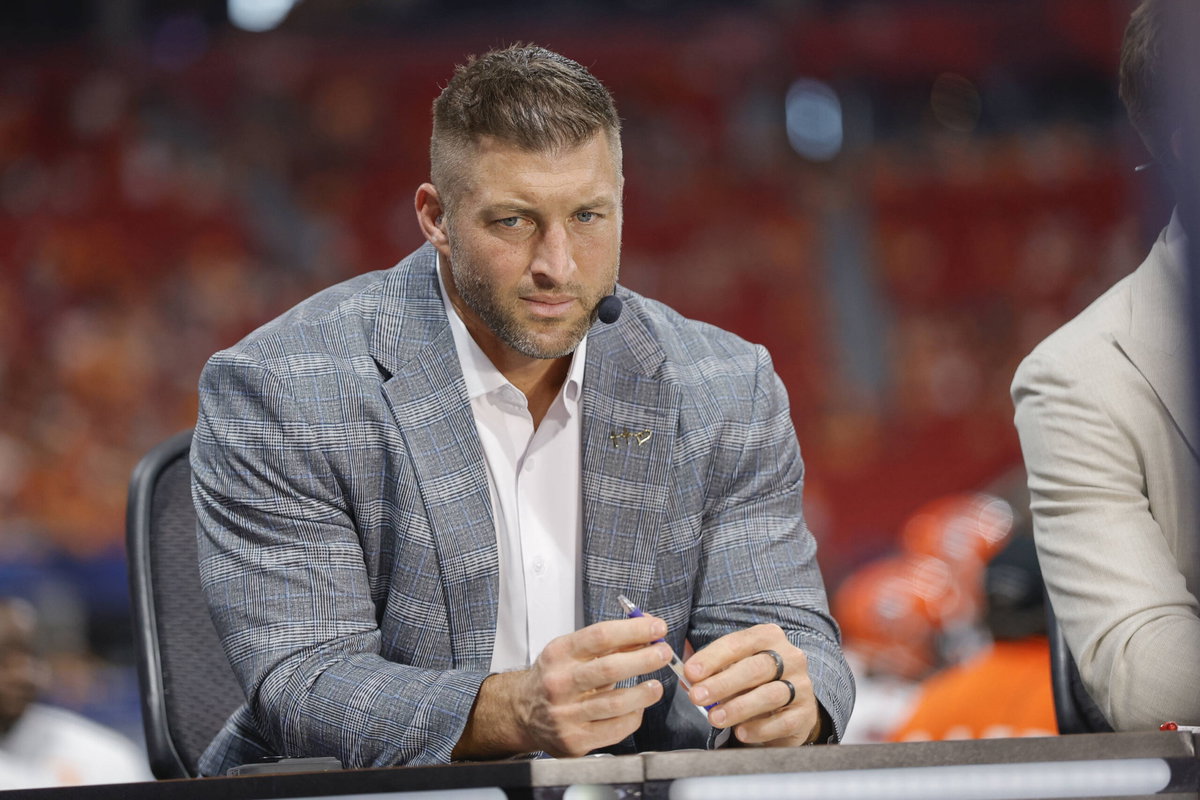
The FBI recently reported that every 11 minutes in the United States, a young person falls victim to a financially motivated sextortion scheme, with boys ages 14 to 17 making up roughly 90% of the targets. Now, former NFL quarterback and Heisman Trophy winner Tim Tebow is stepping forward with an urgent warning about how online predators are specifically hunting down young football players to trap them in devastating catfishing and extortion schemes.
Watch What’s Trending Now!
Because these young men often have starting spots, college scholarships, and local fame, scammers view them as prime targets with a lot to lose.
According to Tebow, the trap is simple and ruthless.
“We know the enemy is going after boys that play sports because they assume they have a platform in their school and a reputation,” Tebow explained while detailing how the scam unfolds on everyday social media apps on the Parenting in a Tech World podcast. He noted that scammers set the bait by “catfishing them, pretending to be a pretty young girl and sending them an explicit photo”.
Thinking they are talking to a peer, many boys take the bait and send a picture back, only for the scammer to immediately flip the script and say, “We got you now”.
What happens next is known as financially motivated sextortion, and it is one of the fastest-growing cybercrimes in America, if not the fastest. Unlike traditional online grooming that might take months to build trust, this sort of scam moves at the speed of a direct message.
Within minutes or so of getting a compromising photo, criminals threaten to send the image to the athlete’s parents, coaches, teammates, and entire follower list unless they immediately pay up. Because teens rarely have thousands of dollars sitting around, scammers often demand quick payouts through Apple gift cards, wire transfers, or mobile payment apps.
Data from the Tim Tebow Foundation and federal investigators show just how massive this problem has become. Even the FBI and NCAA have teamed up to warn student-athletes that international criminal rings, many operating overseas in places like West Africa and Southeast Asia, are actively scanning public rosters and social media profiles to find their next victims.
In August 2026, the FBI and NCAA specifically noted that college athletes are increasingly exposed to these schemes because Name, Image, and Likeness (NIL) deals push players to maintain public social media profiles and respond to unfamiliar accounts.
In his candid remarks, Tebow also pointed out how the nature of online exploitation has shifted over time. “This is a huge growing issue, and actually, the start of that trend was more about pedophilia and the pleasure side of it,” Tebow shared. “But it’s actually grown to become more of the goal of individuals trying to lure and groom to gain money and truly sextort them in an extortion way.”
For these criminal networks, it is no longer about personal gratification; it is a cold, calculated business model built on fear.
The emotional toll on these young athletes is heartbreaking. Suddenly finding themselves caught in a terrifying situation, many boys fear that their football dreams, reputations, and futures could all be ruined. And because they feel embarrassed or scared, many suffer in silence.
Tebow pointed to the tragic reality of that isolation, saying, “And unfortunately, dozens and dozens of boys have now committed suicide because of it, and often within the first two hours, because they don’t know what to do and they feel so ashamed.” Reports from the National Center for Missing & Exploited Children back up just how serious the problem has become, with at least 36 youth suicides linked to financial sextortion since 2021.
That is why Tebow is urging parents and coaches to talk about this before a predator ever reaches an athlete through social media. These scammers often rely on a teenager being too scared to tell anyone. So, having an open and judgment-free conversation can make a huge difference. Young athletes need to know that they can come forward without worrying about getting in trouble or being blamed. Taking away that fear also takes away one of the scammer’s biggest weapons.
If an athlete does get caught in one of these traps, the message from experts and the FBI is: don’t pay, stop responding, save the messages and screenshots, and report it immediately.
Paying the scammer does not make the problem go away. It can actually lead to more demands because the scammer knows the victim is willing to pay. By bringing this hidden problem into the open, Tebow hopes more young athletes will know they are not alone and, most importantly, that asking for help could protect both their future and their life.