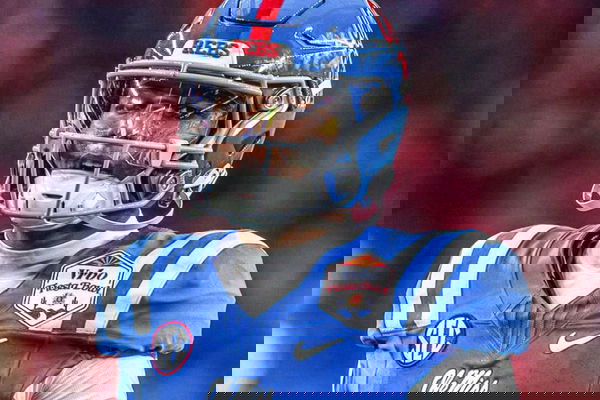
For decades, the NCAA controlled the clock on a college football player’s career. Five years meant five years, no matter the circumstances. But in the NIL era, that grip is slipping, and Ole Miss quarterback Trinidad Chambliss is the latest test case pushing it closer to breaking.
Watch What’s Trending Now!
After the NCAA denied Chambliss’ request for a sixth year of eligibility, the quarterback and Ole Miss escalated the fight beyond Indianapolis. What followed wasn’t just an appeal; it was the beginning of a legal battle that analysts believe strongly favors the player, not the NCAA.
Chambliss’ situation isn’t rooted in poor performance or roster manipulation. It’s grounded in eligibility math colliding with modern college football economics.
After spending four seasons at Division II Ferris State, where he became one of the most accomplished players in the program’s history, Chambliss transferred to Ole Miss and delivered a strong season in the SEC. With NIL and revenue-sharing opportunities now rivaling late-round NFL money, returning to college football made financial and competitive sense.
In November, the school filed a waiver seeking to extend Chambliss’ five-year Division I eligibility clock, citing illness and injury that limited portions of his earlier career. The NCAA formally denied that request in January, triggering an appeal and a looming lawsuit.


ESPN analyst Kirk Herbstreit didn’t mince words when assessing where this fight is headed.
“He’s got a strong chance,” Herbstreit said when discussing Chambliss’ case, pointing directly to the legal posture and the strength of his representation. Central to that confidence is attorney Tom Mars, who has built a reputation as one of the most aggressive and effective legal challengers of NCAA authority.
Mars himself has been equally direct.
“There’s now an opportunity to move this case to a level playing field where Trinidad’s rights will be determined by the Mississippi judiciary instead of some bureaucrats in Indianapolis,” Mars said, criticizing what he views as an inconsistent and punitive eligibility system.
That distinction matters. The fight is no longer just administrative; it’s legal.
The NCAA has defended its denial by pointing to a lack of contemporaneous medical documentation from Chambliss’ time at Ferris State. In its statement, the association cited a physician’s note from December 2022 indicating Chambliss was “doing very well” and noted that his previous school did not provide detailed treatment records.
From a rules-based perspective, that explanation follows NCAA precedent.
From a courtroom perspective, it’s far more vulnerable.
Chambliss submitted a 91-page medical filing outlining how injuries impeded portions of his career. More importantly, his legal team is framing the denial not simply as an eligibility dispute, but as interference with a legitimate commercial opportunity, a framing that has repeatedly found traction in courts since NIL became entrenched.
Legal precedent is quietly on the player’s side
Chambliss is not the first player to challenge NCAA eligibility restrictions in court, and that history matters.
Over the last two years, dozens of lawsuits have targeted NCAA eligibility rules, with courts frequently granting temporary injunctions that allow players to compete while litigation continues. In several notable cases, judges have shown little patience for rigid enforcement of eligibility when financial harm is clearly demonstrated.
That trend doesn’t guarantee a final victory, but it does establish a pattern: once eligibility disputes move from NCAA committees to courtrooms, players tend to gain leverage.
Trinidad Chambliss’ attorneys are betting on that reality.
Even if the NCAA ultimately prevails years from now, that outcome may be irrelevant to the immediate goal.
Chambliss’ legal team is prioritizing a quick injunction, a temporary ruling that would allow him to play in 2026 while the broader lawsuit unfolds. If granted, the practical outcome is clear: Chambliss returns under center at Ole Miss, boosts his draft stock, and fulfills the NIL commitments already in place.
Meanwhile, the NCAA would once again find itself reacting to a changing legal landscape rather than controlling it.
Chambliss’ case isn’t just about one quarterback. It reflects a broader tension as college football transitions fully into a revenue-sharing, market-driven ecosystem.
Rules designed for a pre-NIL era are now colliding with contracts, earnings guarantees, and state courts that increasingly view college athletes as economic actors, not just students governed by internal policy.
That’s why Herbstreit’s confidence matters. It isn’t rooted in sentiment. It’s rooted in the direction the sport and the law are already moving.
For now, Trinidad Chambliss remains in limbo, preparing for both NFL evaluations and a potential return to Oxford. But if recent history is any indication, the NCAA may once again find itself on the wrong side of momentum.
And in this era, momentum tends to favor the player.
Related Newsletters