Imago
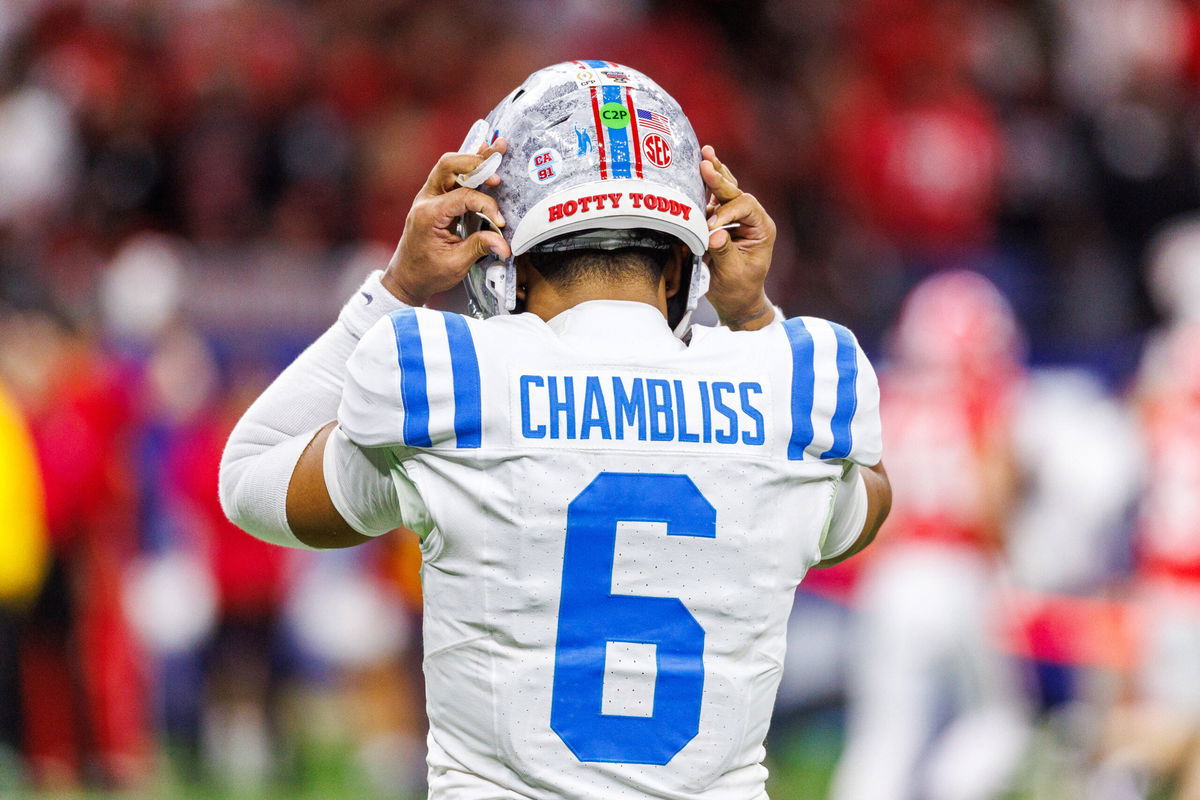
January 01, 2026: Mississippi quarterback Trinidad Chambliss 6 listens for the play call during NCAA, College League, USA football game action between the Ole Miss Rebels and the Georgia Bulldogs at Caesars Superdome in New Orleans, Louisiana. /CSM New Orleans United States of America – ZUMAc04_ 20260101_zma_c04_446 Copyright: xJohnxMersitsx
Imago
January 01, 2026: Mississippi quarterback Trinidad Chambliss 6 listens for the play call during NCAA, College League, USA football game action between the Ole Miss Rebels and the Georgia Bulldogs at Caesars Superdome in New Orleans, Louisiana. /CSM New Orleans United States of America – ZUMAc04_ 20260101_zma_c04_446 Copyright: xJohnxMersitsx
Ole Miss’ QB1 Trinidad Chambliss, after a much-anticipated legal battle with the NCAA, is coming back for one more season after a Chancery court granted him an injunction. Though everything went well in Chambliss and Ole Miss’s camp, the NCAA seems tired of the constant legal scrutiny of its decisions. After the ruling, the NCAA’s attorneys walked out of the Calhoun County Courthouse in Mississippi. But now the judge has hit back with a fresh order against them.
Watch What’s Trending Now!
Judge Robert Q. Whitwell issued a show cause order requiring the NCAA’s attorneys, J. Douglas Minor, Taylor J. Askew, and Daniel J. Zeitlin, to appear before the court. “The judge also ordered the attorneys to ‘show cause and explain why all of them left the courtroom’ before the conclusion of Trinidad Chambliss’s hearing.
According to the order, the attorneys left the courtroom without “obtaining” the court’s prior permission. The judge will hear the matter at “a later proceeding,” at a time decided by the Chancery court. The order came on February 18 for Trinidad’s February 12 hearing, and now it remains to be seen if Judge Robert Q. Whitwell will take any action against the attorneys.
The NCAA attorneys’ action might be the result of the frustration that is eating up NCAA officials. Student-athletes are flooding lawsuits, and it has increasingly frustrated the college sports regulators in recent years. Moreover, differing court judgments sometimes also undermine NCAA authority. Especially when institutions like Ole Miss and Tennessee stand with their players in the legal battle.
Which Prospects should OSU target next?
Let Tony do the scouting, you just make the pick.
Here is the Order to Show Cause requiring the NCAA’s attorneys to appear and explain their early departure from the February 12 hearing in the Trinidad Chambliss case. pic.twitter.com/6nh1Oq0qCu
— Mississippi Appeals (@MS_Appeals) February 19, 2026
“This decision in a state court illustrates the impossible situation created by differing court decisions that serve to undermine rules agreed to by the same NCAA members who later challenge them in court,” the NCAA said in a statement. “The patchwork of state laws and inconsistent, conflicting court decisions makes partnering with Congress essential to provide stability for current and future college athletes.”
Athletes have increasingly found legal avenues to fulfill their goals, going against the NCAA decision. Tennessee’s QB1, Joey Aguilar, has also sued the NCAA for an extra year of eligibility, and other players are following suit. Diego Pavia did it in 2024, and in Robinson et al. v NCAA, a judge granted injunctions to four West Virginia players. What’s more striking now is that programs are also standing with their players, something the NCAA views sternly.
Why did the NCAA attorneys walk out of the courtroom?
The NCAA, in truth, isn’t an outside regulatory body for college athletics. It’s an institution with rules and bylaws that more than 300 programs have agreed to follow. That has been the case since March 31, 1906, ever since President Theodore Roosevelt pushed for sporting reforms. However, when a handful of programs go against the same institution, the situation will trigger an anarchy-like scenario.
Moreover, no matter what the NCAA lawyers do, players and programs still find ways to game the system. The programs are essentially saying that the rules they agreed to with the NCAA mean nothing now. The law does. It also becomes problematic when programs and students file lawsuits at strategic locations to gain an “advantage.” Arguing in that lawsuit would be fighting a losing battle.
“The only way it could be easier would be if the attorneys gave up and walked out before the final ruling. Which is exactly what NCAA attorneys in the Chambliss case did,” Matt Hayes of USA Today wrote. Of course, the NCAA is no saint here. The regulatory body’s bureaucratic tendencies and arbitrary decisions are widely condemned by critics.
However, programs meddling in players’ affairs and taking the NCAA into the courtroom for competitive advantage should be condemnable, too. Especially since the programs themselves took an oath to follow the bylaws and rules, which they agreed to. In that sense, the NCAA’s attorneys’ act of walking out of the courtroom has many layers, and there’s no clear-cut right and wrong here.
Written by

Edited by

Yogesh Thanwani