
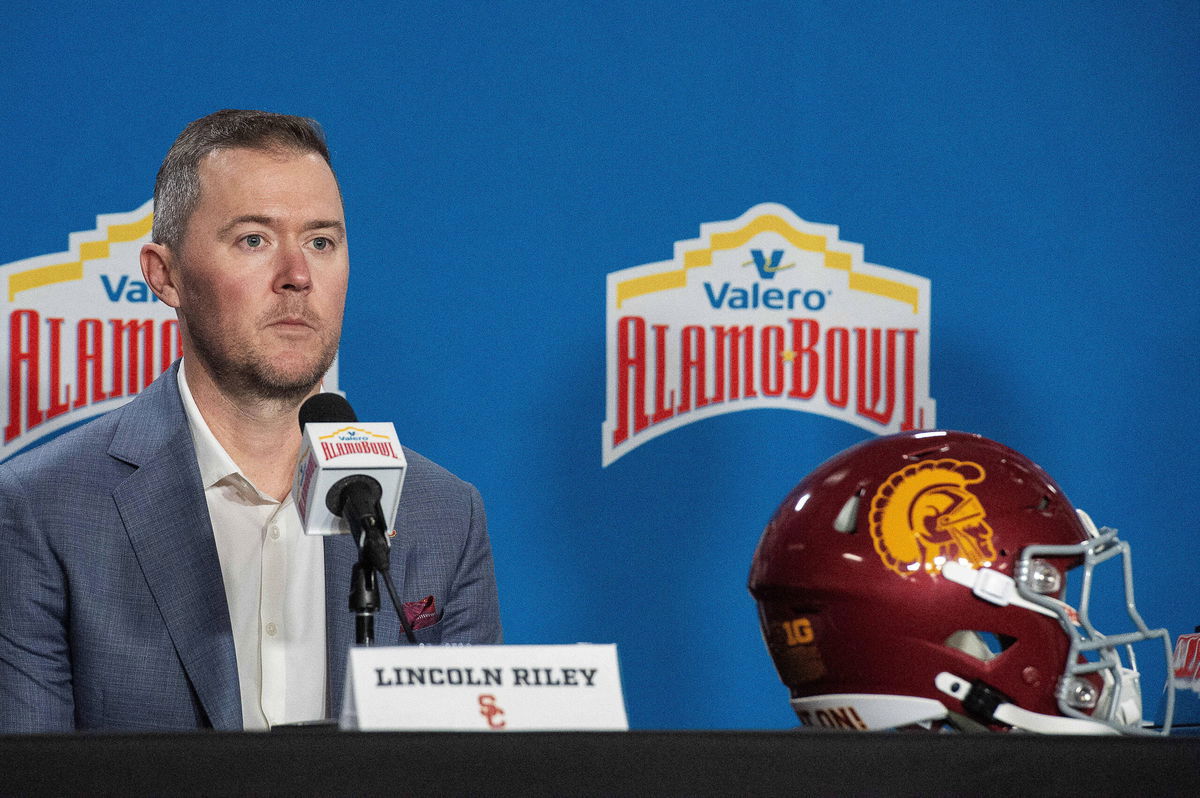
Lincoln Riley has already proved he can build explosive offenses. He has coached Heisman winners and playoff teams. But USC did not hire him simply to score points. The Trojans wanted another national championship campaign. Now, four seasons into his tenure, that goal still feels distant. And it has to do with one crucial thing Lincoln Riley has failed to do at USC, as Urban Meyer highlights.
Watch What’s Trending Now!
“I have a lot of respect… Lincoln Riley, calling plays, running offense,” Meyer said on Colin Cowherd’s August 4 podcast. “That’s just really a small part of your job as a head coach. You can hire a lot of people to call good games. You can’t hire a lot of people to build a culture, recruit to a culture, demand a culture, and that’s at the end of the day how you win. It’s not offense.
“There’s a lot of great offenses out there, a lot of great defenses out there. So, I think this is—I don’t want to say make or break, but we’re getting pretty close to that.”
Culture has always been Riley’s biggest challenge at USC. Pete Carroll had built one of college football’s strongest programs from 2001 to 2009. USC practiced with NFL-level intensity. Competition was constant because future draft picks filled nearly every position. The Trojans kept most of Southern California’s best recruits at home. Physical defense became their identity, and they won seven straight Pac-10 titles, two national championships, and delivered more than 50 NFL draft picks. With Riley, that’s missing at USC.
Riley arrived at USC with a dominant record at Oklahoma, having reached the playoffs three times. His teams were known for explosive offenses, elite QBs, and an emphasis on the transfer portal. Naturally, the $11 million-per-year head coach brought that same approach to USC. He even brought his elite QB, Caleb Williams, with him from Oklahoma to replicate that blueprint. Offensively, USC was dominant, producing an 11-win season, but Riley’s problem has always been defense.
The Trojans have lost games after surrendering huge second-half leads. Opponents consistently controlled the line of scrimmage. Missed tackles and poor gap discipline are recurring problems. Those are usually signs of a team still searching for a consistent identity, not just a better scheme. The results also show why USC’s culture has slipped instead of improved.
After the 11-win first season, the Trojans dropped to 8-5 in 2023. They then went through an uneven first season in the Big Ten. USC failed to compete for a conference title in either year. And 2025 also ended on similar notes with close defeats. The program has not reached the College Football Playoff under Riley despite reportedly giving him a contract worth around $100 million. Expectations at USC have always been measured in championships, not bowl appearances.
Moreover, building culture has become much harder across college football. NIL and the transfer portal change almost every roster. Players can leave after one season. Coaches now spend months recruiting their own team while also chasing transfers and high school prospects. Continuity is difficult when dozens of players enter the portal every winter.
Even so, programs like Georgia, Ohio State, and Notre Dame still build around high school recruiting first. They use the portal to fix specific needs rather than rebuild entire position groups every year. Lincoln Riley has done exactly that, producing a 1st-ranked recruiting class this year. But time is, of course, running out for him. And 2026 might even be his last season if results don’t arrive.