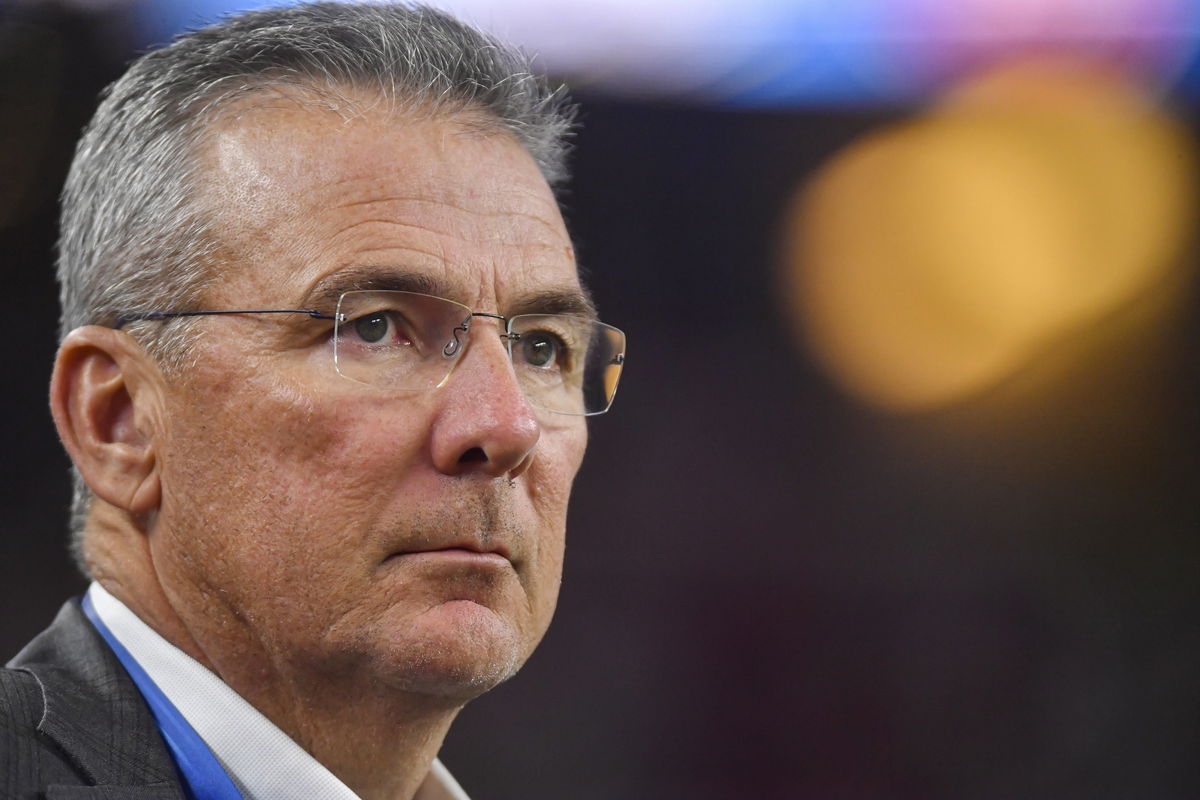
While the NCAA holds the power to adjust its controversial targeting penalties, a rule that massively affected Miami this past season, not everyone is ready to celebrate the potential relief. The proposed “significant” change could soften that situation, but Fox Sports analyst Urban Meyer is not buying into the proposed “significant” change.
Watch What’s Trending Now!
“Here’s the homework I’ve done on this is, that everyone needs to sign off that they will not litigate,” said Meyer during his Monday appearance on The Triple Option. “You know, it’s union, or it’s this is part of the Congress and Senate passing something, say, ‘This is the way it is.'”
Over the years, the legitimacy of the NCAA has come into question, especially regarding its governing-body status. These struggles led Meyer to conclude that, for the time being, the organization doesn’t have the kind of influence it used to.
“To give them credit, every time they’ve set a penalty, they’ve tried to enforce something, they litigate, they go to court, and they lose. So there is some empathy to understand they don’t have subpoena power. They’re a powerless organization right now,” Urban Meyer added.
“Every time the NCAA tries to enforce something, they go to court and they lose.”@CoachUrbanMeyer #collegefootball pic.twitter.com/fuoWg8Y1P2
— The Triple Option (@3xOptionShow) February 23, 2026
Urban Meyer’s claim is not entirely baseless. His opinion is backed by a growing paper trail. Presently, the lack of authority to override federal and state laws in several key areas has made it hard for the NCAA to enforce rules. Amid this legal crisis, the organization has put forth a request to Congress to serve as its legal shield and is seeking a “federal deal” from the Senate. This is a clear admission that the NCAA cannot enforce its own rulebook alone.

If the targeting penalty change is approved in March, it will be a major benefit to players and programs. Remember, Miami DB Xavier Lucas missed the first half of the 2025 national title game because of a targeting penalty that occurred in the previous game, and it impacted the team hugely.
As per the new proposal, the carryover suspension could be removed from first-time targeting penalties in the second half of a game. But that old 15-yard penalty and ejection from the game will still exist, and for more than one target, the punishment can get much worse for the players. Meanwhile, the NCAA’s plan for escalated punishment for multiple targeting offenses could open a massive loophole.
In the current climate, a player who gets suspended for multiple games will have his lawyer filing a lawsuit, talking about the financial toll. How? Well, suspension will automatically lead to loss of wages, NIL exposure, and NFL draft stock. This will ultimately lead to the court freezing the suspension, and this is not a hypothetical scenario. If history has taught us anything, it’s that players have gotten the best of the NCAA in court.
Just take the present eligibility cases in college football. The most recent one is Ole Miss QB Trinidad Chambliss’ sixth-year eligibility vs. the NCAA. First, the NCAA denied his waiver, leading him to file a lawsuit, but the NCAA argued there was a lack of evidence. Ultimately, due to a preliminary injunction, Chambliss was allowed to return to Ole Miss to play for the 2026 season.
There are plenty of cases like this, where the NCAA was barred. The association is not able to enforce bans on NIL-based recruiting inducements. But there is another side to this story.
Is the NCAA really powerless?
In the present situation, college football has gone through several struggling circumstances. Not only have NIL and the transfer era changed the CFB landscape but also present legal fights set another standard in the sport. In that case, some players faced the heat of the NCAA’s power.
You can’t overlook that Oregon State basketball player Lonnie Shelton’s case. He played his final collegiate season after the NCAA declared him eligible. Later, his injunction was overturned, and under the Rule of Restitution, the NCAA vacated his stats from the program’s record book. The NCAA’s power has also been felt by major programs, with Michigan facing significant investigations and penalties.
While the NCAA can still penalize programs, the growing success of legal challenges validates Urban Meyer’s concern. Without a federal shield, any rule change remains on shaky ground, subject to being overturned in court. Let us know what you think in the comments below.