Imago
NCAA, College League, USA Football: CFP National Championship-Ohio State at Notre Dame Jan 20, 2025 Atlanta, GA, USA Urban Meyer looks on during the second half the CFP National Championship college football game at Mercedes-Benz Stadium. Atlanta Mercedes-Benz Stadium GA USA, EDITORIAL USE ONLY PUBLICATIONxINxGERxSUIxAUTxONLY Copyright: xBrettxDavisx 20250120_jcd_ad1_0201
Imago
NCAA, College League, USA Football: CFP National Championship-Ohio State at Notre Dame Jan 20, 2025 Atlanta, GA, USA Urban Meyer looks on during the second half the CFP National Championship college football game at Mercedes-Benz Stadium. Atlanta Mercedes-Benz Stadium GA USA, EDITORIAL USE ONLY PUBLICATIONxINxGERxSUIxAUTxONLY Copyright: xBrettxDavisx 20250120_jcd_ad1_0201
‘College football legend Urban Meyer is officially sounding the alarm on the NCAA’s post-NIL freefall, calling it a “powerless organization” in freefall. To bring back order and power, Urban Meyer has now teamed up with a Harvard sports law expert to expose why the entire system is broken after the March roundtable talk.


During the March 2026 college sports roundtable hosted by President Donald Trump, Urban Meyer did not hold back. Sitting alongside peers like Nick Saban, he bluntly labeled the landscape of college sports a ‘total mess’. Meyer argued that the NCAA is trapped in a brutal cycle: they draft rules, instantly face a lawsuit, and inevitably lose in court because of the lack of a legal ‘shield’ or antitrust protection.
Watch What’s Trending Now!
The former Buckeyes head honcho is pretty convinced that without some serious backup from the government, it’s only a matter of time before college football crumbles under the weight of never-ending lawsuits. On March 13th, Urban sent a DM to Michael McCann, Harvard Sports Law expert and analyst for Sportico.
McCann clarified that the Nebraska situation isn’t a standard lawsuit, but a precedent-setting arbitration fight against the College Sports Commission (CSC) over rejected third-party contracts. For McCann, this multi-million-dollar standoff perfectly validates Urban Meyer’s core warning, which is that, without federal backing, any attempt to regulate NIL money immediately triggers paralyzing legal warfare.
Nebraska players are challenging CSC/NIL rejections, per story from @RossDellenger @CoachUrbanMeyer went straight to Harvard Sports Law Expert @McCannSportsLaw to get his take. https://t.co/SzjsT1idFc pic.twitter.com/8HWgYjwIvO
— The Triple Option (@3xOptionShow) March 13, 2026
McCann validated Meyer’s frustrations. He explained that “antitrust litigation won’t stop” until Congress or the President himself grants the NCAA a specific exemption or until players are officially classified as employees who can collectively bargain.
One of the things that really gets Urban fired up is the whole ‘NIL collective’ scene. He straight-up calls a legalized form of “cheating.” Now, mind you, he’s all fine with players making money from their own fame. He calls that pure capitalism. What he hates is how these big-time outside groups and universities have turned it into a bidding war to “buy” the best rosters. Because of this, Urban Meyer argues that the system creates an imbalance that some of the programs with the deepest pockets can simply outspend others, apparently.
Backing Urban Meyer’s enforcement complaints, McCann also noted that the NCAA’s lack of federal subpoena power makes its investigations virtually toothless. He validated Meyer’s exact theory: without legal authority to compel documents or truthful testimony under oath, any NCAA penalty for tampering is easily dismantled by aggressive state court injunctions.
For example, when a coach is “tampering” with players on another team or offering illegal “pay-for-play” deals, and when they lose in court, almost 8 out of 10 losses happen because they don’t have the federal protection needed to sustain their rulings to begin with.
USA Today via Reuters
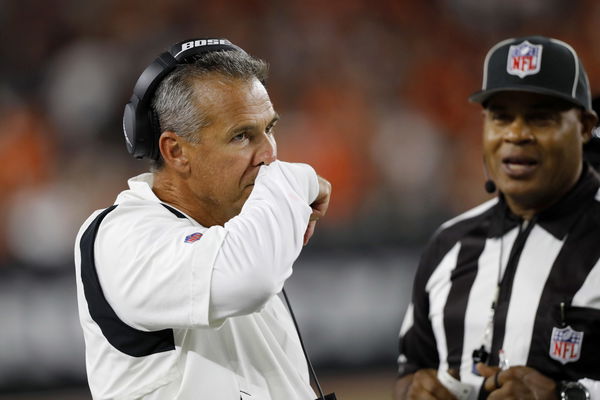
Sep 30, 2021; Cincinnati, Ohio, USA; Jacksonville Jaguars head coach Urban Meyer reacts to a call during the first quarter against the Cincinnati Bengals at Paul Brown Stadium. Mandatory Credit: Joseph Maiorana-USA TODAY Sports | Courtesy: Reuters
Urban’s takeaway, backed by McCann’s legal expertise, is that the NCAA’s rulebook is basically just a “suggestion” until they get the power to actually investigate and penalize people without being sued into oblivion or worse. Looking ahead at the rest of 2026, Urban is putting his weight behind some big-deal laws like the SCORE Act. This is the game-changer he’s looking for because it would finally give the NCAA that “antitrust shield” and maybe even lead to an NFL-style “salary cap” for players.
He’s essentially campaigning for a “New Deal” for college football, a world where players get paid fairly, but there’s also a professionalized, legally protected structure so the game doesn’t turn into some type of anarchy. The Fox analyst is pushing for a system where the rules actually mean something again and there are real-world consequences for anyone trying to cut corners.
McCann ultimately agrees that Meyer’s advocacy for the SCORE Act is the most realistic off-ramp. But granting an antitrust exemption and paving the way for legally binding contracts, this legislation would finally deliver the professionalized and dispute-proof framework Meyer insists is required to rescue college football from total anarchy. A senator from Missouri has a solution to solve Meyer and college football’s biggest problem. But it actually comes big price.
Senator Eric Schmitt’s manifesto to save the sport of college ball
So earlier today, Senator Eric Schmitt hopped onto Dan Dakich’s podcast and kept it blunt, saying that college football is in a “crisis” and needs a serious reality check sooner than later. His big solution is to create a National College Sports Commission. Think of it like a central referee for the entire country that actually has the power to make and enforce rules. Its main motive is replacing the current mess, where every state does its own thing and everyone is constantly suing each other.
The main problem Schmitt wants to tackle is the “pay-for-play” chaos. He wants one national standard for NIL so that a player in Missouri is following the same rules as a player in Florida, rather than dealing with meaningless differences in regulations.
He also pushed for antitrust protection, but it comes with a price. Schmitt is worried about the “little guys”: the non-revenue sports like wrestling, track, or volleyball. He’s afraid that if all the money just flows to football players through these unregulated collectives, schools will start cutting smaller programs to save cash. His goal with this commission is to protect the entire athletic department. Since 80% of the funds go to college football, cutting them would be the end of something. This is where college football and the government might not see eye to eye. Regardless, this is going to be one long off-season.
Related Newsletters