College football’s NIL era has turned into a legal and financial free-for-all, and Urban Meyer thinks there’s a straightforward way to restore order. He provided a solution that involved curbing the collective-driven bidding wars and giving the NCAA real teeth again. However, any federal backstop would come with a catch that would change everything today.

So, during the big college sports roundtable with the POTUS earlier this week, Urban Meyer didn’t hold back and asked for federal help. The three-time Natty head coach believes the ‘simple fix’ for college football is to get rid of NIL collectives entirely and wants the NCAA to grow its spine back and take over control with the help of federal lawsuit protection.
Watch What’s Trending Now!
“The NCAA, when I was growing up in the profession, if you violated a rule, that was a problem. You lose your job. That was made very clear,” Urban Meyer said. “Throughout litigation and other issues, the NCAA has become. They don’t have subpoena power, and every time they make a decision, they get litigated.”
Meyer argues that the current model isn’t true NIL, but unregulated “pay-for-play” cheating. While he fully supports athletes signing legitimate corporate endorsements, he insists that donor-funded collectives pooling millions to buy rosters must be federally abolished to restore the sport’s competitive integrity.
View this post on Instagram
Federal intervention is now highly viable following Urban Meyer’s direct pitch at President Donald Trump’s White House college sports roundtable. With executive support growing, Senator Eric Schmitt’s proposed legislative framework for a formalized oversight commission finally gives the NCAA a realistic path to gaining antitrust immunity.
“So the way it would fix it, Congress would say, ‘In exchange for you protecting women in Olympic sports and having a better system, we’re gonna grant you lawsuit protection to be able to make these kinds of basic rules,’” Senator Schmitt said on Don’t @ Me with Dan Dakich podcast.
Schmitt told Dan Dakich that the government isn’t just going to hand the NCAA a “get out of jail free” card from lawsuits without some serious strings attached. The biggest caveat Schmitt brought up is that if football wants federal protection, it has to save Olympic and women’s sports first.
If the NCAA wants to be shielded from multi-billion-dollar antitrust lawsuits, it must agree to a federal framework that mandates transparency and uniform standards across all 50 states. They have to end the ‘patchwork’ of state laws that currently allow some schools to cheat legally while others cannot.
Imago
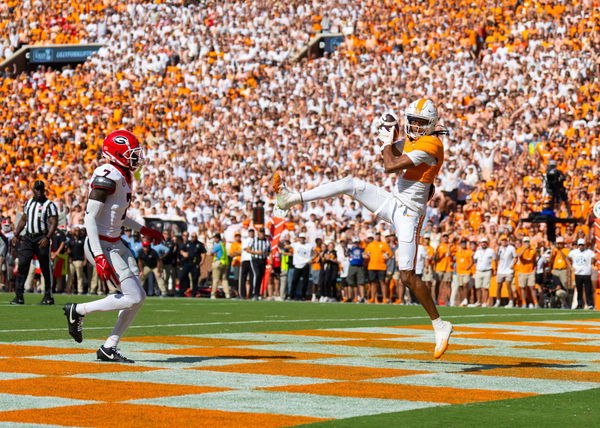
September 13, 2025: Chris Brazzell II 17 of the Tennessee Volunteers catches a pass for a touchdown during the NCAA, College League, USA football game between the University of Tennessee Volunteers and the University of Georgia Bulldogs at Neyland Stadium, Knoxville, TN /CSM Knoxville United States – ZUMAc04_ 20250913_zma_c04_216 Copyright: xTimxGangloffx
Football cannot be saved at the expense of everyone else. He warned that if the current “pay-for-play” model continues unregulated, schools will inevitably start cutting non-revenue sports (like wrestling, track, and gymnastics) and women’s athletics to balance the books. His caveat for federal intervention is a requirement that schools guarantee the survival of these programs.
In today’s Power 4 landscape, roughly 80% of an athletic department’s budget is often dedicated to the football program. If Senator Schmitt’s plan goes through, football will “suffer” because it will lose its status as the exclusive priority.
So instead of them sinking every extra dollar from massive TV deals into football facilities or $30 million worth of roster for college ball, schools now would be legally forced to spread their wealth across all the non-revenue and low-revenue sports. Football programs would have to operate on a tight budget.
To make this even more intriguing, to keep the ‘revenue pie’ balanced for all sports, the new National Commission will probably have a say in how much a school can spend on its football players or not. If it ever comes to that, the days of “infinite” donor money through collectives would end. While these stop the “cheating” Meyer hates, it also means star players might see a “pay cut” compared to the crazy, unregulated deals they’re getting now in the “Wild West” era.
Eric Schmitt also wants to end the ‘Wild West’ feel of the transfer portal in college football
Both Senator and Urban hate that rosters change every five minutes, but Schmitt’s catch is that any new rules have to be a national standard. Right now, every state has different laws, which is why it’s so chaotic. Under the National Commission, the players would likely get one free transfer. Anything other than that will be strictly regulated.
Under Schmitt’s proposed framework, shutting down rogue collectives means universities must pivot to formalized revenue-sharing. While this would likely end the illicit bidding that Urban Meyer despises, athletes would receive fair-market compensation directly from university TV deals. This will bring players’ payments safely in-house under strict federal compliance.
Another part of this fix is moving the money out of the shadows. Instead of these sketchy donor collectives handing out bags of cash, Schmitt and Urban both seem to prefer a model where schools directly share their TV revenue with the players. The play here is that this has to be done legally and fairly. Schmitt wants his National College Sports Commission to oversee all of this so that “real” NIL, like a legit jersey deal, stays, but the “fake” pay-for-play stuff gets shut down for good.
To get the legal shield it wants, the NCAA may have to surrender what it has fought to keep, which is control. Federal protection is unlikely to come as a free pass. It comes at the price of hard, enforceable standards and a reallocation of football’s money to safeguard Olympic and women’s sports. The real trade may just be survival, not tradition. What do you think? Drop your comments below.
Related Newsletters