
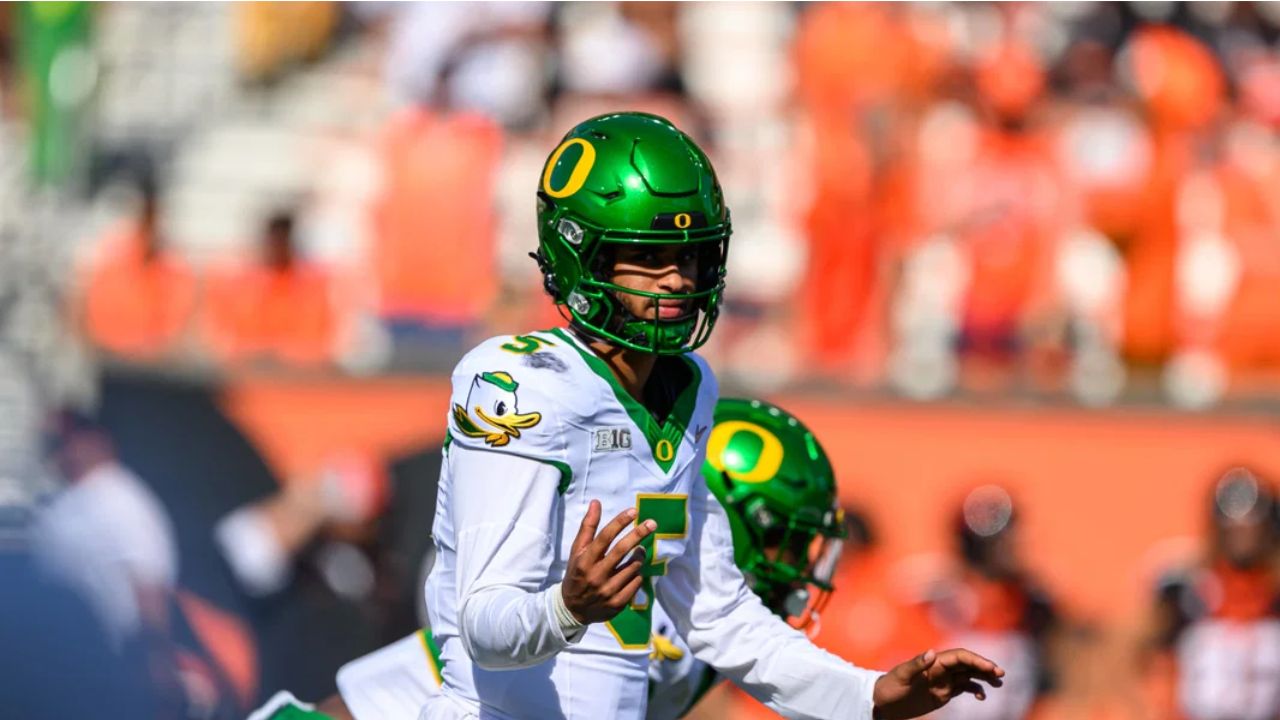
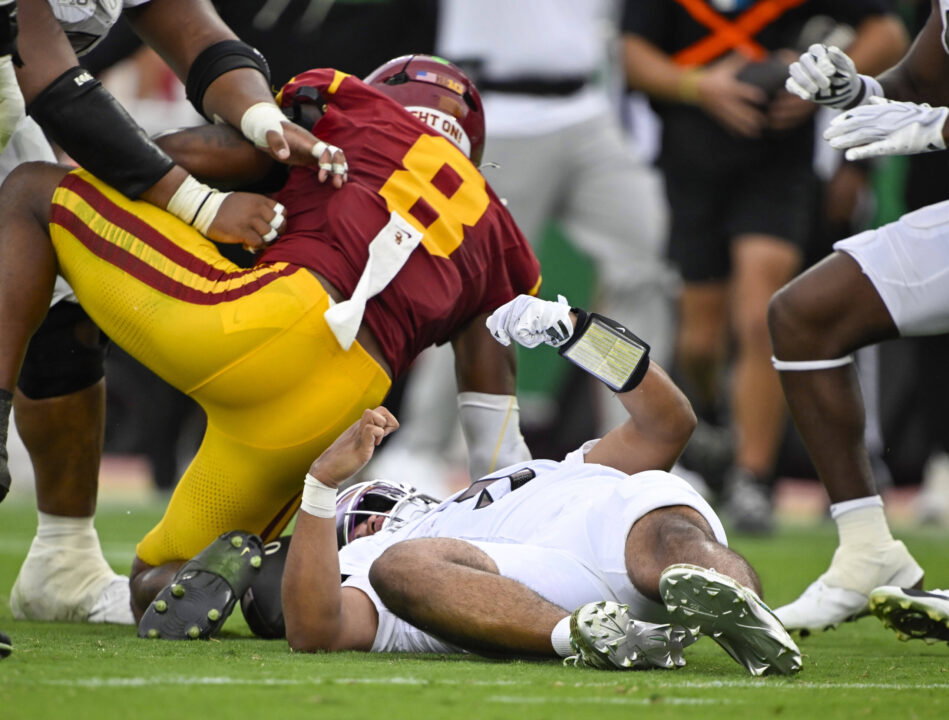
Oregon quarterback Dante Moore did everything by the book during Saturday’s high-stakes game against USC. Sliding early to give himself up, he tried to avoid contact as the Trojans’ defense swarmed in. Instead, USC linebacker Desman Stephens II launched helmet-first into Moore’s head, leaving the young quarterback unconscious in a fencing posture before medics rushed him out in an ambulance.
Watch What’s Trending Now!
Stephens was ejected for a brutal targeting hit, but inside the USC radio booth, play-by-play veteran Pete Arbogast refused to accept what everyone on television had just witnessed.
KOIN reporter Brenna Greene posted a clip of the USC radio broadcast footage, calling it “straight embarrassing.” Inside the booth, Pete Arbogast, USC’s longtime play-by-play voice, wasn’t buying the targeting call. The footage quickly drew attention because he kept pushing the idea that Dante Moore was partly responsible for what happened.
“He did not try to slide feet first,” he said in the clip. “And Stephens went in helmet first, but he kind of ran into Dante Moore, who ducked into that hit.”
That was only the beginning. The replay didn’t really help Pete Arbogast’s case. As the booth watched the replay, Shaun Cody, the former USC DL working as the radio analyst, appeared far less convinced. At one point, an off-camera voice noted that Dante Moore was on the ground with his feet forward, like how a QB would be if he was sliding.
Imago
Credits: IMAGO
Pete Arbogast wasn’t having it. He argued that USC had “spun him around” and later described Dante Moore’s attempt as “more of a knee slide.”
“Not a feet-first slide, more of a knee slide,” he argued. “It didn’t look like targeting on the replay to us.”
Shaun Cody’s reaction said plenty without saying much at all. He looked toward the camera with the sort of expression normally reserved for someone hearing an argument they don’t particularly want to join. It became an uncomfortable moment in a broadcast that was supposed to explain what viewers had just watched.
Pete Arbogast has been around USC football long enough to have seen nearly every version of the program. The 71-year-old USC graduate first handled Trojans play-by-play from 1989 through 1994 before spending time calling Cincinnati Bengals games. He returned to USC in 2001 and has remained a familiar voice around the program ever since. Still, being the home broadcaster doesn’t mean pretending every play went the home team’s way.
Former Oregon star and NFL OL Geoff Schwartz made that distinction clearly.
“I’m pro homer radio,” he wrote on X. “I love it. But at some point, you owe it to the listeners to be truthful about what occurred. And even after replay, that didn’t happen.”
This kind of bias is not new for local team broadcasts, and Arbogast has built his entire career on being an unashamed voice for USC. Across college football, home announcers are famous for looking at the game through team-colored glasses, like when local callers try to blame referees or brush off late hits as aggressive play.
But there is a big line between cheering for your guys and openly denying a clear, dangerous hit on live radio while a player is down. When announcers cross that line to protect their team’s image, they stop reporting the game and start rewriting reality.
NFL Network’s Rich Eisen also criticized the call, while Yahoo Sports college football insider Dan Wolken said he contacted Pete Arbogast directly. According to Wolken, the veteran broadcaster declined to comment. Ryan Kartje of the Los Angeles Times also reported that both USC and Arbogast declined to comment when contacted about the broadcast.
That silence only raised eyebrows. There is an obvious difference between defending your team and defending a particular play. Fans understand homerism and even expect some of it. But when a QB is injured on a hit that results in a targeting ejection, the burden shifts. The audience needs the broadcaster to describe what happened, not explain it away.
Desman Stephens eventually received a one-game suspension from USC. Both he and head coach Lincoln Riley also issued apologies following the incident. Still, the hit itself will remain the headline from Saturday.
Pete Arbogast’s call created a strange subplot of its own, though. Shaun Cody didn’t need a long explanation. That look in the booth did plenty of talking. And sometimes the most revealing part of a broadcast isn’t what the announcer says. It’s the reaction from the person sitting beside him.