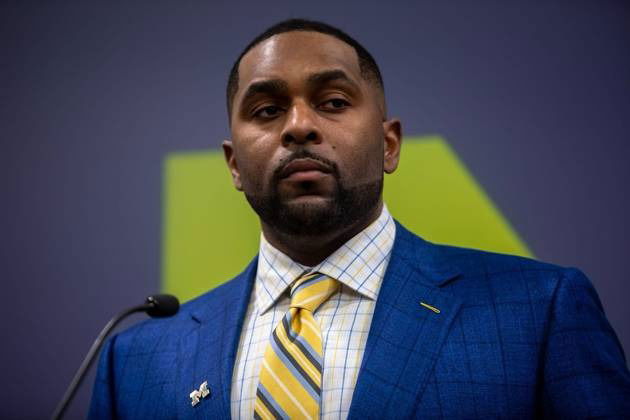
Imago
Source: Imago
Imago
Source: Imago
Sherrone Moore’s exit from Michigan was not the standard transition that follows a disappointing season. It was a termination for cause, issued on Wednesday after an internal university investigation found he had engaged in an inappropriate relationship with a staff member. The manner of his departure immediately shifted the financial conversation around his future earnings.
Watch What’s Trending Now!
As of Dec. 1, Sherrone Moore’s buyout sat at $13.89 million, according to USA Today’s salary database. That figure ranked as the second-lowest among all listed Big Ten coaches, but it was still significant enough to trigger high-level internal analysis. The key question now is whether Michigan will owe any portion of it.
Terminations for cause historically trigger extended disputes, often moving toward arbitration or civil court. Universities generally argue contractual violations, while coaches push for negotiated partial settlements. Sherrone Moore’s situation presents the same blueprint with clear language on standards of conduct, a defined burden of proof, and a financial structure that either protects or exposes the university.
ADVERTISEMENT
Sherrone Moore’s contract ran through 2029 and included $5.5 million annually in base salary and additional compensation, plus a $500,000 retention bonus each season. The buyout formula required Michigan to pay 75% of the remaining base and additional compensation, but the deal also obligated the coach to pursue new employment, with any earnings deducted from the school’s payout. That clause could become a major factor in determining what he ultimately collects.

USA Today via Reuters
Aug 31, 2024; Ann Arbor, Michigan, USA; Michigan Wolverines head coach Sherrone Moore on the sideline in the first half against the Fresno State Bulldogs at Michigan Stadium. Mandatory Credit: Rick Osentoski-USA TODAY Sports
ESPN’s Pete Thamel was the first to report the firing shortly after the early signing period closed. Michigan AD Warde Manuel followed with a statement declaring Sherrone Moore’s conduct a violation of university policy and reaffirming a “zero tolerance” standard. The timing placed the program in immediate operational flux, arriving just as the HC completed his second season with the Wolverines.
ADVERTISEMENT
Sherrone Moore concluded his Michigan tenure with an 18-8 record, including a 9-3 finish this season, capped by a 24-7 loss to Ohio State. His tenure included multiple disciplinary issues, including a one-game suspension in 2023 tied to recruiting infractions and another one-game suspension pending for the 2026 opener related to the sign-stealing investigation. These earlier penalties are now part of the broader evaluation of his overall conduct history.
His first full season produced an 8-5 record (5-4 in the Big Ten) and two high-impact victories, including a fourth straight win over No. 2 Ohio State in Columbus and a postseason win against Alabama in the ReliaQuest Bowl. Michigan also retained all four rivalry trophies under Sherrone Moore during that campaign. Those results are now overshadowed by the nature of his exit and the financial conflict that follows. The school’s decision now moves from on-field evaluation to contractual interpretation, setting up a direct examination of how it defines misconduct within employment language.
ADVERTISEMENT
Understanding for-cause firing
A for-cause firing is a contractual mechanism allowing a university to terminate a head coach without paying the remaining buyout. It happens if the school establishes a legitimate and documented violation of employment terms. The language typically covers personal conduct, ethical breaches, criminal activity, dishonesty, or actions deemed damaging to the institution. In Sherrone Moore’s case, Michigan asserts that his conduct violated explicit behavioral standards tied to university policy. A for-cause ruling fundamentally alters every financial expectation attached to a coaching contract.
Comparable precedents exist. Michigan State fired Mel Tucker in 2023 after an investigation involving misconduct toward a Title IX advocate. His case moved into litigation, and the school later vacated 14 wins from his tenure. Such examples outline the contentious process that often follows a for-cause determination. Michigan’s posture indicates it is preparing for a similarly firm defense of its decision.
ADVERTISEMENT
Michigan now enters the bowl season under an abrupt leadership change in a volatile coaching cycle. For now, associate HC Biff Poggi will serve as interim coach for the Citrus Bowl against Texas on December 31. He coached under Jim Harbaugh and rejoined Sherrone Moore’s staff midseason, previously going 2-0 as acting HC during Moore’s earlier suspension. Including his Charlotte record, Poggi holds an 8-16 career head-coaching record. The program’s next major decision involves whether Moore’s buyout is reduced, contested, or eliminated entirely.
Top Stories
Paramount’s UFC Launch Under Fire After Kourtney Kardashian’s Husband Sparks Backlash

Joe Rogan Shows No Mercy at Rose Namajunas’ Past as She Falls to Natalia Silva at UFC 324

NFL Announces Punishment Decision for Josh Allen’s Bills Following Divisional Round Loss

When 49ers HC Kyle Shanahan Got Arrested Defending Raheem Morris at 2005 NFL Combine
Donald Trump Announces Super Bowl Decision, Slams Halftime Performer Bad Bunny & Green Day

Patrick Reed Willing to End Rory McIlroy Feud Using Bizarre Measure Years After ‘Tee-Gate’

ADVERTISEMENT
ADVERTISEMENT
ADVERTISEMENT
Related Newsletters