
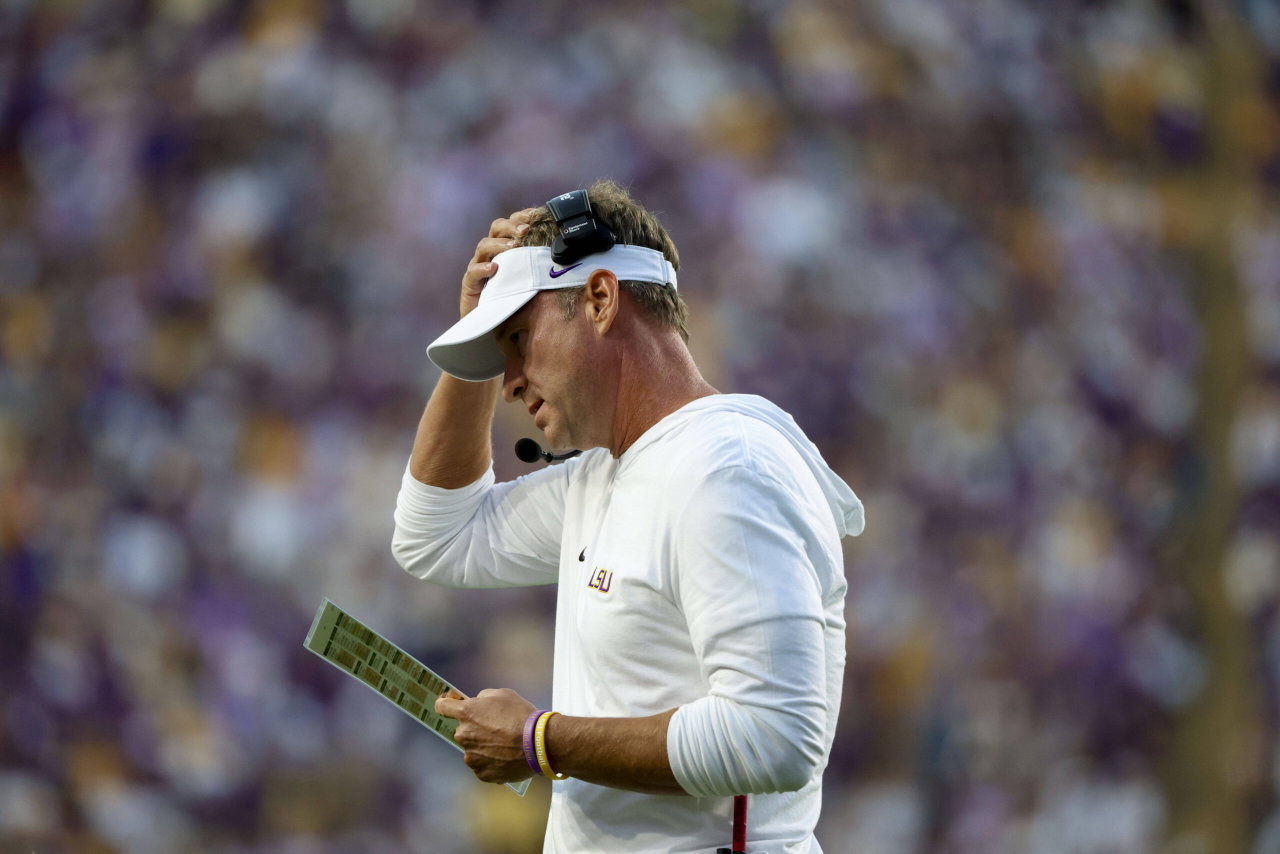
A breakup rarely happens in one conversation. There are usually warning signs, arguments, and a period of indifference before somebody finally walks away. Former ESPN broadcaster Jason Whitlock used that familiar pattern to explain the LSU vs. SEC dispute. With the conference now preparing to consider removing the Tigers, Whitlock suspects the school may be pushing the relationship toward a split.
Watch What’s Trending Now!
“This is the second time we’ve heard about, ‘Hey, they’re considering a breakup,’” Whitlock said on November 24. “I’m not so sure if LSU doesn’t want to legitimately break up from the SEC and they’re forcing to kick them out.”
Whitlock’s theory rests on the way the conflict has unfolded over several months.
The dispute began taking shape before the 2026 season, when Kiffin moved to bring two former Ole Miss players, Dae’Quan Wright and Zxavian Harris, to LSU. Both had already attended NFL training camps before Kiffin made his move.
Wright, a tight end, and Harris, a defensive tackle, had gone undrafted and pursued another college season. They sought legal relief to regain eligibility, and a Louisiana court ruling gave them a route back to college football.
Did the Steelers make the right call benching Aaron Rodgers for Mason Rudolph?
The SEC, however, introduced a rule barring players who had signed professional contracts from returning to its teams. So, LSU’s pursuit of the pair put Kiffin and the conference on a collision course.
“When you’re a clever person, a corrupt person,” Jason Whitlock said. “You force the other person to break up with you. You force the other person, so you’re not the bad guy.”
In September, the SEC took the dispute to federal court, filing a lawsuit that named LSU, Lane Kiffin and several university officials. Expelling LSU was also raised as a possible step, though the situation cooled once the school completed its roster without signing Wright or Harris.
SEC leaders did gather later that month, but no vote was held on LSU’s membership. For a time, it looked as though the dispute might cool down. But that was just the calm before the storm.
The latest flashpoint came from LSU’s men’s basketball program. RJ Luis Jr., the 2025 Big East Player of the Year at St. John’s, had signed professional agreements with the Utah Jazz and the Boston Celtics’ G League affiliate.
He had not played in an NBA regular-season game, but his professional contracts placed him under the SEC’s eligibility restrictions. However, a Louisiana court granted Luis an injunction allowing him to play, and the Louisiana Supreme Court upheld that protection.
LSU then put him on the floor against Louisiana-Monroe on November 18, as Luis scored 11 points and collected nine rebounds in 15 minutes during a 79-67 win.
The response from the conference was swift. LSU president Wade Rousse announced the following day that he had instructed coach Will Wade not to play Luis again.
“In my role as President of the LSU System, after further review, I have instructed LSU Men’s Basketball Coach Will Wade not to play RJ Luis,” Rousse said in a statement.
LSU’s move may have stopped the row from getting any worse, but the SEC was not ready to let the matter go. In its latest filing, the conference said LSU could not be trusted to stick to the rules.
It accused the school of following them when they suited its needs and ignoring them when they did not. The SEC also said it had no reason to believe LSU would not break the rules again.
Its complaint points to the Luis situation as evidence of what it considers a lack of institutional control inside the athletic department. Importantly, the conference has now set December 3 as the date for a meeting to consider terminating LSU’s membership.
The vote would require support from two-thirds of the 16 presidents and chancellors, meaning 11 votes are needed. Yahoo Sports’ Ross Dellenger had reported that the conference executives have the required votes to remove the Baton Rouge program.
This is the second time in three months that the SEC has moved toward considering LSU’s removal. “This is Lane Kiffin and LSU stirring the pot for a breakup,” Jason Whitlock concluded.
LSU has called the SEC home since 1933. Losing that place would leave the school without a seat at one of college sports’ biggest tables.
It would affect more than the football schedule, putting conference television money, recruiting, and other athletic programs in question. LSU would also have no guarantee of finding another Power Four conference willing to take it in.