
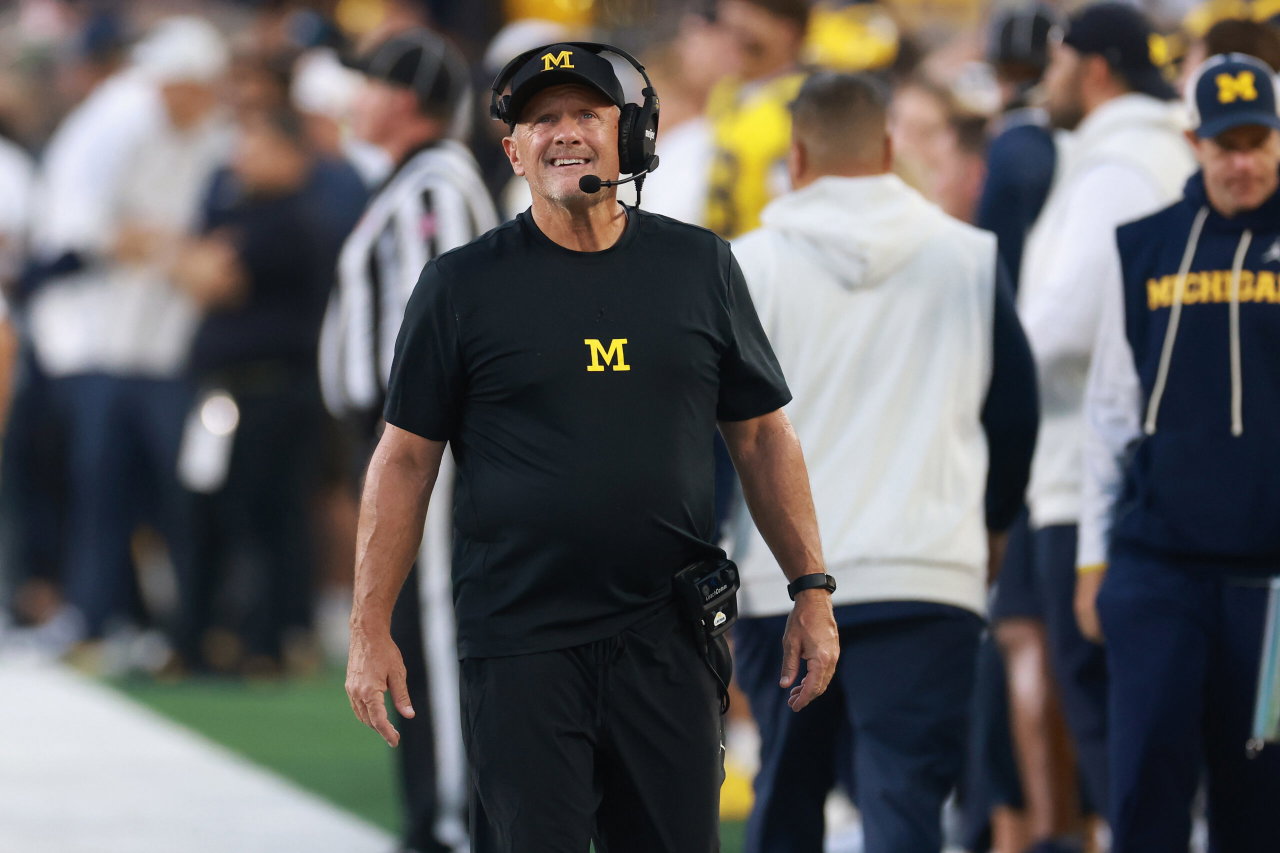
Michigan’s offense has become an outright disaster, and Kyle Whittingham is finally putting the blame where it belongs: on his coaching staff. After firing offensive coordinator Jason Beck, Whittingham admitted the coaches failed to adapt to their personnel and reopened the quarterback battle, just a week after declaring Tommy Carr his starter for the “foreseeable future.” Once ranked No. 16, the Wolverines are now 5-4, with their bowl hopes hanging in the balance.
Watch What’s Trending Now!
His quarterback announcement came a day after he fired Jason Beck, the coordinator he brought over from Utah, following a humiliating 15-6 home loss to a Michigan State team that entered at 2-6 without a Big Ten victory. Whittingham initially suggested he would evaluate Beck’s future in the offseason but changed his mind after reviewing the game film. The decision also comes with a reported buyout exceeding $7 million.
Whittingham has been upfront about how late he arrived, with half the roster already in the portal and January spent holding the team together. Though the easy move was to lean on the current roster, that approach hadn’t proved fruitful this season. However, he refused to use those circumstances as an excuse for the offensive failures.
“I’m not going to make excuses,” Whittingham said during a press conference, according to Michigan Athletics, on November 9. “We’re glad to get the players back that we did get back. Wish we could have got a few more back, but there’s not a college football, I mean, 95% of the snaps in college football are spread from the gun shotgun. I mean, there aren’t far more similarities and differences in offenses throughout the country.”
“And so not going to use that as an excuse that we didn’t have the right players for the personnel because as a coach, you got to, you got to make it work. You got to make it fit, and you can’t just say, ‘Okay, here’s what we’re doing on offense, period.’ We’re not going to be flexible with it. We’re going to be very rigid, and you got to be able to adapt to your personnel, and we just didn’t do a good job of that this year. Plain and simple.”
The game film made his frustration understandable. Against Michigan State, Michigan managed just 192 yards, rushed for 54 on 26 carries, committed four turnovers, surrendered five sacks, and converted only 2 of 10 third downs. The Wolverines remained scoreless until 1:35 left in the fourth quarter, when they finally reached the end zone. It was their third straight home game without a first-half point, something that hadn’t happened in a single season since 1979.
The embarrassment went deeper. Michigan State didn’t score a touchdown and still won on five field goals, handing Michigan its first loss without allowing a touchdown since 1985.
The Wolverines rank 132nd of 138 FBS teams in total offense at 302.6 yards per game, ahead of only Michigan State among Power Four programs. They also rank 126th in scoring at 19.6 points per game, 125th in passing, and 109th in rushing. Meanwhile, the defense ranks 14th nationally in points allowed at 16.2 per game, keeping Michigan competitive despite an offense that continues to struggle.
Quarterback has been a mess since the offseason. Bryce Underwood, the No. 1 overall recruit in the 2025 class, completed 58.1 percent of his passes for 924 yards, five touchdowns, and six interceptions before being pulled at halftime against Penn State on October 17, with Michigan trailing 3-0. Tommy Carr replaced him, and the Wolverines rallied to win 21-18.
Carr subsequently took over the starting job and appeared to justify the switch against Rutgers, completing 22 of 27 passes for 266 yards and accounting for three touchdowns, including two rushing scores. His 81 percent completion rate was the highest ever by a Michigan freshman starting quarterback with at least 20 attempts. That performance convinced Whittingham to declare Carr his starter for the “foreseeable future.”
But that confidence didn’t last. Carr went 1-2 in his three starts, and his latest performance against Michigan State raised fresh doubts. He completed just 14 of 26 passes for 138 yards and threw two interceptions, contributing to another offensive collapse. Whittingham even considered bringing Underwood back during the game before deciding to stick with Carr.
“To be determined, but there was consideration about whether to insert Bryce and try to create something,” Whittingham said when asked about Saturday’s starting quarterback. “And after discussion, it was determined that we would stay the course with what we had in that particular game. But going forward, we’ll take a look at everything again and see what gives us the best chance to win, as it always comes down to that.”
Whittingham isn’t pretending a quarterback change fixes everything. With offensive line coach Jim Harding taking over as interim offensive coordinator, Michigan isn’t planning a wholesale schematic overhaul this late in the season. However, the playcalling and approach could change as the staff reevaluates how best to use its personnel.
The biggest concern remains execution, particularly along the offensive line and at quarterback. Whittingham wants greater efficiency from both positions, and whoever demonstrates the ability to operate the offense effectively will have the best chance of starting.
Michigan travels to Oregon on Saturday before hosting UCLA and visiting Ohio State, a difficult three-game stretch to close the regular season. One victory would bring the Wolverines to six wins and make them bowl eligible, while losing all three would leave them without a bowl appearance for the first time since 2014.
Whittingham has already fired his offensive coordinator and reversed course on his starting quarterback. Now, with Michigan’s postseason hopes hanging in the balance, Saturday’s decision could determine whether the Wolverines can salvage anything from a disappointing season.