
Essentials Inside The Story
- If you are not an official FIFA sponsor, there are certain strict rules that you need to comply with.
- Stadiums in the United States are subject to the Clean Stadium Policy.
- Explore what changes the stadiums have undergone.
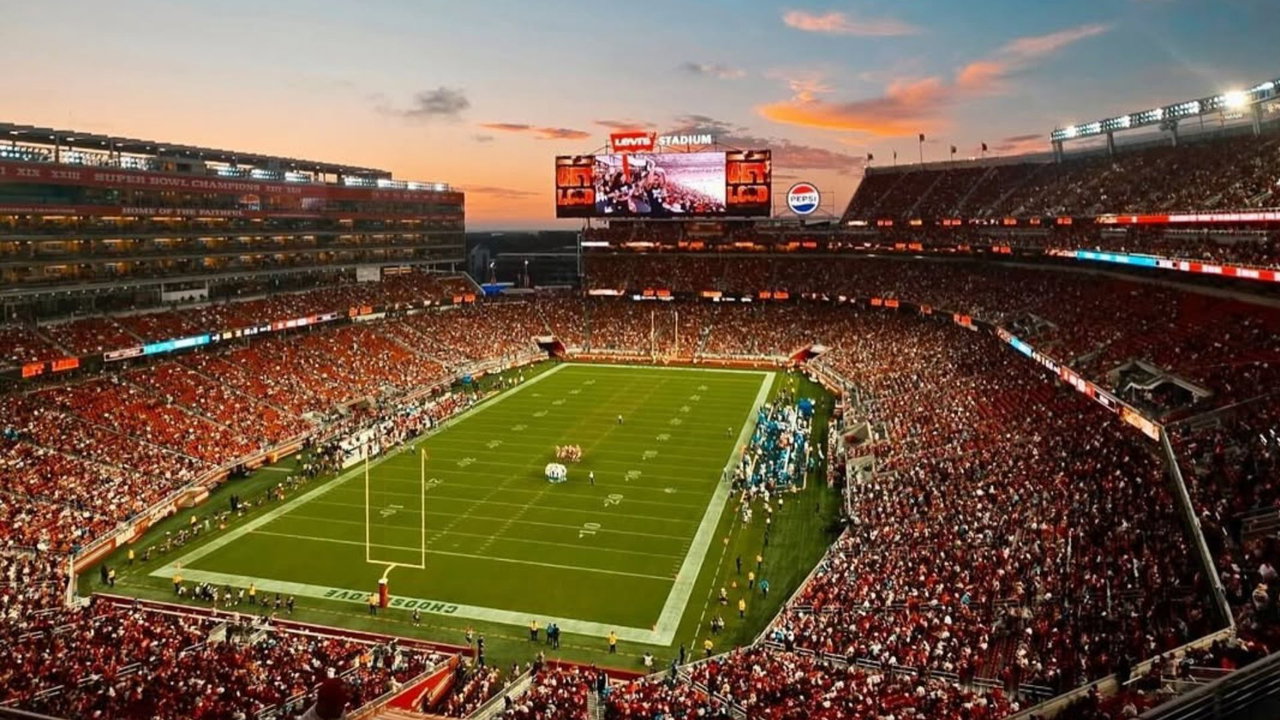
Levi’s Stadium was nameless during the Qatar vs. Switzerland match on Saturday. For a company worth $8.88 billion, that kind of silence doesn’t come easy. So they responded creatively in the only way FIFA’s rulebook allowed them to. The venue complied with FIFA’s strict rules, yet found a creative loophole with its Batwing logo.
Watch What’s Trending Now!
The Instagram post shared a video of the stadium’s name being covered by a white sheet. To make things even more interesting, the post used TikTok’s viral Nobody’s Gonna Know audio in the background. Even the official Instagram account updated its profile icon, replacing the Levi’s logo with a white sheet against a red background. Nobody was supposed to know it was there. Levi’s made sure everyone did.
“Welcoming the world to the beautiful [redacted] stadium!” Levi’s wrote in the caption, taking a subtle jab at FIFA’s restrictions.
It’s a response to clause 6.4. ii of the nearly 100-page contract between the stadiums and FIFA. According to this clause, the requirement is as follows.
“The requirement that there shall be no advertising, marketing, promotion, merchandising, licensing, signage or other commercial identification of any kind on any stands, scoreboards, seats, seatbacks, time clocks, staff uniforms, Accreditation passes, fences or elsewhere inside, surrounding, or in the airspace above and around the Stadium other than that which is installed by, or at the direction of, FIFA or which is approved in writing by FIFA.”
View this post on Instagram
This is not the first time this has happened, as seen in the 2006 FIFA World Cup, where the Allianz Arena in Germany was renamed to the FIFA World Cup Stadium, Munich, for the duration of the tournament. However, it is a first for America, despite the FIFA rules being in place before the 1994 tournament.
In that edition, all the host stadiums (Rose Bowl, Giants Stadium, Foxboro Stadium, Stanford Stadium, Cotton Bowl, Soldier Field, Robert F. Kennedy Memorial Stadium, Citrus Bowl, Pontiac Silverdome) did not have a sponsorship name.
Only entities associated with FIFA are permitted to engage in branding and advertising at tournament venues.
“FIFA will determine the official names of the Stadium and Training Sites for the Competition and change the name of the Stadium and the Training Sites for any purposes in relation to the Competition to any non-commercial name that it deems appropriate, without any reference to the naming rights sponsor, owner, or user of the Stadium,” states clause 8.2.3 on page 32 of its Seattle stadium agreement, per The Washington Post.
For the duration of the 2026 FIFA World Cup, stadiums will be referred to by their host cities. As a result, Levi’s Stadium was renamed San Francisco Bay Area Stadium. The change did not sit well with many locals, given that the venue is located in Santa Clara, California, about 40 miles from San Francisco.
The stadium has a capacity of around 68,500 and is well known as the home for Super Bowl 50 and WrestleMania 31. It also hosted Super Bowl LX this year. Yet, it can’t even highlight its biggest sponsor, Levi Strauss & Co.
The Athletic highlighted that the same trend was seen inside Levi’s Stadium’s press box. A black tape covered the branding on approximately 23 condiment bottles. However, companies like Coca-Cola, Visa, Adidas, etc., sponsor FIFA with massive amounts of money, which brings them free exposure inside the stadiums during the tournament.
Billions of people watch FIFA events, and every second of brand visibility can be worth millions to companies. But was Levi’s Stadium the only venue affected by FIFA’s Clean Stadium policy? Not quite.
FIFA has brought similar changes to other NFL stadiums
All 11 American stadiums playing host to FIFA World Cup games will need to mask the actual names over the course of the World Cup.
Lumen Technologies, the brand associated with the Seattle Seahawks stadium, has installed the word “LUMEN” on top of Lumen Field. The letters span about 300 feet across the stadium’s roof, and at night they glow. However, to accommodate the FIFA World Cup, officials had to cover the word on the roof, along with other signage in the vicinity that reads “LUMEN.”
MetLife Stadium has also removed the ‘MetLife’ branding from the stadium, but the one thing that worried locals was the cup holders installed behind the seats. With more than 80,000 cup holders in the stadium, renaming the entire venue would cost a significant amount of money. Hence, the host committee pushed back.
The Cowboys’ AT&T Stadium also had to change its name to Dallas Stadium. On top of that, Jerry Jones had to put up a tint on the eastern and western sides and block the glare during the late afternoon games.
Apart from these four stadiums, the following stadiums have also been temporarily renamed.
- SoFi Stadium<-> Los Angeles Stadium
- Gillette Stadium <-> Boston Stadium
- Arrowhead Stadium <-> Kansas City Stadium
- NRG Stadium <-> Houston Stadium
- Lincoln Financial Field <-> Philadelphia Stadium
- Mercedes-Benz Stadium <-> Atlanta Stadium
- Hard Rock Stadium <-> Miami Stadium
Of course, the international tournament brings unparalleled global attention and massive tourism revenue, but American stadium operators are learning that hosting the world’s biggest game requires completely surrendering their own corporate identities at the door.