
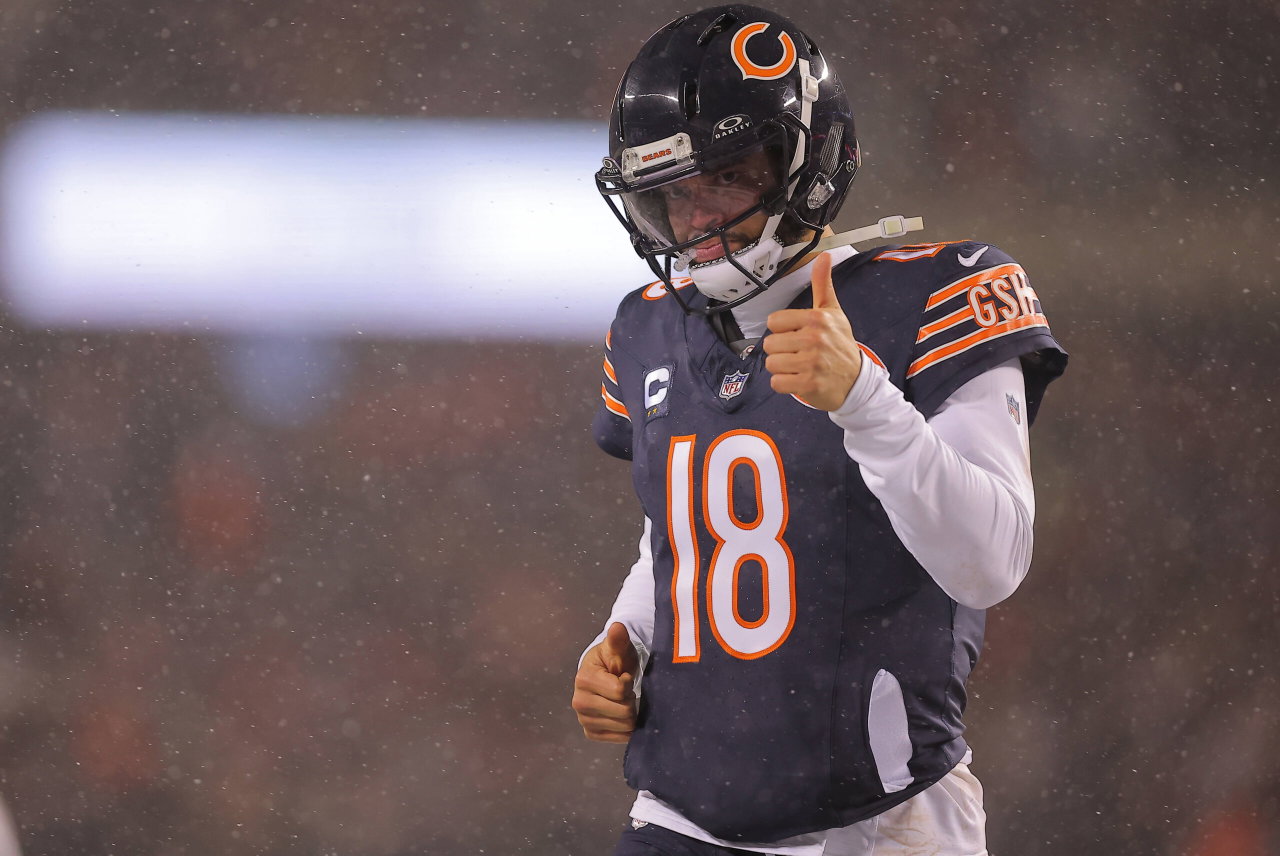
Caleb Williams threw four interceptions in the Chicago Bears’ 27-24 win over the Buccaneers on November 8, the first time he had done so at any level of football. Chicago still came away with the win, but the performance drew criticism. Now, Brian Urlacher has pushed back on those critics, defending the quarterback after the game.
Watch What’s Trending Now!
“I love his confidence,” Brian Urlacher said. “He’s confident but not cocky. Like, that’s what you want from your quarterback. But like, he’s gotten better in every category. Like, everyone’s like, ‘Oh, he’s not accurate with the ball.’ 77% (though stats say 68.7%) this year. Shut up. He throws the ball. He’s very accurate with the football. He checks it down when he has to, he’s on time, and he’s accurate as… Like, there are some of the throws, the windows, like versus the St. Louis last year, that throw he made to Kmet in the corner – no one makes that throw but him.”
The numbers back him up. Williams’ completion rate climbed from 58.1% last season to 68.7% this year, and most of that jump comes down to accuracy. His on-target rate moved from 68% to 79%, which suggests he is placing the ball better and trusting the offense more. He is also protecting it. PFF had his turnover-worthy throw rate at 2.5%, compared with 2.8% for his career and 3.1% last year.
For a third-year quarterback trying to prove he can lead a contender, the Tampa Bay outing stood out as a sharp outlier rather than a step backward. Across his six starts this season, Williams has thrown for 1,546 yards and eight touchdowns while posting a 95.4 passer rating. Four of his five total interceptions on the year came in that single game, showing how clean his decision-making has otherwise been in 2026.
Urlacher has been in Caleb Williams’ corner for a while, and he made his case before the Buccaneers game even kicked off. The Hall of Fame linebacker spent 13 seasons with the Bears, and when he went on the Rich Eisen Show, he spoke plainly about where the Bears sit in the NFC North.
“They’re in a tough division. They’ve got really good teams. But I’m going to go back to the quarterback play, and he’s playing the best in that division right now. I think they have a leg up on the other teams. They have a great chance to do it on both sides of the football. They’re great.”
Surviving that sloppy night mattered more than the box score suggests. The victory pushed Chicago to 7-2 on a four-game winning streak, keeping them just half a game ahead of the 6-2 Lions and 6-2 Vikings at the top of a crowded NFC North. Dropping a winnable game at home would have knocked the Bears out of first place and tightened their margin for error in the NFC playoff race.
Then Tampa Bay happened. PFF charged Williams with three turnover-worthy throws, pushing his rate for the game to 7.3%. Without that one night, his season would look excellent, which is why Urlacher’s comments now read as the counterpoint to the criticism that followed.
Williams himself did not let it shake him.
“I’m going to throw until I can’t throw anymore,” Williams said. “That’s how I live. I work my tail off to be in this position. I’ll never not throw the ball. I could throw 100 picks in one game… “That’s how I grew up. That’s who I am. I don’t get gun-shy. That’s not me, that’s not my identity, that’s not who I am. With that, I’m going to keep grippin’ it, keep rippin’ it, and Coach calls it, it’s time to go make a play.”
He also took responsibility for the mistakes.
“The one earlier, gotta just check it down, it wasn’t the right coverage, and I made a bad decision. That happens, and you learn from it. The other one was the same thing.”
Not everyone is convinced, but even the more cautious voices like analyst Nick Wright aren’t writing him off.
“You guys know how much I like Caleb, but we’ve got to be honest about the year he’s having up to this point,” Wright said. “At times spectacular.”
He then added, “He’s played six games. Four of them, he was excellent, and two of them, he was downright awful.”
That middle ground is probably the fairest read. One bad night doesn’t erase a season of real improvement, and Urlacher’s argument still holds up.