
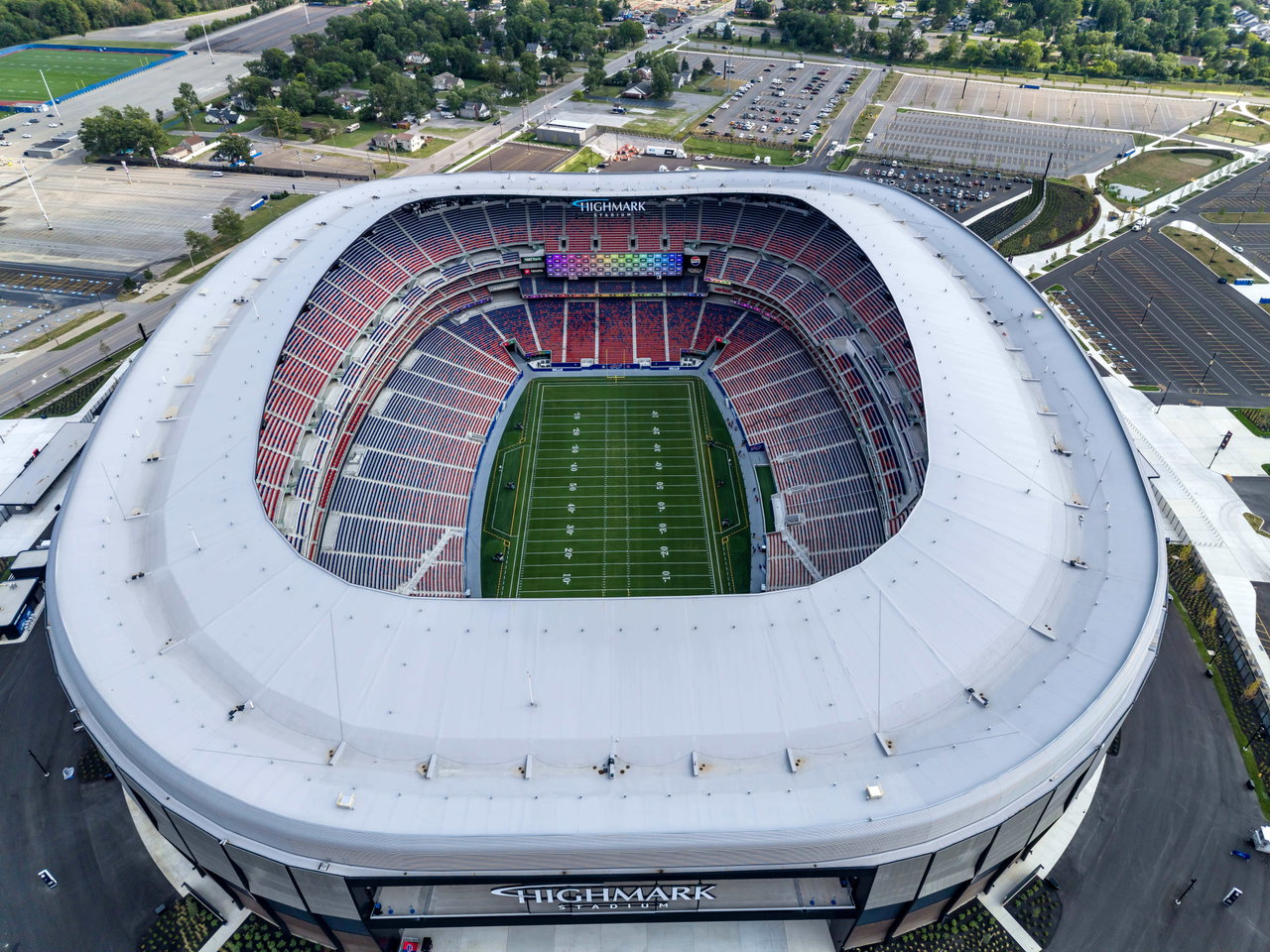
Only a few weeks into the new stadium, and the Bills already have a repair on their hands. With the regular season approaching, players and coaches should be focused on football. Instead, Buffalo has added another problem to the cart, with NFL players raising concerns about Highmark Stadium’s soft, unstable grass surface.
Watch What’s Trending Now!
“We’re committed to having the best possible playing surface for our players,” Bills president of business operations Pete Guelli said in a statement, according to The Athletic. “With a stretch of three consecutive home games early in the season, we decided it was the appropriate time to re-sod our field.”
After 53 years at the old Highmark Stadium, the Bills moved across the street into a $2.2 billion home. Just weeks into using it, the field already needs work. Buffalo will begin re-sodding the grass on August 31, ahead of its September 17 home opener against Detroit.
The move comes after players raised concerns following Buffalo’s August 15 preseason opener against Carolina, the first preseason football game at the new Highmark Stadium. The grass came loose in chunks, and Bills quarterback Kyle Allen even tore up a clump when he went down. Now, before the stadium hosts its first regular-season game, Buffalo is already replacing the surface.
“This process will begin on Monday, with full installation of a new surface completed by the end of the week. We will continue to monitor the field and every aspect of our new stadium to ensure it is the best possible experience for our players and fans.” Pete said.
This was not one bad play exposing a new field. The warning signs were already there. Buffalo’s Kentucky bluegrass had been in place since October 2025, yet by the Bills’ first preseason game against Carolina on August 15, the surface was already wearing down before kickoff.
The Bills had documented crews installing the natural-grass field in October 2025, with the process taking several days. By July 2026, the team was still highlighting the stadium’s final construction work as it prepared to open for the season.
That timeline matters because the surface was not a last-minute addition before the Panthers game. The grass had months to establish itself before Buffalo’s preseason debut, making the loose sod and recurring divots a notable concern once players finally took the field.
Bills tight end Dalton Kincaid had to call over a staffer to repair a troublesome divot during warmups. Another damaged spot got bad enough that a team employee stood nearby to keep players away.
Then came the first quarter. Kyle Allen was driven into the ground near the sideline, and the impact ripped out a massive clump of sod with roots and dirt attached. Josh Allen, DJ Moore, Dion Dawkins and Spencer Brown went onto the field and stomped it back into place.
That was only the start. One anonymous Bills player did not sugarcoat it, saying, “The field is a** right now,” although he added that it was still early. Another called the surface “soft, but not in a good way.”
Dorian Williams was less harsh, but he noticed the same issues. “A couple spots kind of chunked up a little bit,” he said, adding that players could see the grass “mound up” before guys knocked it back down. Still, Williams said he had not experienced traction problems and preferred natural grass to turf. “The body loves playing on grass. Hitting feels a lot better,” he said.
But the surface kept breaking down as the game went on. Officials had to reset Buffalo’s play clock in the first quarter so umpire Tab Slaughter could push loose soil back down.
By halftime, bald patches had formed between the hash marks. By the fourth quarter, several small craters had appeared between the 14- and 21-yard lines. Long snapper Reid Ferguson even had to stomp one down before an extra point.
Buffalo did not make a significant change to the surface before its preseason finale against Pittsburgh on August 27. The Bills beat the Steelers 28-27, and while the field was reportedly better than it had been against Carolina, Buffalo still decided to replace the grass before the regular-season home opener.
The move was not an admission that the field had been unplayable. Guelli said the organization could be satisfied with the surface’s performance and playability while still deciding that a new field was the better option. With three straight home games early in the season, Buffalo chose to re-sod rather than risk further issues at its new stadium.
Tyler Bass later missed a 46-yard field goal, though he blamed his own mechanics rather than the grass. Even after the game ended, the work continued, with 16 groundskeepers still inspecting and repairing the surface two hours later.
Carolina players noticed it too. Panthers running back Jonathon Brooks described the field as “a little lumpy,” though he said it otherwise felt good. James Cook also called the surface “smooth,” showing that not every player viewed it as unplayable.
That only made Buffalo’s situation more awkward. The field was not universally condemned, but there were enough divots, loose chunks, and in-game repairs to make the problem impossible to brush aside.
Two days later, Bills president Pete Guelli defended the field, saying the new grass simply needed time to settle.
“From a playability and safety perspective, everybody’s very happy,” Guelli said after the 29-14 win over Carolina. “It’s Year 1. So it’s a brand-new field, and it’s going to take time for the foundation to build up. So some of the things people saw in the game, those will dissipate over time.”
Buffalo had another preseason home game against Pittsburgh on August 27, and the field showed improvement from its rough debut against Carolina. Still, the Bills did not make a notable change to the surface before facing the Steelers, instead waiting until the preseason was over to move forward with a full re-sodding.
The Bills beat Pittsburgh 28-27 in the preseason finale, but the decision to replace the grass soon after showed that the improvement was not enough ahead of the regular-season home opener. Buffalo announced the full re-sodding plan two days later, with the new surface scheduled to be in place before Detroit visits on September 17.
The switch itself was a big one. Buffalo played on artificial turf at its old stadium, but the new Highmark Stadium marks the Bills’ return to natural grass for the first time since 1972. The reason was simple. About 92% of NFL players prefer grass, while Buffalo’s old turf earned an F in last season’s NFLPA report card.
But fixing what mattered to the players did not exactly win over the fans. While the field drew complaints from those on it, the seating quickly became a problem for those watching from the stands.
New Highmark Stadium criticized for seating arrangement
The field isn’t the only thing the Bills need to worry about. Fans did not seem completely sold on the seating either. During the Red & Blue practice on August 8, when 51,807 fans got their first real look inside the stadium, videos and photos showed some sightlines blocked by railings, safety glass, cable wires, and stair landings.
Others complained that the view from their seats did not match what they thought they had paid for, making the issue even harder to ignore with the franchise introducing personal seat licenses for the first time in team history. Some fans claimed they had specifically asked about possible railing obstructions while viewing virtual seat representations before making their purchases.
Guelli pushed back on the scale of the backlash, saying fewer than 1% of the Bills’ more than 17,000 PSL account holders had contacted the team with sightline concerns. He also maintained that the virtual stadium representation was “pretty representative” of what fans would actually see.
Still, Buffalo said it would review complaints on a case-by-case basis.
There was one important distinction. Some of the most extreme obstructed-view seats circulating online had not been sold and were not intended to be sold for football games, though they could potentially be used for other events. But other PSL holders still raised legitimate concerns about the views from seats they had purchased.
The Bills eventually responded to the wider criticism.
“Saturday’s practice was a great opportunity to test the new stadium,” the Bills’ statement read on August 10. “We are currently addressing internal and external feedback regarding the facility’s operation following the first event. We’ll utilize the next six weeks to refine any details as we prepare for the home opener on Thursday, September 17.”
And there is not much room to waste. The new Highmark Stadium has a seating capacity of just 60,108, making it the smallest stadium in the NFL by seating capacity and considerably smaller than Buffalo’s previous home.