
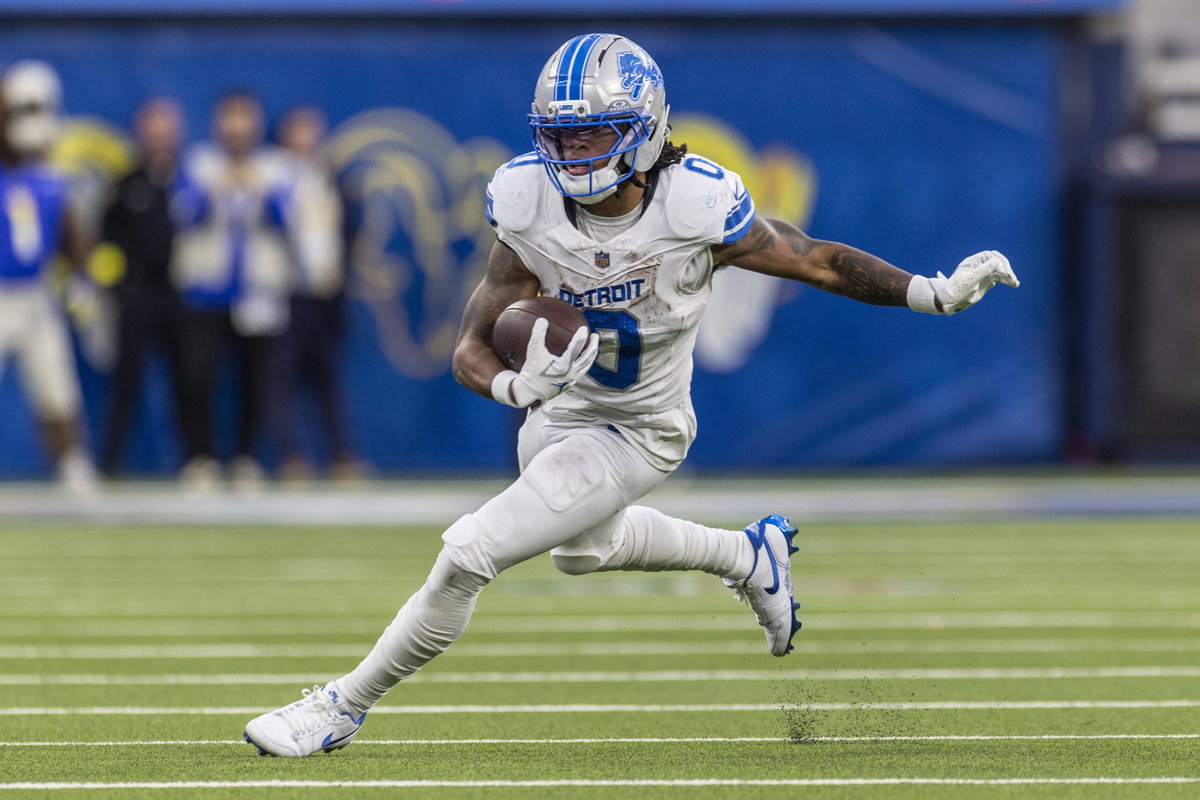
Jahmyr Gibbs had already been asked to do plenty for Detroit before the Lions reached Buffalo. In the opener against New Orleans, the third-year running back handled 29 carries and caught five passes, finishing with 186 yards from scrimmage and two touchdowns. With Isiah Pacheco unavailable, Gibbs had again been a major part of the offense four days later, even as Detroit found itself chasing the Bills for most of the night.
Watch What’s Trending Now!
By the final seconds of the first half, Buffalo had stretched its lead to 27-10, but Detroit still had one last play before the break. With six seconds on the clock, Jared Goff handed the ball to Gibbs, who picked up seven yards before being brought down at the Buffalo 33. The play appeared to give the Lions a little more ground before halftime, but the officials had seen something else in the tackle.
Landon Jackson was flagged for tripping Gibbs on the play, adding 13 yards to the Lions’ field position. The penalty itself was costly enough in the moment, but for Jackson, the flag could have consequences beyond Thursday night. That is especially because the Bills defensive end has already been fined by the NFL this season for a violation in the same disciplinary category.
The earlier fine came after Buffalo’s preseason opener against the Carolina Panthers. The NFL’s accountability records list Jackson for an unnecessary-roughness violation classified as “striking/kicking/tripping/kneeing,” with a fine of $8,190. That makes Thursday’s call more relevant to Jackson’s disciplinary record, even though the league has not yet announced any punishment for the Gibbs play.
The NFL’s current fine schedule lists “Striking/Kicking/Tripping/Kneeing” at $12,537 for a first offense and $18,507 for a second offense. But that does not mean Jackson is automatically facing an $18,507 fine. The league still has to review the play and determine whether it warrants additional discipline and how it should be classified.
That review happens after games as part of the NFL’s broader enforcement process. The league says its Officiating Department reviews every play and refers potential violations to its Football Operations compliance team. In Jackson’s case, Thursday’s flag means the play is already on the officials’ radar; the question now is whether the postgame review leads to another fine.
There is also an important distinction between a repeat fine and a suspension. The NFL’s fine schedule separately lists offenses such as horse-collar tackles, hip-drop tackles, launching, hits on defenseless players and blindside blocks, with certain repeat violations subject to the league’s three-offense suspension provisions. The “striking/kicking/tripping/kneeing” category is not part of that specific three-offense suspension framework.
For Jackson, the situation comes less than a year after his rookie season was cut short. The Bills selected him No. 72 overall in the 2025 draft after acquiring the pick from Chicago. He appeared in only three games as a rookie and suffered MCL and PCL injuries against Miami in November, ending his season.
Jackson’s path to a larger role had already been a slow one. He spent much of his rookie season buried on the depth chart before getting his opportunity in Week 10. That chance lasted only two defensive snaps against Miami before the knee injury forced him out. He returned to Buffalo’s plans in 2026 after recovering and entered his second season trying to establish himself in the defensive rotation.
Both Teams Entered Buffalo Chasing the Same Clean Slate
The tripping penalty also landed in a game where Detroit was already struggling to put its Week 1 mistakes behind it. The Lions had opened the season by building a 21-0 lead over New Orleans before allowing the Saints to force overtime, eventually winning 31-30. Gibbs was central to that game, rushing for 156 yards and two touchdowns, while the Lions’ defense gave up 410 passing yards to rookie quarterback Tyler Shough.
Detroit also had personnel issues to sort through along the offensive line. Ben Bartch had played 66 of 77 offensive snaps against New Orleans after a delayed start to training camp, and Dan Campbell acknowledged that the veteran guard was still working through the rust.
“Just inconsistent, a little rusty,” Campbell said. “I mean, he got a few reps, he got that last week, and so he’s only going to be better as we keep going here.”
That made the short turnaround to Buffalo another test for a Lions team that had survived Week 1 without playing a clean game. Buffalo arrived at 1-0 as well, having erased a 31-26 deficit to beat Houston 36-31. Both teams therefore entered Thursday night with the same simple objective: move to 2-0 without carrying their opening-week mistakes with them.
Detroit didn’t manage that part. By halftime, the Lions had committed seven penalties for 36 yards and trailed 27-10. Campbell addressed the problem directly during his halftime interview with Amazon Prime sideline reporter Kaylee Hartung.
“We’ve just got to stay on the field, and we’ve got to score points, and cut out the penalties because they’re killing us right now. The little s* is killing us.”**
Jackson’s flag was one of those penalties, although it should not be folded into Detroit’s broader penalty problem: the foul was committed by Buffalo, not the Lions. Its significance is instead tied to what happens after the game, because Jackson had already appeared in the NFL’s disciplinary records once this season for the same broad category of conduct.
That leaves two separate threads from Thursday night. Detroit has to address the penalties and the 27-point deficit it created for itself, while Jackson now has to wait to see whether the NFL considers his tripping foul worthy of another entry in its fine records.