
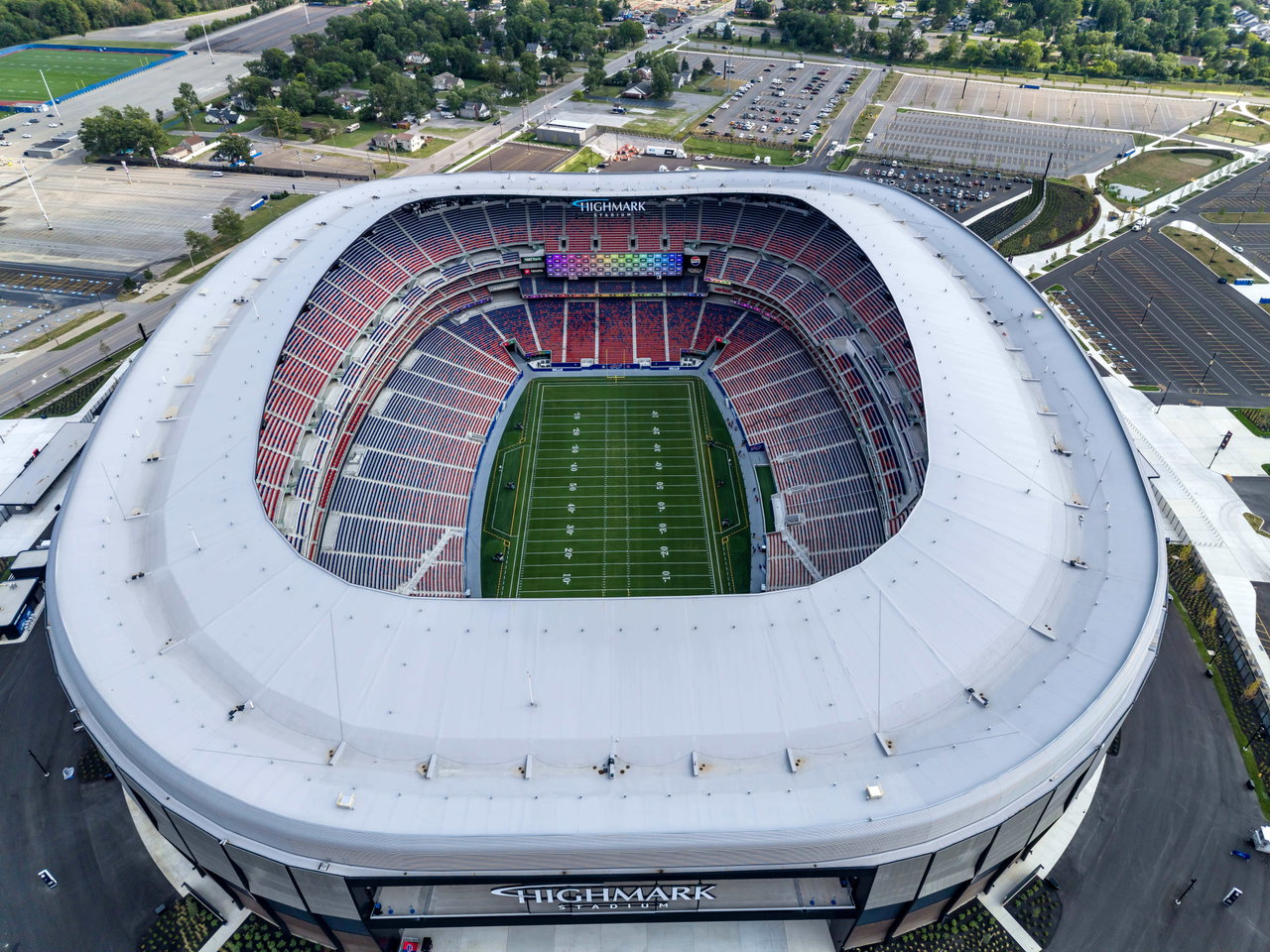
The Buffalo Bills invested millions of dollars into the creation of a new Highmark stadium, promising their fans the best facility possible. Yet, with players slipping, sliding, and falling because of what looks like patchwork ground rather than high-quality natural turf, the criticism came fast from all corners. From turf specialists to former groundskeepers, the verdict is already in.
Watch What’s Trending Now!
From “I’m never putting Josh Allen on a field in that condition” to “That’s the worst sod I’ve seen in the NFL in my career,” Agronomists and groundskeepers couldn’t help but criticize the Bills’ failure.
The Bills’ new $2.2 billion stadium was supposed to be a triumph. Instead, its grass field has become the story nobody wanted heading into the 2026 season. Tim Graham of The Athletic spoke to the people who actually know turf for a living, and their reaction wasn’t pretty.
Start with George Toma, the man they call The Sodfather. He’s spent decades as the most trusted groundskeeper in sports. Watching what’s unfolded at Highmark Stadium and the need to rip up the ground to revamp it even before the season begins genuinely stings him.
“That hurts me,” Toma said. “That’s terrible to happen at all, but so soon? Somebody fell asleep.”
Here’s the timeline that has people scratching their heads. The Bills laid down natural Kentucky bluegrass, sourced from Tuckahoe Turf Farms in New Jersey, all the way back in October 2025. Then the field sat untouched for ten months. You’d think that kind of head start would help it settle in.
Instead, after just two preseason games against the Panthers and Steelers, plus a couple of open practices, the sod was getting torn up in massive chunks. The Bills didn’t wait around. They ripped the whole thing out and started over.
Resodding a field midseason isn’t unheard of in the NFL. What’s raising eyebrows is how fast this one failed.
An award-winning sports agronomist, who’s helped build dozens of NFL and college fields and asked to stay anonymous to protect his industry relationships, didn’t hold back.
“I saw their press release and heard some of their rationale, and they probably ought to start their stories ‘Once upon a time,'” he said. “That’s the worst sod I’ve seen in the NFL in my career. I can’t even imagine how that could have happened.”
Tony Dick, who teaches sports management at Baldwin Wallace University and used to work as an assistant head groundskeeper for the Browns, is just as blunt.
“Natural turf is safer in a perfect setting,” he said. “But if you have the situation as you have in Buffalo, and I went back and watched the film, you cannot tell me that field was safer than the artificial turf they just left. I’m never putting Josh Allen on a field in that condition.”
Dick went a step further, predicting artificial turf could be back at Highmark within three years, simply because it might end up being the safer bet.
As for what caused it, the theory points back to that thin initial cut the Bills used, meant to encourage thicker growth later on. Unfortunately, it only ended up leading to root growth downward but not horizontally, making the turf susceptible to ripping.
With the Bills opening the season on the road against Houston, the timing lines up well to get this fixed before fans are in the stands.
Bills Replacing the Grass at New Highmark Stadium
The team is tearing out the current field and laying down a new one. That matters because the Bills have three straight home games coming up in Weeks 2 through 4.
Pete Guelli, the Bills’ president of business operations, explained the thinking in a statement.
“We’re committed to having the best possible playing surface for our players,” he said. “With a stretch of three consecutive home games early in the season, we decided it was the appropriate time to re-sod our field. We will continue to monitor the field and every aspect of our new stadium to ensure it is the best possible experience for our players and fans.”
This isn’t coming out of nowhere. After the preseason opener, one Bills player didn’t mince words with The Athletic, saying “the field is a– right now,” and with field experts already ripping the Bills over poor grass conditions, this move felt bound to happen.
Aaron Ramella, the Bills’ senior director of fields and grounds, put it simply.
“We chose to re-sod because we were not happy with the way the current field was performing. Until we can get a full season of play on the field, we will continually be learning and correcting what we do to the field.”
Worth noting, both an NFL consultant and an independent expert checked out the field during the Steelers preseason game and cleared it as safe and playable. The Bills just wanted better, not just adequate.
“You can be happy with the performance and playability and still make the change,” Guelli told the Buffalo News. “If it’s even slightly better, we’re going to make the change and err on the side of performance.”
Well, from here, the only way from seems up.