
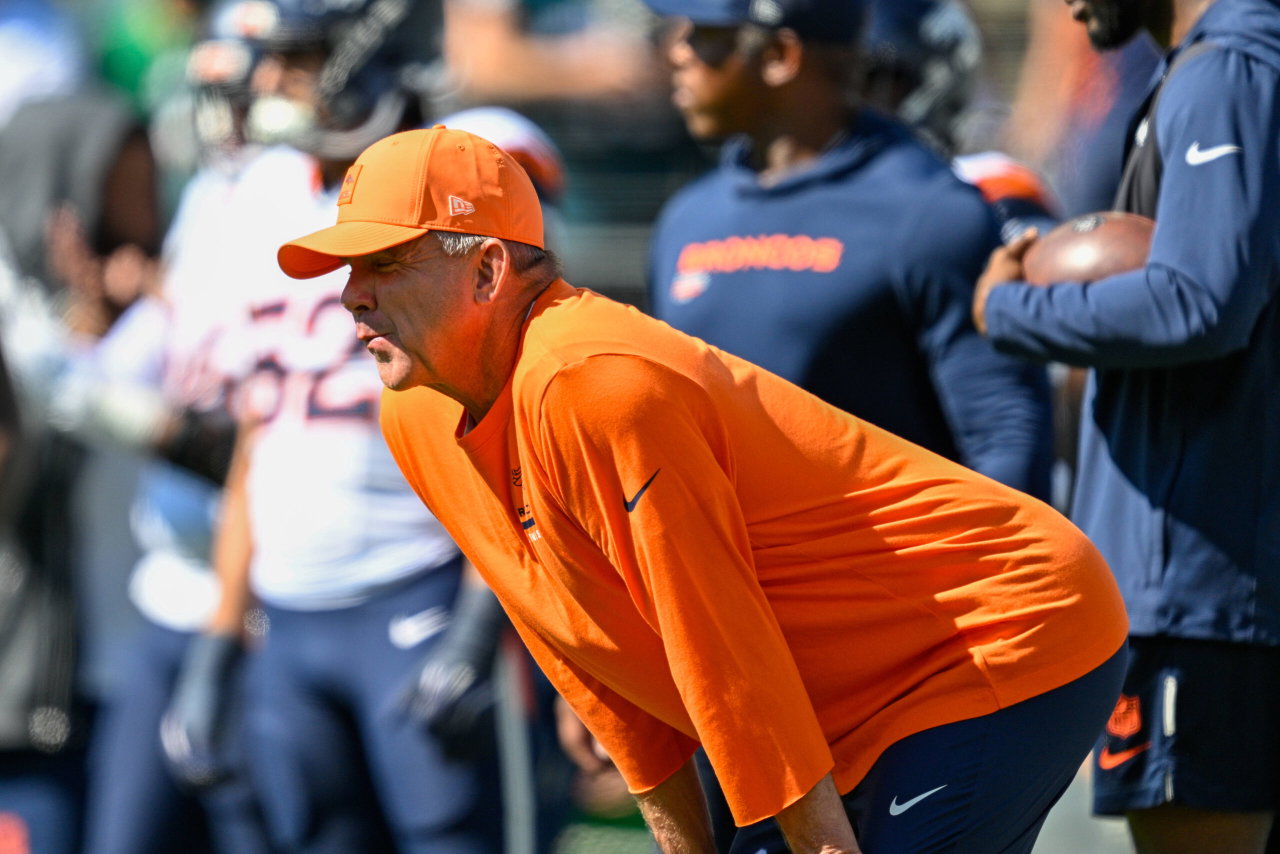
Watching Denver Broncos head coach Sean Payton observe his team while bent over with his arms on his knees raised concerns about his health at 62. After their Week 1 game, he revealed that he had been dealing with a spinal disc issue (L4 – L5). A day after his squad defeated the Jacksonville Jaguars in Week 2, those questions evolved into whether he’d require surgery to fix the issue.
Watch What’s Trending Now!
“No, no, no, no. Fair question,” Coach Payton said on the Orange and Blue Today. “So, in 2013, I had an L4-5, a little disc issue, and it was just from too much CrossFit or working out, and so that kind of calmed down, and then cleared up this summer. So, I already had the little procedure, which is an epidural injection. It really can get aggravated when you’re standing for three and a half – four hours. No, there’s no surgery for the back.
“I’ve got a toe issue. There’s some other issues now that are crickety, but the stress on the back can be relieved if you get into that position. But that actually – 13 years ago was the first time that that area of your 4-5, which is a specific location that can give you more of a radiating pain than a true pain, if that makes any sense.”
Standing on the sidelines for nearly two decades takes an unyielding physical toll, and no one knows it better than Payton, whose battle with lower back pain is a 13-year fight against one of the most vulnerable points in the human body. The L4-L5 disc sits at the base of the spine, absorbing the heaviest stress loads whenever we stand, walk, or bend. Acting as a shock absorber between two lower vertebrae, this disc prevents bone-on-bone friction. Because it bears the brunt of the body’s weight and sits right above immovable lower segments, it carries the highest risk of wear and degeneration on the entire spine.
When an L4-L5 issue flares up, it triggers symptoms that can make even standing upright a test of willpower:
- Sharp pain, typically felt as a shooting and/or burning feeling that originates in the lower back and travels down the leg in the distribution of a specific nerve, sometimes affecting the foot.
- Numbness in different parts of the thigh, leg, foot, and/or toes.
- Weakness while moving the thigh, knee, or foot in different directions.
- Abnormal sensations, such as a feeling of pins and needles and/or tingling.
When those nerve flare-ups occur, relieving the agony requires targeted intervention. That is where a lumbar epidural steroid injection (lumbar ESI) comes in. Rather than repairing structural damage, this procedure delivers a powerful anti-inflammatory corticosteroid directly into the epidural space surrounding the compressed spinal nerve roots. By soothing the irritated nerves in the lower back, an ESI cools down the severe local inflammation.
Payton has quieted these exact symptoms since 2013, when he was returning to the New Orleans Saints following his one-year suspension. Despite managing back spasms and pain, he pushed through to lead New Orleans to an 11-5 record and a top-five defense. This wasn’t even the first time Payton coached through severe physical trauma. On October 16, 2011, during a matchup against the Tampa Bay Buccaneers, Saints tight end Jimmy Graham was driven out of bounds, accidentally bowling over his head coach.

USA Today via Reuters
NFL, American Football Herren, USA Carolina Panthers at New Orleans Saints, Jan 2, 2022 New Orleans, Louisiana, USA New Orleans Saints head coach Sean Payton on the sidelines in the second quarter against the Carolina Panthers at the Caesars Superdome. Mandatory Credit: Chuck Cook-USA TODAY Sports, 02.01.2022 16:21:48, 17444244, New Orleans Saints, NPStrans, NFL, Carolina Panthers, Sean Payton PUBLICATIONxINxGERxSUIxAUTxONLY Copyright: xChuckxCookx 17444244
Payton slammed into the turf, clutching his leg as trainers rushed over. He spent the rest of the first half on the bench with his leg elevated in a brace, his staff maintaining a clear viewing lane so he could keep calling the game. Halftime X-rays confirmed a devastating injury list: a broken knee, a broken tibia, and a torn MCL. Yet, Payton coached the entire second half from the Saints’ locker room on a monitor, refusing to leave the stadium.
That resilience defines Sean Payton. But even the toughest competitors reach a point where the body demands a break. The cumulative weight of these structural injuries, combined with 16 grueling seasons in New Orleans and the emotional transition after Drew Brees’ retirement, eventually caught up to him. When Payton stepped away from football after the 2021 season, he explicitly cited his health and the need to recharge as key reasons for walking away.
“I felt the time was right – for me,” he said. “It’s something I’ve been thinking about…Not many get to choose their terms. And I looked at it as an opportunity to see my kids more, to travel more, to get in better shape.”
Cut to 2026, the ailments haven’t vanished, but the passion for football has been reignited as he enters his fourth year coaching the Broncos. He’s already turned them into a championship-caliber team, who are looking forward to building on their 1-1 record as they get ready to host the Los Angeles Rams in Week 3. We will most likely see Sean Payton hunched over on the sideline once again, but at least we can rest assured that the head coach isn’t moving from that spot anytime soon.