
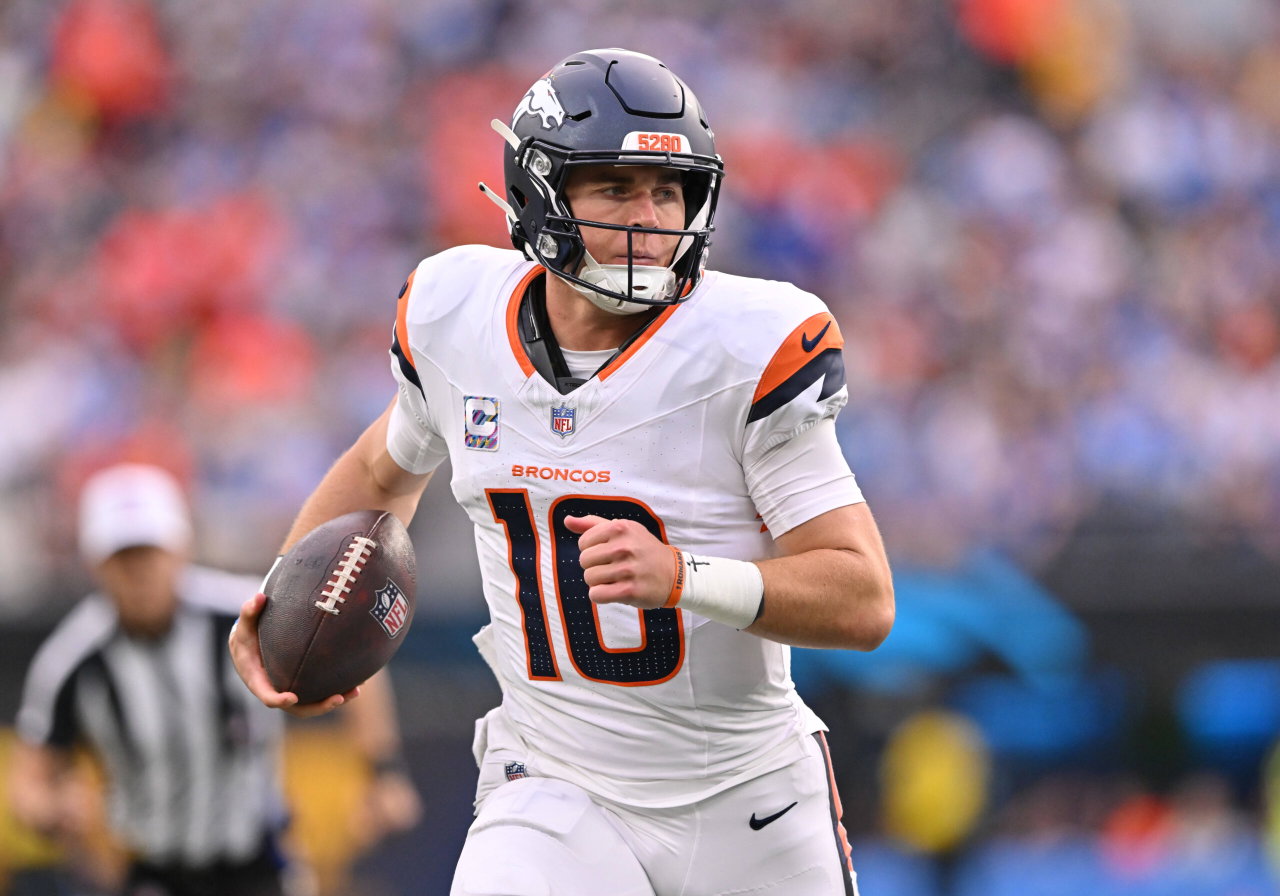
Despite a 17-14 overtime win over the Seattle Seahawks in OT, the Denver Broncos’ offensive struggles keep making headlines. At the center of the discussion is quarterback Bo Nix, whose inconsistency has become a major concern, especially as he continues to experience intermittent stiffness and swelling in his surgically repaired right ankle.
Watch What’s Trending Now!
“I think the best thing that could happen for Bo right now is he needs to sit for a while,” Mark Schlereth said on The Herd with Colin Cowherd podcast this week. “You need to sit him down. You need to say, ‘Hey, man, maybe it’s your ankle.’ You could take some of the pressure off. Say the ankle’s not right. He doesn’t have confidence in it. Whatever the case may be, he needs to sit down and see it from a 30,000-foot view because this is unsustainable.”
Nix completed 17 of his 27 passes against Seattle but gained only 107 yards, his lowest passing yards of this season so far. Denver’s longest pass covered just 16 yards, and both Broncos touchdowns came on the ground.
With Nix struggling to produce through the air, his previous ankle injury is another factor to consider. He broke his ankle during Denver’s 33-30 overtime victory over the Buffalo Bills in the AFC Divisional Round on January 17, 2026. The injury forced him to miss the remainder of the postseason.
Nix subsequently underwent surgery on his right ankle, and he has indicated that he is feeling healthy. However, his performances continue to raise questions about whether the injury could be affecting his play.
Even Nix recognizes that Denver is struggling to create explosive plays.
“We’re definitely capable,” Bo Nix said postgame. “We’ve shown it, and I don’t know where the disconnect is right now, to be honest with you. . . . I just think we’re really, for some reason, struggling to find those explosive plays and that’s what makes an offense really spectacular — finding explosive plays. And right now we don’t have those.”
The problem is not limited to one game. Against the San Francisco 49ers, Nix completed 25 of his 42 passes for 214 yards and one touchdown. His longest pass covered 30 yards, but he struggled to take advantage of opportunities to make bigger plays.
Broncos analyst Lance Sanderson highlighted one instance. In the first quarter (6:35 remaining), Denver faced second-and-four. Tight end Evan Engram ran across the middle of the field, while Marvin Mims Jr. ran deep and pulled a defender away, leaving Engram with plenty of open space.
Nix had good protection from his offensive line and enough time to throw the ball to Engram for a potentially big gain. However, he hesitated and chose a short pass to running back R.J. Harvey on the left side. Harvey gained only two yards.
Beyond Nix’s individual struggles, Denver’s overall offensive performance against Seattle was also poor. The Broncos managed just 168 total yards, compared with Seattle’s 353, and recorded only 13 first downs while the Seahawks had 24. These numbers highlight how difficult it was for Denver to sustain drives and keep its offense moving.
The Broncos also struggled on third down, converting just three of 14 attempts, a 21.4% success rate. Seattle, meanwhile, converted seven of 17 attempts, or 41.2%.
Denver’s running game was ineffective as well. The Broncos rushed for 74 yards on 28 attempts, averaging just 2.6 yards per carry. Seattle averaged 4.3 yards per carry and gained 113 rushing yards. Denver did benefit from committing zero turnovers while Seattle gave the ball away three times. Despite that advantage, however, the Broncos managed only 168 total yards.
Now, it remains to be seen whether Sean Payton and the Broncos can address these offensive issues and find a way to generate more explosive plays in the games ahead.