
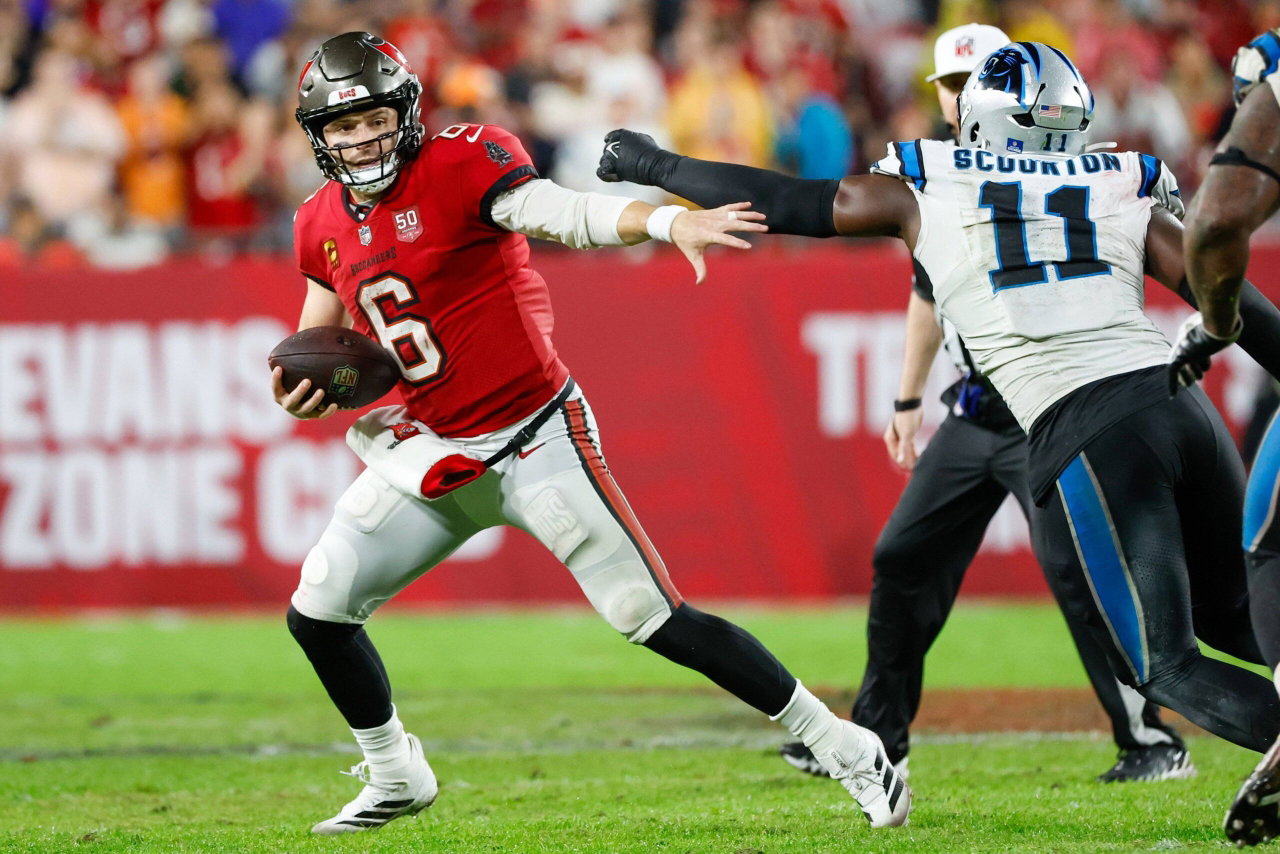
The NFL has dealt with this situation before. In 2011, following a similar complaint from Tony Romo, the league sent a memo to all 32 teams reiterating that defenders could not resort to certain tactics to throw opposing offenses off before the snap. As per Rule 12, Section 3, Article 1(i) of the NFL rulebook, the violation even carries a 15-yard penalty and an automatic first down for the offense.
Watch What’s Trending Now!
The league, however, has acknowledged that such incidents can be difficult for officials to detect. And now, that very thing may have been a factor in the Tampa Bay Buccaneers‘ Week 9 matchup against the Chicago Bears.
Chicago escaped with a narrow 27-24 victory, but Tampa Bay’s five false-start penalties added to the frustration. While Baker Mayfield believed the Bears’ defense was deliberately interfering with the Buccaneers’ cadence, head coach Todd Bowles suggested his players needed to focus better and hold their positions. Mayfield, however, felt there was more to the situation than his offense simply failing to execute.
Speaking to reporters after the game, the Buccaneers quarterback said, “To be honest with you, I don’t know the last one. I know they’re barking out the cadence, which you can’t do that. So tough for the refs to call that because they’re not right there at the line of scrimmage. But I think they called that on Tristan, but that’s — can’t do that.”
Mayfield’s complaint was specifically about the final false-start penalty called on left tackle Tristan Wirfs. He did not, however, identify the words the Bears’ defenders had allegedly shouted or name any of the players involved. There has also been no independent confirmation of what was said on the field. His claim was that Chicago’s defenders were calling out signals that sounded like his cadence, potentially prompting Tampa Bay’s offensive line to move before the snap. What could make it more believable is the fact that Chicago has a history of using a different kind of pre-snap tactic to disrupt opposing offenses.
Defensive tackle Andrew Billings is known for shouting “MOVE!” to signal the Bears’ defensive front to shift laterally before the snap. The call can catch offensive linemen off guard and has helped Chicago draw false-start penalties.
The Bears were even working on how to handle Billings’ call during Caleb Williams’ first training camp in 2024. Offensive lineman Teven Jenkins explained that Billings would use it to catch Chicago’s own offensive line off guard, so the players had to learn to tell the defensive signal apart from Williams’ cadence. They practised recognising it during indoor walkthroughs, with Jenkins describing the Bears as “one of the best move teams in the whole NFL.” It is not just a practice-ground tactic, either.
In a November 2025 report, Chicago Tribune’s Brad Biggs detailed how defensive coordinator Dennis Allen works the move call into the Bears’ game plan. Billings said he watches opposing quarterbacks to get a feel for their snap patterns before choosing when to call it, often waiting until just before the snap. Defensive line coach Jeremy Garrett said the Bears use it selectively, averaging around two or three calls a week. Billings also noted that he had drawn five false starts during the 2024 season.
“As the game goes along, you get a feel for the snaps. You get a feel for the cadence,” Billings explained, describing how he reads an opponent’s timing before making the call.
But there is a crucial difference between that tactic and what Mayfield accused the Bears of doing. Under NFL rules, a defender can shout “MOVE!” to signal a legitimate shift in the defensive front. What defenders cannot do is deliberately imitate the opposing quarterback’s snap signals to confuse the offense. Chicago’s use of the former is well documented, but it does not establish that the team crossed the line against Tampa Bay.
The distinction came into focus during another game in November 2025, when the Baltimore Ravens faced the Minnesota Vikings. Minnesota committed eight false starts, and running back Aaron Jones suggested Baltimore’s defenders were making move calls that sounded like J.J. McCarthy’s cadence. Ravens head coach John Harbaugh defended his team’s approach, saying, “You’re allowed to say, ‘Move.’ You’re not allowed to say ‘set,’ or ‘hut,’ or anything else. Or a cadence, which we never have done.” Harbaugh added that he had reviewed the footage and found no evidence of his defense doing what Jones had alleged.
In Tampa Bay’s case, Mayfield’s accusation does not explain all five false starts. Pro Football Talk reported that after the final penalty on Wirfs, Mayfield was hit while attempting an incomplete pass. He was then sacked on the next three plays, although one of those sacks was nullified by a penalty. It was a damaging sequence for a Buccaneers offensive line that had struggled to find its footing throughout the game.
Head coach Todd Bowles, for his part, pointed to his own team’s discipline rather than a communication problem. “It wasn’t a communication thing. We just got to hold our water,” he said after the game. His message was that Tampa Bay’s players needed to stay in position and avoid reacting before the snap, regardless of what they heard from Chicago’s defense.
The Buccaneers still managed to make a game of it. Bucky Irving rushed for 97 yards on 20 carries and scored twice, while Mayfield finished 18 of 32 for 243 yards. But the quarterback also threw two interceptions, one of which proved particularly costly. Jaylon Johnson returned one of those picks 67 yards for a touchdown in the third quarter, helping Chicago take a 24-13 lead.
Tampa Bay’s defense had given the offense opportunities to respond. Caleb Williams threw four interceptions, with Zyon McCollum picking him off twice in the first half. Tykee Smith and Alex Anzalone also came away with interceptions, while the Buccaneers forced five turnovers in total, including a fumble. Yet they struggled to make enough of those takeaways, converting just two of 12 third-down attempts despite putting up 352 total yards.
Williams, meanwhile, found ways to keep Chicago moving despite the turnovers. He completed 22 of 37 passes for 279 yards and two touchdowns, with rookie receiver Luther Burden III leading the way through the air. Burden finished with seven catches for 97 yards and a touchdown. Reflecting on how the team responded when one side of the ball was struggling, Williams told Yahoo Sports, “We obviously want to be clicking on all three, but when a side of the ball isn’t clicking, we’re going to step up, we’re going to stand up for each other. Defense did that today.”
The Bears nearly let their own mistakes undo that effort late in the game. With 3:38 remaining, Burden fumbled after being hit by Keionte Scott, who forced the turnover. Ifeatu Melifonwu recovered for Tampa Bay at Chicago’s 17-yard line. Irving made the most of the opportunity, scoring on a six-yard run before Mayfield ran in the two-point conversion to level the score at 24-24 with 2:51 left.
Chicago had the final say, though. Williams found Colston Loveland for a 38-yard gain that took the Bears to Tampa Bay’s 16-yard line with 40 seconds remaining. Two kneel-downs later, Cairo Santos made a 38-yard field goal as time expired, sealing the 27-24 win.