
While the Kansas City Chiefs opened Week 1 with a statement win over the Broncos, it came with some hefty costs to their players. First, it was Rashee Rice and Kenneth Walker III who came under scrutiny for gestures in the game. Now, it’s an O-line player who has taken the financial hit.
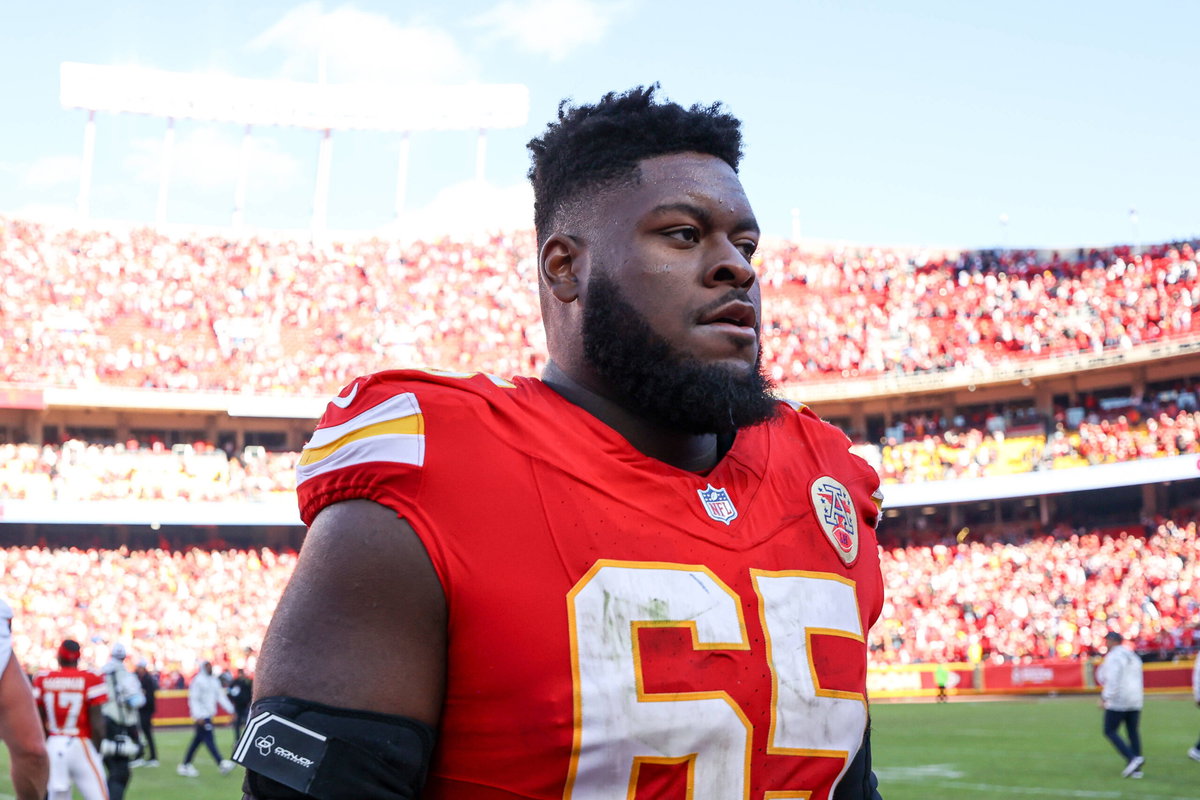
On September 19, A to Z Sports editor and PFWA member Charles Goldman reported on X that Smith had been fined for a fourth-quarter infraction from Kansas City’s September 14 opener. “Kansas City Chiefs OL Trey Smith was fined $6,750 for a chop block with just under 10 minutes remaining in the fourth quarter of Week 1,” Goldman wrote.
Well, by the time the fourth quarter began, Kansas City was already in control. Kenneth Walker III’s touchdown pushed the lead to 31-10, Denver went three-and-out, and the Chiefs got the ball back deep in their own territory. Kansas City then started chewing clock, moving from its own 6 to the 34 before Emmett Johnson took a first-down handoff to the left with 9:50 remaining.
That was when Trey Smith was flagged for the chop block, a penalty meant for an illegal high-low combination where two offensive players tackle the same defender. The rule doesn’t just come with a financial penalty, as Smith found out.
The run was wiped out, and the 15-yard penalty pushed the Chiefs from 1st-and-10 at their own 34 to 1st-and-25 at their own 19, making it much harder for Kansas City to continue the drive. The penalty was supposed to benefit Denver by putting the Chiefs well behind the chains and giving the Broncos a better chance to get the ball back.
And that is exactly what happened. Kansas City recovered 19 yards on the next play, but the drive eventually stalled after Zach Allen sacked Patrick Mahomes on third down, forcing a punt with 7:08 left. So while the score stayed 31-10, Smith’s penalty did help Denver end the possession and get the ball back.
The $6,750 figure also was not arbitrary. A first-offense chop block normally carries a $12,537 fine, but under the CBA, a player cannot be fined more than 10% of his game check for a first offense. Since Smith’s 2026 base salary is $1.215 million, which works out to $67,500 per regular-season week, 10% of that comes to exactly $6,750.
Interestingly, Smith may not have to pay the fine after all. That’s because the NFL and the Players Association negotiated a system wherein players who don’t repeat offenses after being fined once can get a refund at the end of the season.
As Kevin Siefert of ESPN put it, “100% refunds for fines on one-time offenses for striking, kicking, tripping or kneeing an opponent; face mask; leg whip; late hit; use of helmet; roughing the passer; low block; chop block; unsportsmanlike conduct (except as detailed above); taunting; throwing a football into the stands.”
That same regulation applies for Smith’s teammates, Rashee Rice and Kenneth Walker, both of whom received a fine for punting a football into the stadium. And while three Chiefs stars took financial hits, Denver didn’t get off scot-free either. “Denver Broncos LB Alex Singleton was fined $11,941 for unnecessary roughness against RB Emmett Johnson on the first play of the fourth quarter,” Goldman reported in the same post.
Singleton’s incident actually happened before Smith’s chop block. On the first play of the fourth quarter, with Denver trailing 24-10, Johnson turned a short Mahomes pass into a 25-yard gain to the Broncos’ 4-yard line. Singleton missed his initial chance to stop him, then came back into the play and hit Johnson after he was already down.
Now, if all four players do not have to pay any money at the end of their season if they don’t repeat the offenses, why are the fines significant? Well, they may be tied to the league’s strategy on viewership.
While the penalties on Smith, Rice, Walker, or Singleton may not be a direct part of it, the fines are a part of the NFL’s wider plan, after the league handed out fines to 20 players. It believes that tamping down on defensive backs could open up the passing game, leading to higher-scoring games.
Reporter Mark Maske wrote, “League leaders and rule-makers have generally believed that high-scoring games increase fan interest and broadcast viewership. In this case, the league is calling strict enforcement of illegal contact a “continuing” point of clarification by the competition committee.”
The league also went on to issue clarifications in its Week 2 officiating videos. The message to players is clear: keep things clean on the field, whether you’re on the defense or the offense.