
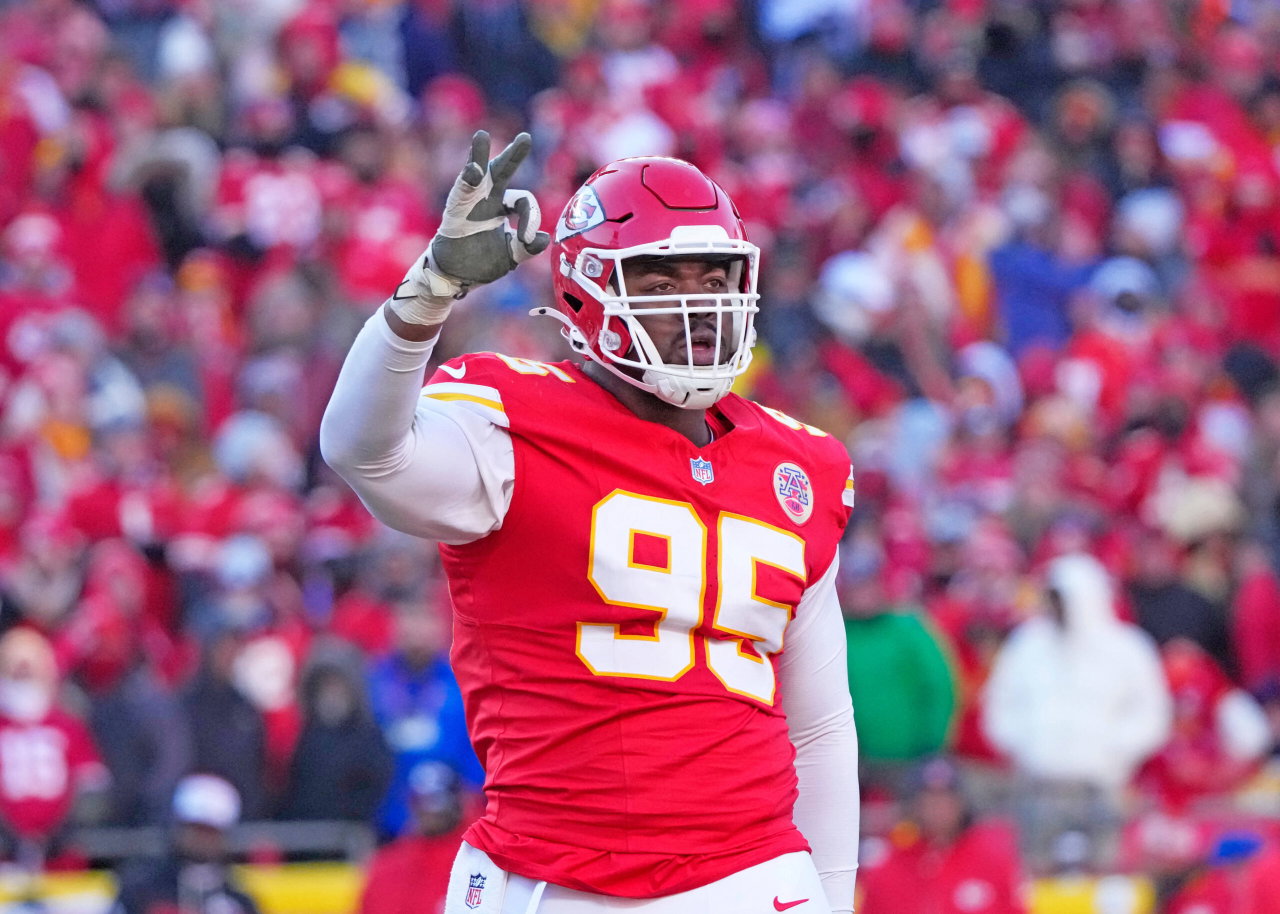
During the Kansas City Chiefs’ Week 6 game against the Los Angeles Chargers, defensive end Ashton Gillotte took two hits on quarterback Justin Herbert. But one of them resulted in a penalty of roughing the passer and resulted in a 15 yard penalty.
Watch What’s Trending Now!
While the Chiefs questioned the decision, veteran defensive tackle Chris Jones gave a simpler response, acknowledging the questionable nature of the call while reminding Gillotte and his teammates that arguing with officials would not change the outcome.
“He [Ashton Gillotte] stopped, and the QB [Justin Herbert] flopped—the next progression of that is when you make those types of calls, then being able to go look at the film as a ref and to be able to pull that flag back up when you see that there’s flopping going on—the NBA came up with a rule for flopping…but you don’t argue with the ref’s calls,” Jones told reporters Thursday, via KSHB 41.
Jones addressed the incident after Kansas City’s 22-6 victory over the Los Angeles Chargers, sharing about the penalty and suggesting that the league could explore ways to review potential flopping by quarterbacks.
During the second quarter, Gillotte made contact with Herbert as the quarterback released a short pass over the middle. The pass was intercepted by cornerback Christian Roland-Wallace while Gillotte was defending the play. Replays showed Gillotte attempting to pull up and prevent Herbert from falling, though he was ultimately unsuccessful.
The decision drew criticism from Kansas City fans, who believed Gillotte had tried to avoid unnecessary contact rather than deliberately roughing up the quarterback. CBS rules analyst and former NFL referee Gene Steratore also questioned the ruling.
“To me, Kevin, I do realize that there is some contact to Justin Herbert’s helmet there,” Steratore said to announcer Kevin Harlan on the CBS Sports broadcast. “But in my opinion, I think Ashton Gillotte is trying to pull up a little bit. It’s not forcible [contact] initiated to the head and neck area. To me, I just didn’t like the foul for roughing the passer there, guys.”
The penalty gave the Chargers another chance to continue their drive, even after what appeared to be a costly turnover for the Los Angeles Chargers. Jones believes the NFL should consider allowing officials to review such decisions after the play, considering that the seven-time Pro Bowler is in for potential NFL punishment for a hit on Herbert as well.
In the fourth quarter, Jones was flagged for roughing the passer himself. With 1:28 remaining and the Chargers facing fourth and 22, Jones’ arm made contact with Herbert’s head and neck area.
Herbert completed a 14-yard pass to Theo Wease on the play, but the penalty gave the Chargers half the distance to the goal, moving the ball to the Chiefs’ 13-yard line with a fresh set of downs.
For Gillotte, his attempt to pull up did little to prevent the penalty, showing how difficult it can be for defenders to adjust in a split second. Though frustrated, the Chiefs recovered from the setback. The defense continued to pressure Herbert, and LB Jack Cochrane later intercepted a pass, regaining control of the situation.
For Gillotte, the best response is to learn from experience and keep making plays. As Jones made clear, you can question a call after the game, but arguing with the referee will not change the flag.