Imago
September 15, 2021, Moscow, Russia. The emblem of the Kansas City Chiefs football club on the sand of the beach. xkwx exchange, coin, field, stadium, mahomes, arrowhead, conference, league, missouri, collectable, symbol, kansas city, logo, chiefs, football, kansas city chiefs, kc, nfl, team, illustrative, american, editorial, internet, online, service, closeup, site, close-up, technology, display, football team, website, close up, news, us, company, web, network, industry, screen, sign
Imago
September 15, 2021, Moscow, Russia. The emblem of the Kansas City Chiefs football club on the sand of the beach. xkwx exchange, coin, field, stadium, mahomes, arrowhead, conference, league, missouri, collectable, symbol, kansas city, logo, chiefs, football, kansas city chiefs, kc, nfl, team, illustrative, american, editorial, internet, online, service, closeup, site, close-up, technology, display, football team, website, close up, news, us, company, web, network, industry, screen, sign
Essentials Inside The Story
- Some brutal hits symbolize football's toughest era
- The former Kansas City Chiefs star has opened up about troubling memory issues
- His story is becoming another reminder of what many former players fear after retirement
Under the bright lights of Monday Night Football in 1990, one collision captured the brutality of football. Charging forward was running back Christian Okoye, the feared ‘Nigerian Nightmare,’ when defensive back Steve Atwater stepped in. Giving up nearly 30 pounds, he met Okoye head-on and stopped him cold, a thunderous hit that instantly became one of the NFL’s most unforgettable tackles.


Moments like that once defined the league’s toughest era, but they also helped spark deeper conversations about player safety. As concerns over repeated head injuries grew in the early 1990s, then-commissioner Paul Tagliabue created the Mild Traumatic Brain Injury Committee, marking one of the NFL’s first steps toward addressing the long-term impact of the game’s hardest hits. However, some hits still leave a deeper impact on players, as Okoye revealed what he has been going through.
Watch What’s Trending Now!
“I’m being tested for Alzheimer’s disease and stuff, and so I don’t know if I have it because, you know, all this forgetfulness that I have, it’s there,” Okoye said on the 4th and Favre podcast this week, while addressing how injuries still affect players after years of retirement. “So it’s one of those things that those players, the players that I know and friends that I played with and against, we all fear that that day never comes.”
During the 1987 NFL season, running back Christian Okoye, from Azusa Pacific University, took a leap of faith by joining the NFL. Over the years, Okoye transformed from an underdog into a beloved legend of the Kansas City Chiefs. But now the legend is facing major health issues, the same disease that killed Marty Schottenheimer, one of the most beloved coaches in the NFL, who died after a 10-year battle with Alzheimer’s disease in 2021. Besides that, Okoye also added that his memory struggles have gradually worsened in recent years.
“It’s gotten a little worse, yeah, because I do see a doctor up in Orange County, California, and I get tested and he tells me so. And he gave me some medications to be taking and some things to be doing to help out. So I’m just active, I’m very active, and if it’s going to come to delay it some, or at least not to have it as bad. It’s just one of those things that you have to keep working at.”
Imago
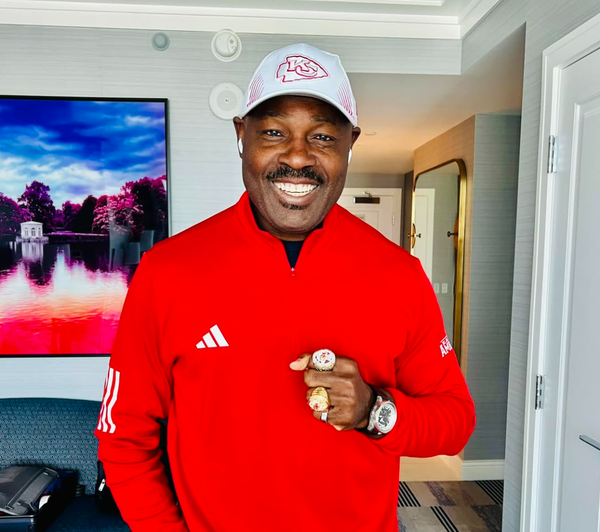
@christianokoye35/Instagram
Looking back, his concerns are not difficult to understand. During his prime years with the Chiefs, Okoye ran through defenders with unmatched power. However, injuries soon began to take their toll.
One of the first setbacks arrived in 1988 when a thumb injury kept resurfacing throughout the season. Because of it, he missed seven games and finished the year with fewer than 500 rushing yards. Even though he later bounced back, the injury marked the beginning of a difficult stretch physically. Soon after that, knee trouble became the biggest obstacle.
The issue began bothering him during the 1990 season and never fully went away. Even though he still managed a 1,000-yard campaign in 1991, the constant pain pushed him into a limited goal-line role by 1992. The situation became so severe that he underwent arthroscopic procedures on both knees before the 1993 season, which ultimately led to his release from the Chiefs with an injury settlement.
During his Chiefs tenure, he also dealt with a herniated disk in his back that required minor surgery during the summer of 1994 as he attempted to return to football.
On top of that, the constant hits absorbed by his neck and shoulders during his career made everyday movement more difficult than it once had been. By the final year of his career in 1992, the effects of those injuries were becoming impossible to ignore. Okoye started only five games that season, and the Chiefs often limited how much he played in order to protect what remained of his health.
Today, fans still remember the dominance he once showed in Kansas City.
Christian Okoye was still hopeful of making a comeback after being released
Back then, shoplifting was a constant worry for store owners across the country. But that wasn’t really the case for Christian Okoye. He opened his sports apparel shop in Azusa, near the San Gabriel Mountains, and had a built-in form of security. The former Chiefs star stood 6-foot-1 and weighed around 260 pounds, and he liked to joke that the photo of him at the front of the store was enough to scare off anyone with bad intentions.
Known across the NFL as the ‘Nigerian Nightmare,’ Okoye had already carved out a powerful career before injuries slowed things down. After surgeries on both knees and his back, he stepped away from the field but never lost the drive to return. During that stretch, he spent mornings training at Azusa Pacific University and afternoons running the shop, surrounded by jerseys, photos, and reminders of his playing days. His story had always been unique.
Born in Enugu, Nigeria, he didn’t even see a football until arriving in Azusa in 1982 on a track scholarship. Coaches once had to place a big arrow on the field just to show him which direction to run. Yet he learned quickly, piling up thousands of rushing yards in college before the Chiefs drafted him in 1987. What followed was a bruising run through the NFL that produced nearly 5,000 rushing yards and a reputation as one of the league’s most feared runners.
Even while running his store and waiting for another opportunity, Okoye made it clear he still missed the game and hoped the phone might ring again. But it never did. Nevertheless, Christian Okoye still carries real credibility among the Chiefdom.
The former running back played for the Kansas City Chiefs from 1987 through 1992 and built a reputation as one of the league’s most punishing runners. Over those seasons, he collected two Pro Bowl selections and reached first-team All-Pro status in 1989 and second-team All-Pro in 1991, while also establishing himself as a key piece of the Chiefs’ offense.
Related Newsletters