
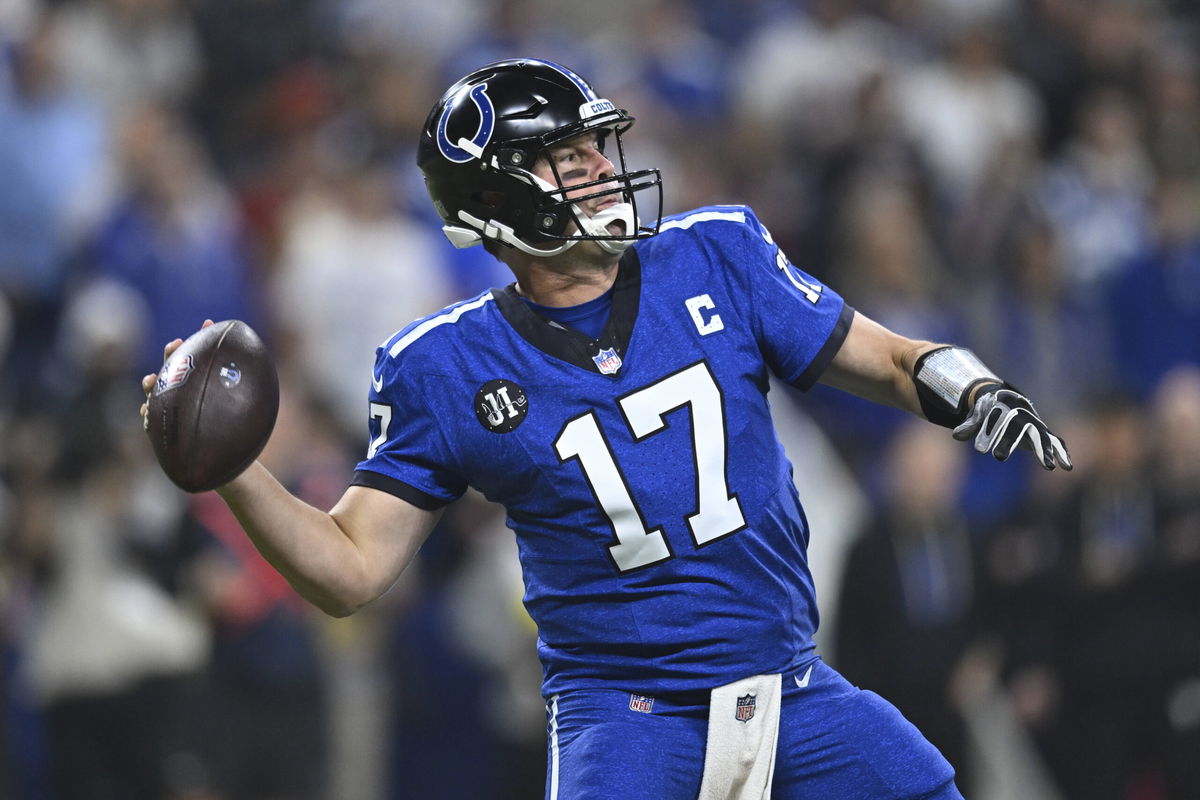
For a team that was seemingly open to listening to offers for its players, the Indianapolis Colts had drawn a rather firm line when it came to Daniel Jones. The quarterback hadn’t quite delivered the performances the franchise had hoped for when it handed him a $88M contract, and the growing frustration surrounding his situation suggested that the partnership wasn’t working out as either side had envisioned. Yet, despite interest from multiple teams ahead of the trade deadline, Indianapolis chose to hold on to its starting quarterback.
That decision was particularly puzzling given the interest from Baltimore and Minnesota. The Ravens, dealing with injuries to Lamar Jackson and Tyler Huntley, reportedly checked on Jones before eventually acquiring Jacoby Brissett, while the Vikings were also linked to the Colts quarterback. According to The Ringer’s Tom Pelissero, Indianapolis had listened to calls but never intended to trade Jones before the November 10 deadline.
Given his struggles and the financial implications of retaining him, moving him could at least have brought the Colts something in return. Instead, Jones remained in Indianapolis and started against the Houston Texans. That stance lasted just 10 days beyond the deadline.
“BREAKING: The #Colts have released QB Daniel Jones. He signed a 2-year, $88M contract in the offseason. Now he’s gone,” NFL insider Ari Meirov shared on X.
By the time Thursday night in Houston was over, the football side of the equation had stopped being ambiguous. The Colts were 3-8 and had lost six of their last seven. Three of those losses came in the AFC South, including one to a Tennessee team that hadn’t won a game until it beat them. General manager Chris Ballard was dismissed after that Week 6 loss, and the Jaguars and Texans then beat Indianapolis by a combined 58 points in Weeks 8 and 11.
But there was the roster situation to consider, and the fact that the situation had become increasingly difficult for Jones even before his release.
A Quarterback Watching the Roster Disappear
Jones had come to Indianapolis to win, and he did early on, going 8-2 over his first ten starts in 2025 and earning the extension that followed. So it couldn’t have been easy to watch the Colts spend the days before the November 10 deadline selling off four starters for future picks. Quenton Nelson went to Seattle, Keenan Allen and DeForest Buckner to San Francisco, and Josh Downs to Kansas City. The day after the deadline, Jones didn’t dress up how he felt.
“You’re not happy to see it, right?” he told reporters. “You’re a player, and you’re going out there competing and doing everything you can to win games.” He added that it was out of the players’ control and that the job was to stay ready, but the frustration was hard to miss.
It also didn’t line up with what the organization was saying. When owner Carlie Irsay-Gordon fired general manager Chris Ballard on October 19, she insisted the move didn’t change the team’s goals and that she expected the Colts to “compete, improve, and win football games.” Her quarterback was then asked to do exactly that while throwing to Anthony Gould, Ashton Dulin, Deion Burks, and Laquon Treadwell.
Jonathan Taylor survived the sale, with the Colts reportedly demanding a blockbuster offer before they’d even consider moving him, but Jones was the one left to steer an offense without any supporting cast.
That would be hard on any quarterback, and Jones wasn’t helping himself. His own performances weren’t giving the franchise much reason to continue building around him.
The Numbers Tell Why
Indianapolis had gone from an 8-2 start in his first 10 appearances in 2025 to a 3-8 record in his 11 starts and threw seven touchdowns against a league-high 13 interceptions.
His numbers reflected that decline. Jones finished his Colts stint with seven touchdown passes against 13 interceptions, the latter being the most in the league at the time of his release. His 65.4 passer rating was also the lowest among NFL quarterbacks, and Thursday’s outing against Houston only added to the concerns. His 65.4 passer rating was the worst in the NFL, and so were his 5.6 yards per attempt. His completion rate of 58.4% ranked 28th among 31 qualified quarterbacks, and his EPA per dropback of -0.23 was 30th. Thursday made it six straight games with an interception, the longest such streak by a Colts player since Curtis Painter’s stint filling in for Peyton Manning in 2011. According to CBS Sports Research, Jones is also the first quarterback since Jim Hart in 1979 to start each of his team’s first 11 games without once throwing more touchdowns than interceptions.
There’s a contract-year pattern in his career, too. In 2022 with the Giants and 2025 with the Colts, the seasons that came right before he got paid, Jones went 17-11-1 with a 96.0 passer rating. Everywhere else, he’s 18-46 with a 79.3 rating. He has earned $166.9 million in his eight NFL seasons, and 2026 was never a contract year.
The damage also showed up in the run game. Defenses haven’t respected Jones’s arm, and the Colts have seen the eighth-lowest rate of light boxes in the league on run plays, according to Next Gen Stats. Taylor managed just 21 yards on 11 carries in Week 11, his 18th straight game without a 100-yard performance, the longest drought of his seven-year career. The offense as a whole is averaging 19.2 points per game, seventh-lowest in the league.
Shane Steichen Explains Why the Colts Moved On
Shane Steichen was careful in how he framed the move. Jones didn’t ask to be released, he said, and waiving him rather than simply benching him was “made for the best interests of both parties.” The coach didn’t pin the failure on one person:
“Obviously, the quarterback takes a lot of the blame. That’s the business that we’re in. But things just didn’t work out.” He also didn’t hold back on the personal side, pointing to a quarterback who played through a broken leg for three or four games last season, tore his Achilles, and returned in eight and a half months to take every snap of training camp.
It was a gracious send-off, but it doesn’t change what the tape showed. Jones came back from the injury and never got close to the player he was in 2025.
Richardson Gets His Chance
That leaves the job to Anthony Richardson, who will start against the Giants in Week 12, his first start since Week 16 of the 2024 season. His situation is an unusual one. He asked for a trade this offseason after the team prioritized Jones over his development, and got permission to look for one, but nothing materialized. He attempted just two passes in 2025 after a freak pregame eye injury in Week 6. Through all of it, he has earned praise for how he handled the demotion.
His 2024 season was a strange one. He led the NFL in yards per completion at 14.4 while finishing last in completion percentage at 47.7%, a combination only three other players had managed since the 1970 merger. That ceiling is the appeal now.
Steichen pointed to the maturity Richardson has shown in his preparation and the benefit of a full week of practice as the starter, and said his athleticism gives the offense “a unique skillset.” A deep-ball threat who can run is also what a defense stacking the box against Taylor has to think about.
Riley Leonard, the third-stringer who started last year’s season finale, could also see time. Steichen said “there’s a world” in which that happens and that the staff will evaluate it weekly.
What the Release Costs
Cutting Jones is expensive, and the cap math isn’t tidy. If he clears waivers, the Colts take on a $14.9 million dead-cap charge this year and $35.2 million in 2027, which comes from his $44 million signing bonus being spread across the length of the deal, void years included. In total, Indianapolis will have paid roughly $50 million for 11 starts. Of the $88 million, $49.49 million was fully guaranteed, and the deal could reach $100 million with incentives. Releasing him now does save the team $11.6 million in 2027, since he was due a $46.8 million cap hit next season.
The decision not to trade him looks worse in hindsight. The Ravens and Vikings were both looking for quarterback help before the deadline. Baltimore settled on Brissett, and Minnesota landed Kirk Cousins from the Raiders. The Colts could have gotten something back. Instead, they got a $35.2 million cap charge, and nothing else for it.
Where Jones Could Land
He won’t be out of work long. Teams will claim or sign quarterbacks with 93 career starts, and CBS Sports identified three that stand out for the rest of 2026:
- New England (5-5): Drake Maye reportedly fractured his fibula in Week 10, and the alternative is Tommy DeVito, who has eight career starts. Josh McDaniels is the offensive coordinator, and Jones spent his Giants years playing for another former Patriots assistant in Brian Daboll.
- Baltimore (4-6): Lamar Jackson is on injured reserve with a broken and dislocated right thumb, and Brissett has the league’s lowest rate of explosive passes per dropback at 5%. Jones is four years younger than the 33-year-old and more willing to throw downfield.
- Philadelphia (2-7): With Jalen Hurts out for the season with blood clots and a seven-game losing streak, Jones’s experience would be a clear step up over Tanner McKee (5 starts) and Joe Milton (1 start).
For a player who arrived in Indianapolis as the stabilizing option, Jones leaves it as the reason the Colts felt they had to start over. But now, with Richardson, Indianapolis has six games to find some answers on offense. The team is averaging just 19.2 points per game, the seventh-lowest mark in the league, and changing quarterbacks alone won’t resolve all its problems. As Steichen put it, “We’ve got to get that thing back on track in a hurry.”