
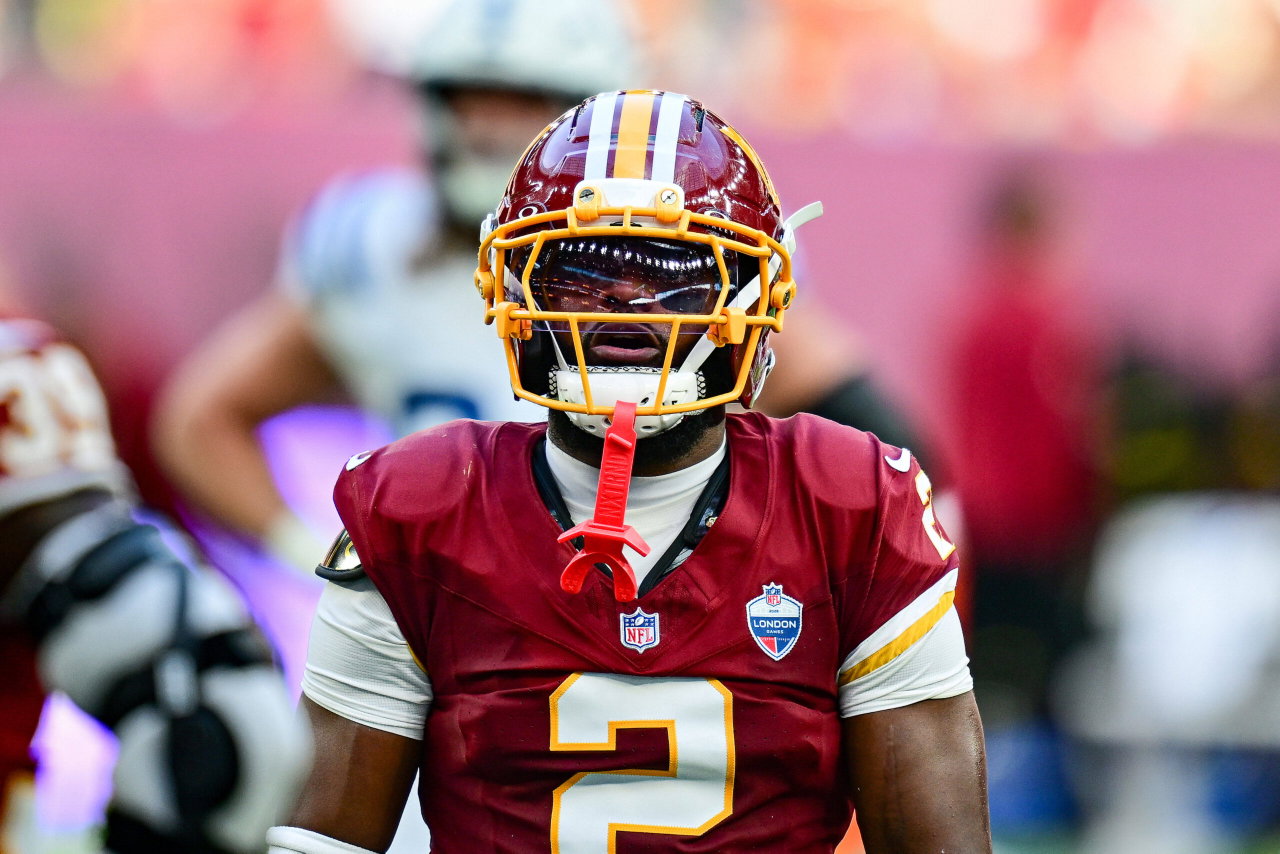
Washington Commanders cornerback Amik Robertson had reason to leave Sunday’s game against the New York Giants frustrated after a pivotal moment changed the course of the contest. Washington was trying to protect its lead when a defensive play that appeared to deliver a turnover instead gave New York another chance to score. The game eventually ended in a 27-27 overtime tie on October 11.
Watch What’s Trending Now!
Giants quarterback Jameis Winston’s throw toward the goal line looked like a chance for Washington to take the ball away. Robertson grabbed the interception and returned it 25 yards, only for a defensive pass interference flag to wipe out the play. The Giants kept possession, turning what could have been a big defensive stop into another scoring opportunity.
“I just can’t shake it…this shi unreal, bro. We need better Z’s,” Robertson wrote on his Instagram story.
The penalty had an immediate consequence. Three plays after the flag, Winston connected with tight end Isaiah Likely for a three-yard touchdown, cutting Washington’s lead to 19-13. Instead of gaining possession after Robertson’s interception, the Commanders had to defend another scoring drive.
The penalty was debated by viewers, but the available reporting does not establish that the officials made an incorrect call. The flag proved costly for Washington. Robertson’s interception was wiped out, and the Giants turned the possession into a touchdown. What could have been a key defensive stop instead gave New York a chance to cut into the Commanders’ lead.
Washington later went up 27-13 but couldn’t hold on. The Giants scored twice in the fourth quarter to force overtime, turning a two-touchdown deficit into a tie. The 27-27 finish left Washington at 1-3-1 and New York at 3-1-1.
The Commanders had another chance to win in overtime after Giants running back Cam Skattebo fumbled, and Washington recovered. Jayden Daniels moved the offense into position for a potential field goal, but with no timeouts remaining, he was stopped for no gain, and Washington failed to get lined up for another snap before the clock expired. The game ended without a score in overtime.
Daniels acknowledged the team’s late-game mistakes after the tie, saying Washington needed to improve its situational awareness.
“We all gotta be better situationally,” Daniels said. “Starts with me. Everybody will say the same thing, but we just gotta be better at situational football. . . . We gotta stop the clock, we gotta know the situation. We gotta relay that as an offense, it starts from everybody top down. Ultimately, it’s on me”
Head coach Dan Quinn acknowledged that Washington’s overtime clock-management mistake put Daniels in a difficult position and cost the team a chance to attempt a potential game-winning field goal.
“The sequencing of that does not fall on (Daniels),” Quinn said. “It’s an outside throw or a clock those are the two (options). Out-of-bounds throw or a clock, that has to come from me. I don’t have to put him in that spot. I can do that earlier. We can finish with a kick. We don’t need to gain more yards.”
While Daniels took responsibility for Washington’s overtime mistake, Robertson’s frustration followed a separate incident that had already cost him financially the previous week.
Amik Robertson’s Previous Fine Came After the Colts Game
Robertson was fined $11,941 following Washington’s 30-13 loss to the Indianapolis Colts in London on October 4. The NFL classified the incident as unnecessary roughness involving a facemask. After a third-down completion to Colts wide receiver Josh Downs, Robertson shoved tight end Tyler Warren after the whistle, extending Indianapolis’ drive. Jonathan Taylor scored a five-yard touchdown three plays later.
Robertson had voiced concern about the financial consequences after that game. According to reporting by Martenzie Johnson, he said:
“I don’t want to be fined.”
The Colts game also featured a significant difference in the teams’ penalty totals. Washington was penalized 10 times for 84 yards, while Indianapolis was flagged once for five yards. Those figures contributed to postgame discussion about the officiating, but they do not prove that the officials favored either team. Robertson’s fine was tied to his conduct during the Colts game, rather than simply to the number of penalties called.
With a fine already behind Robertson, his latest message has put the spotlight back on him, but whether the NFL has anything more to say remains an open question.