
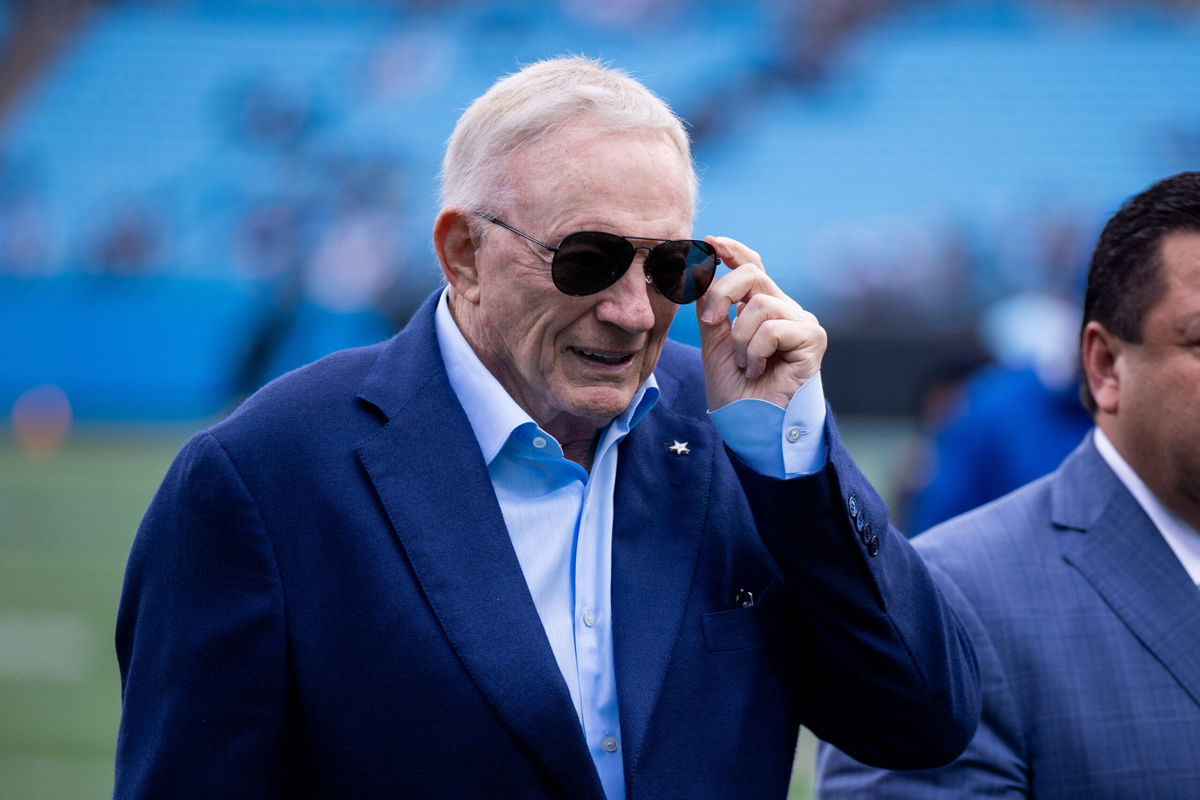
There are two sides to Jerry Jones. He has a long history of giving controversial Cowboys players considerable backing rather than punishing them. On the other hand, he has also once made history by imposing the largest fine ever imposed on an NFL coach. That history made the Saints joint practice an interesting test.
Watch What’s Trending Now!
Dallas had already had productive work against the Rams earlier in camp, and the expectation was more of the same in Oxnard. Instead, a wrestling-style takedown, a thrown helmet, and repeated fights made the Cowboys and Saints coaches even discuss whether to end it early. This time, Jones didn’t leave the discipline entirely to the league. The NFL fined both organizations $500,000 over the brawls, and Jones said the Cowboys would also impose internal fines on the players they deemed responsible. Former NFL star Shannon Sharpe, however, saw a problem with that approach.
“’Jerry Jones said the Cowboys will internally fine players they deem responsible for the $500,000 organizational fine handed down by the NFL,'” Shannon Sharpe stated on the recent Nightcap episode. “That’s not what the NFL intended that to do when they fined a team; then you try to go back there like, ‘Well, you started it, you started it!’”
Sharpe’s objection becomes clearer when the NFL’s reasoning for the $500,000 penalty is taken into account. The league did not fine individual Cowboys and Saints players $500,000 each. It fined the two organizations because clubs had already been reminded before training camp that they were responsible for preventing unsportsmanlike behavior at joint practices that could result in injuries. Jones himself acknowledged that distinction while explaining why he understood the league’s decision.
“It starts with everybody at all levels of a club,” he said, adding that the size of the punishment “really emphasizes the league’s intent to control it from the very top.” At the same time, Jones said Dallas would appeal the $500,000 fine and separately fine the players involved, with the team deciding how those individual fines would be handled. That is the gap Sharpe is attacking.
His argument is not that the Cowboys should simply let the players off. It is that the NFL chose an organizational penalty because it wanted the club’s leadership to bear responsibility for failing to keep the practice under control. If Dallas subsequently makes the players responsible for the financial consequences, Sharpe believes the punishment is being redirected from the organization to the roster.
The NFL, however, has not publicly said Jones is prohibited from separately disciplining his players, so the issue is about the purpose of the fine rather than whether Dallas is legally allowed to impose additional discipline.
Chad Johnson took the opposite view on Nightcap, arguing that players need to feel consequences personally. For an owner, a $500,000 league penalty can be absorbed as a business expense; for a player, a separate fine can hit much closer to home. Furthermore, the practice itself gives Jones a stronger case for wanting individual consequences.
This was not one isolated shove after a whistle. Players from both teams repeatedly left their areas to join altercations, a helmet was thrown, and one Cowboys player was slammed to the ground. Cowboys linebacker Donovan Ezeiruaku was ejected after throwing a punch, and it was his second ejection of training camp. There was also a detail that made one of the most replayed incidents particularly unusual.
Saints wide receiver Brock Rechsteiner, the son of WWE Hall of Famer Scott Steiner, took Cowboys safety Jalen Thompson down in a wrestling-style move during one of the altercations. That moment became one of the clearest examples of how far the practice had moved beyond the controlled physicality coaches wanted from a joint session. Jones’ own explanation for punishing the players was blunt:
“I think that you have to have consequences, and that needs to register.” He said people who are not sensitive to the consequences of their behavior can find themselves “brought to your knees pretty quick.” In his view, the internal fines are therefore not an attempt to replace the NFL’s punishment but an additional consequence for the individuals the Cowboys believe contributed to the fights. That distinction also matters historically.
The $500,000 penalty is significant for Dallas because it is an organizational fine against the Cowboys themselves, not a personal fine against Jones or a routine player penalty. It is also not the largest organizational fine the NFL has ever issued: the league fined the Saints $500,000 in 2012 as part of the bounty scandal, alongside suspensions and draft-pick penalties. The Cowboys’ current punishment is therefore notable specifically because of its size and the league’s decision to use it to hold both clubs accountable for joint-practice conduct.
For Dallas, the immediate consequence is that the $500,000 appeal and the player fines will now exist side by side.
The Dallas Cowboys are set to face the Arizona Cardinals in Glendale on Saturday, August 22, before returning to Texas for the final stages of training camp. The Saints practice may be over, but its fallout will continue with the NFL fine on appeal and internal player discipline still to be determined.