
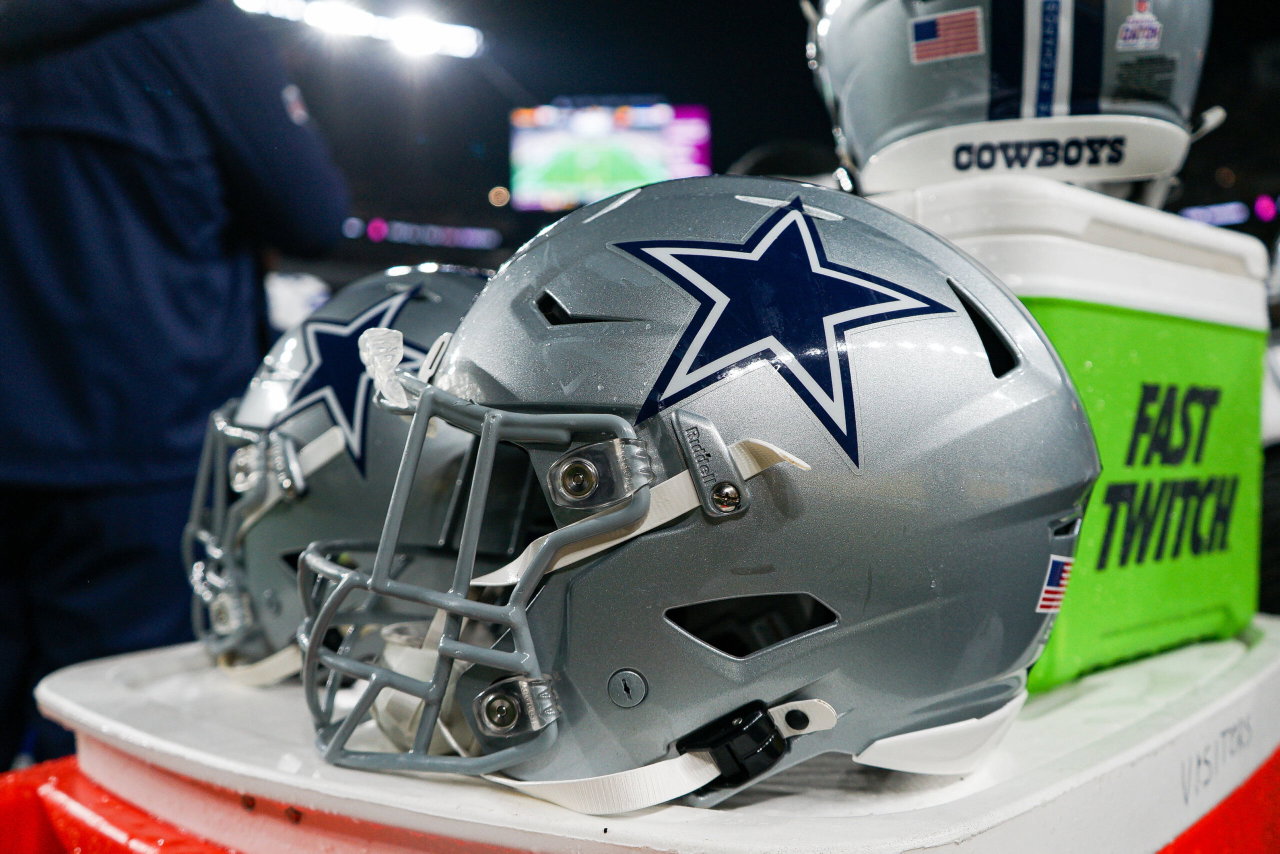
Dallas Judge Martin Hoffman made his ruling. The NCAA, SEC, and SEC commissioner Greg Sankey cannot prevent professional players from returning to play for their final year of eligibility. And while over forty players rejoiced at learning the door to return to college had been cracked open, NFL teams are paying the price.
Watch What’s Trending Now!
In the case of the Dallas Cowboys, it looks like the team is about to lose a rookie they had brought in for a massive bargain. We’re talking about WR Jordan Hudson. And while he might be looking at a collegiate return as the best option, it’s a decision that may come back to bite him.
“Dallas Cowboys rookie WR Jordan Hudson was among over a dozen players granted a TRO against the NCAA & SEC on Thursday in a Dallas courtroom to allow them to enter the transfer portal and return to college football,” Nick Harris of the Star-Telegram wrote on X. “Hudson will still play in the team’s final preseason game on Friday night.”
Now, Hudson played for SMU in the last three years of college eligibility, managing to reach a career high of 766 yards and Third-team All-ACC in his senior year. But despite that, he went undrafted. That’s when the Cowboys picked him up for a bargain on a three-year, $3 million deal with just $105,000 guaranteed.
That’s where a return to college play seems the most enticing. Having trained with an NFL team and coming off his best year in college, Hudson could boost his stock for 2027. Add to that the prospect of NIL deals and a college contract that pays much higher than his rookie deal and the pot becomes even sweeter for Hudson.
Hudson is at a crossroads. The Cowboys were clearly impressed with the receiver in training camp. Hudson was even hyped by Bleacher Report’s Gary Davenport, who identified what he brought to the table.
“Despite a lack of elite size or speed, Hudson is a physical wideout who holds his own in contested-catch situations. He also possesses plus hands. But like so many wide receivers entering the NFL, he needs to improve his route tree, and he can struggle to separate due to a lack of explosiveness and high-end speed. Hudson is going to be something of a project, but there are tools to work with.
But a roster spot isn’t guaranteed. Hudson is competing with another UDFA, Camden Brown, who has had a better time in camp. The Dallas receiver room already has big names, so both will have to fight a spot on the roster. And that’s what brings us to Hudson’s biggest problem.
On one hand, it’s the prospect of playing in the NFL against a chance to perform in college for better pay and a shot at a bigger team. On paper, it looks like an easy choice. But there’s an important caveat to it all.
Judge Hoffman’s decision is only a temporary ruling. Even if Hudson decides to go back to college, the ruling that has enabled him at the moment may not stick. After all, Power Four conferences imposed new rules disallowing ‘professional’ players who have been linked to the NFL through the Draft, training camp, or being signed and waived by a team to return to college football. A temporary order will not end the blanket ban permanently.
That’s why his performance in the final preseason game will be crucial. Hudson will still feature in the final exhibition game against the New Orleans Saints on August 28 to attempt to make the final 53-man cut. To keep his options open for a career in the NFL, the best shot for Hudson might just be to make the cut by the end of this weeked, rather than return to college.
How a Late NCAA Ruling Led to This Legal Drama
These strict rules imposed by the conferences this week didn’t come out of nowhere. It all started when the NCAA drafted the new eligibility rules in June. Instead of four years of playing eligibility in five years of college, they introduced a “Five for Five” rule, granting five seasons of eligibility in five years.
But the High School class of 2022 felt they were barred from the chance to earn a fifth-year option. Former Ole Miss tight end Dae’Quan Wright was among the first set of players to file a lawsuit against the NCAA in a Louisiana court.
Fortunately for them, the Louisiana judge issued a temporary restraining order, allowing them to return for a fifth year of college sport. Among other players involved were Seattle Seahawks running back Anthony Hankerson, Arizona Cardinals safety Wydett Williams Jr., and Tampa Bay Buccaneers linebacker Jack Pyburn also received eligibility.
“It’s something that really needs to be addressed because it does open a door that is difficult for NFL teams and colleges alike,” an NFL general manager said on Thursday (via ESPN). “It either has to happen on the college side where they don’t sign these guys, or the NFL makes it punitive for these players on reentry, which I don’t know the legality of. It really ends up being a question of what is legal on both sides.”
Some players have already used their fifth-year option, with Junior Tuihalamaka joining LSU, Trent Hendrick joining UCLA, Ethan Johnson joining South Carolina, and Luke Drzewiecki joining Minnesota.
The NFL has also weighed in on recent college football moves by players. Just this Wednesday, NFL Executive Vice President of Football Operations Troy Vincent reiterated the NFL rules, stating that players who return to college football will not be part of the 2026 NFL season and will be considered free agents for the 2027 season.
It is unclear whether Hudson will play college football, with the NCAA’s stance opposing the court’s rulings. Even if the NCAA has to comply with the rulings, it doesn’t guarantee Hudson or the other players a spot on a team.