
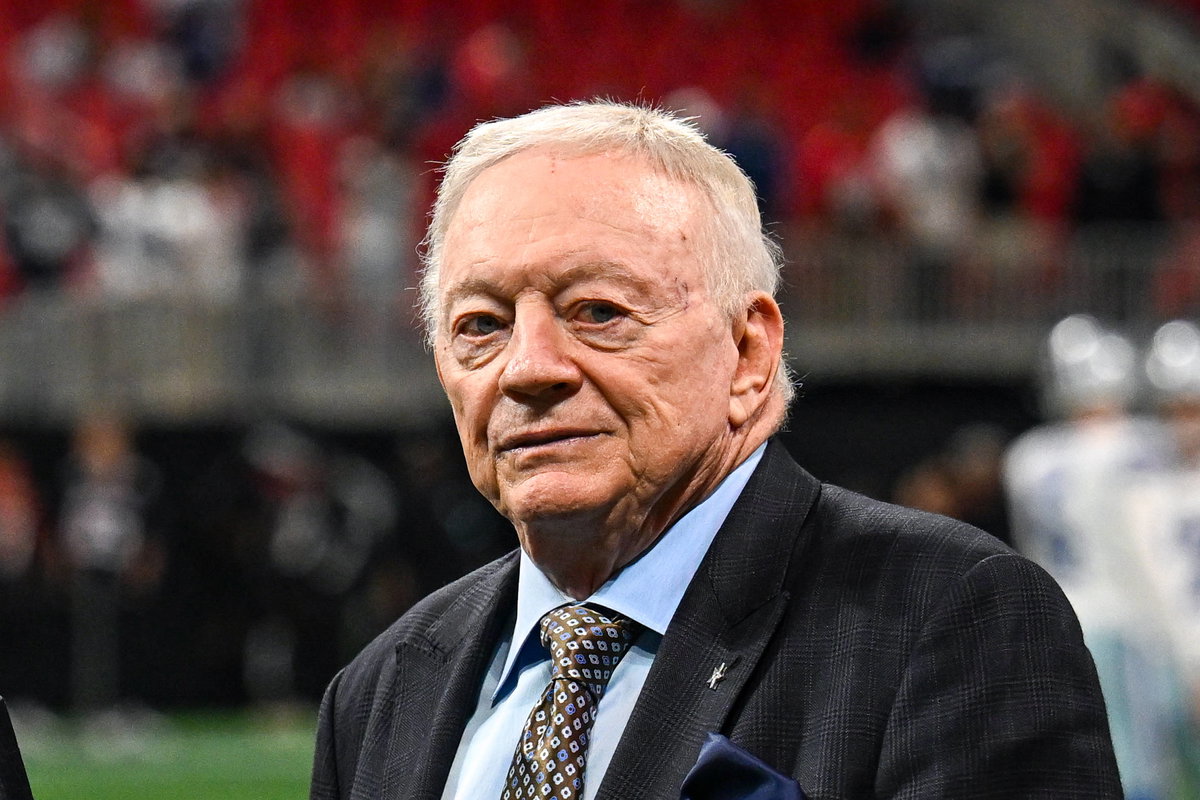
Owners often hire people they like and trust. General managers are supposed to hire the best qualified for the job, even if it means letting a friend go. When the same person makes both calls, loyalty and results can blur. Mark Cuban, the former principal owner and current minority owner of the Dallas Mavericks, offered a view on why owner-GMs like Jerry Jones make different calls.
Watch What’s Trending Now!
“The number one job of a GM is to keep their job. There are only 32 spots in the NFL. An owner has a different perspective,” Cuban wrote in an X post. “They have to consider the short term vs. long term. If you have any sense of how hard it is to win a ring, there will be times when you think you have a chance to win, and you go all in, and take risks you otherwise might not take.
“The age of the owner also matters. Time/Seasons go by faster. That comes with age. So you can accept a rebuild or risk, because 6 months used to be a long time. It no longer is. But then you reach an age, and you start realizing your own mortality. You don’t have unlimited time. It could be now or never. Which impacts your decision-making. This is one of the reasons I love Jerry Jones. You can see how much he loves the Cowboys and how much losing hurts him. It doesn’t mean it always works.”
Jones became the owner and general manager of the Dallas Cowboys in February 1989, purchasing the franchise from H.R. “Bum” Bright for $140 million. Since then, his nearly four-decade tenure in the dual role has been widely viewed as a tale of two extremes.
First came the immediate, historic dynasty success in the 1990s. Jones wasted no time reshaping the organization, firing legendary coach Tom Landry on day one and hiring Jimmy Johnson.
Despite a rough 1-15 season in 1989, aggressive moves like the blockbuster Herschel Walker trade built a powerhouse roster around Troy Aikman, Emmitt Smith, and Michael Irvin. Jones became the first owner in NFL history to win three Super Bowls in his first seven years.
Then came the 30-year championship drought (1996-present). Following a power struggle that led to Jimmy Johnson’s departure in 1994 and one final title under Barry Switzer in January 1996, Jones and the Cowboys have struggled to get past the divisional round.
While the Cowboys have frequently fielded competitive regular-season rosters, including a streak of three straight 12-5 seasons from 2021 to 2023, postseason collapses have fueled persistent criticism that Jones’ hands-on GM style undermines coaching authority.
Cuban was not necessarily criticizing how Jones runs the Cowboys. He was explaining how an owner’s perspective differs from a general manager’s.
As for Jones, he has been unapologetic about serving as both owner and general manager, repeatedly stating that he bought the Cowboys specifically to have final say over football operations.
“No, just no. I bought the team,” Jones said in 2025, per Cowboys beat reporter Clarence Hill Jr. “I think the first thing that came out of my mouth when somebody asked [after that transaction], ‘Did you buy this for your kids?’ I said, ‘Hell no. I bought it for [myself], and I didn’t buy an investment. I bought an occupation, and I bought something that I was going to do for the rest of my life, and that’s what I’m doing.”
For Jones, the question was never whether to separate the two roles. He bought the team so he wouldn’t have to. Until the Cowboys’ results change, or until Jones decides to step back, the structure that critics blame and Cuban understands is not going anywhere.