
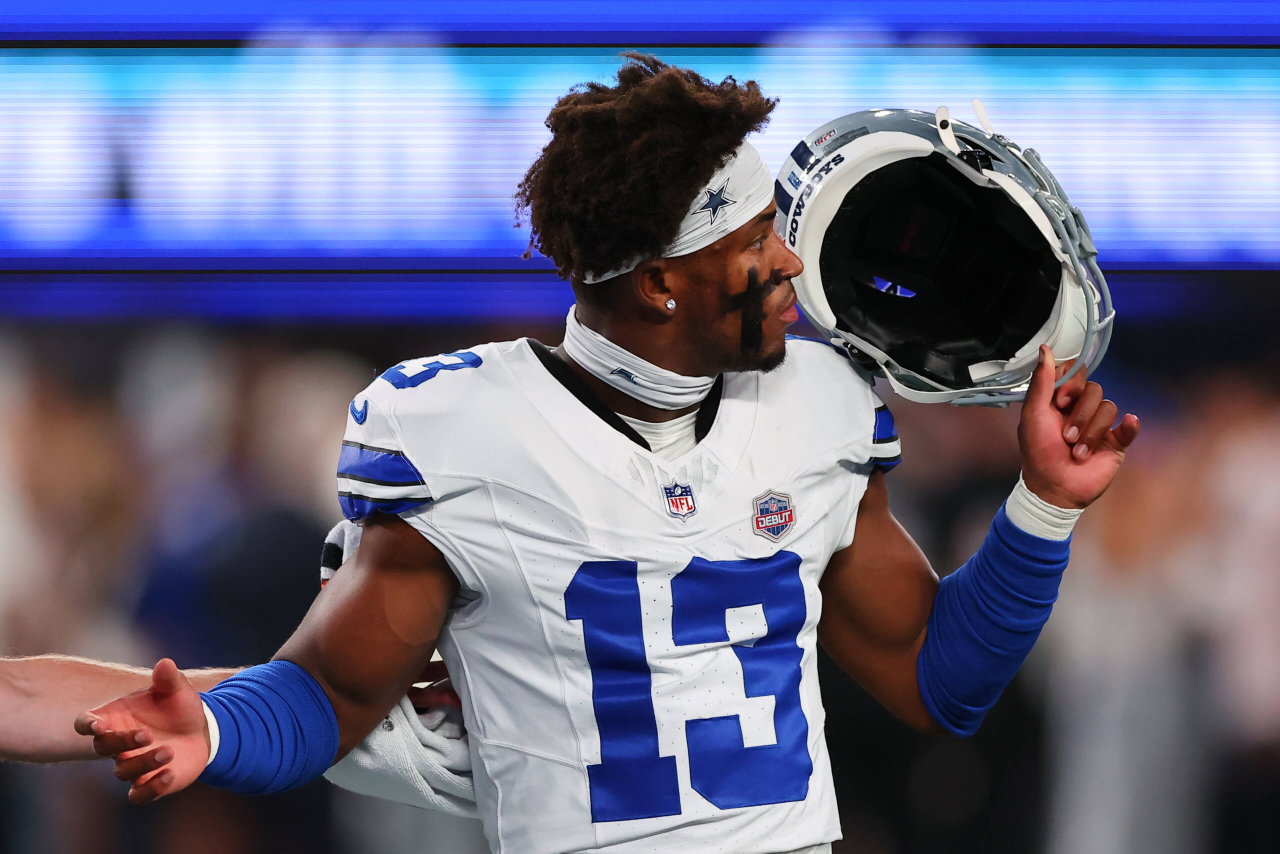
Cowboys rookie safety Caleb Downs didn’t hold back when asked about the field his team played on during last week’s trip to Brazil. On the Downs2Business podcast, the Cowboys’ first-round pick broke down how the Maracanã Stadium turf changed over the game and why he and his teammates had no interest in using it as an excuse.
“It was okay at the beginning of the game,” Downs said on the podcast, which he co-hosts with his brother, Josh Downs. “Honestly, we had prepared that week. A lot of us practiced in seven studs, just making sure we were ready. So even at the end of the game, it was still slipping out there. I’m like, bro, this is terrible. But it was what it was, and you can’t make any excuses about it because they had to play on it.”
Downs wasn’t speaking in isolation. The field had already drawn attention leading into Sunday’s game, with the NFL and NFLPA signing off on the surface after testing it Saturday, and the Cowboys specifically bringing seven-stud cleats as an option for players once on the ground. Downs confirmed after the game that the grass surface genuinely deteriorated as the afternoon went on, describing it elsewhere as feeling like “pretty much just dirt” by the final whistle, a notable shift from how solid it felt early on.
His brother and Colts WR Josh Downs also drew an interesting comparison to a surface closer to home, one he’d clearly encountered before this trip ever happened.
“I will say that the Patriots’ practice facility has similar grass to the overseas stadiums,” Josh said. “It’s just slick grass. I don’t know what it is, but it’s the same type of slick grass on their practice field. People just slip all over the place and stuff.”
The game itself ended in heartbreak for Dallas regardless of the turf. The Cowboys lost 34-31 in the NFL’s first-ever regular-season game in Rio de Janeiro, with Baltimore kicker Tyler Loop drilling a 56-yard field goal as time expired to seal it. The deciding sequence came after Ravens quarterback Lamar Jackson found receiver Zay Flowers on a 27-yard dig route with seven seconds left, a defensive rep Downs was directly involved in alongside fellow defensive backs Caelen Carson, Reddy Steward, and Alijah Clark.
“(Flowers) had a 25-, 26-yard dig and caught the ball,” safety Downs said afterward, when asked to break down the play. “That’s what it is.”
Ravens head coach Jesse Minter gave Baltimore’s side of that same sequence afterward, crediting the tight window his team had to work with.
“Honestly, anything less than seven seconds would have been really hard to do the play that we did,” Minter said. “We may have even just ran the clock out.”
Downs did have a genuine bright spot earlier in the game, too, stuffing Baltimore running back Derrick Henry for no gain on a critical fourth-and-1, a stop that flipped field position and set up a Dallas touchdown on the ensuing drive. It was the kind of impact play that’s quickly become a theme for Downs since Dallas traded up to select him 11th overall out of Ohio State in the 2026 draft, after transferring from Alabama to Ohio State.
Baltimore Ravens radio analyst and Hall of Fame defensive back Rod Woodson praised Downs’ transition to the NFL just days before the Brazil game, calling him “a really good athlete” with instincts that reminded Woodson of his own path from college safety to NFL nickel corner.
Despite the loss, Downs stayed focused on fixable issues rather than the conditions he’d played through.
“I think we did a lot of good things,” Downs said, “but we also have a lot of things to clean up.”
At 1-2 following the defeat, Dallas doesn’t have much room left to treat any game- or turf-related frustrations or otherwise as a throwaway.