
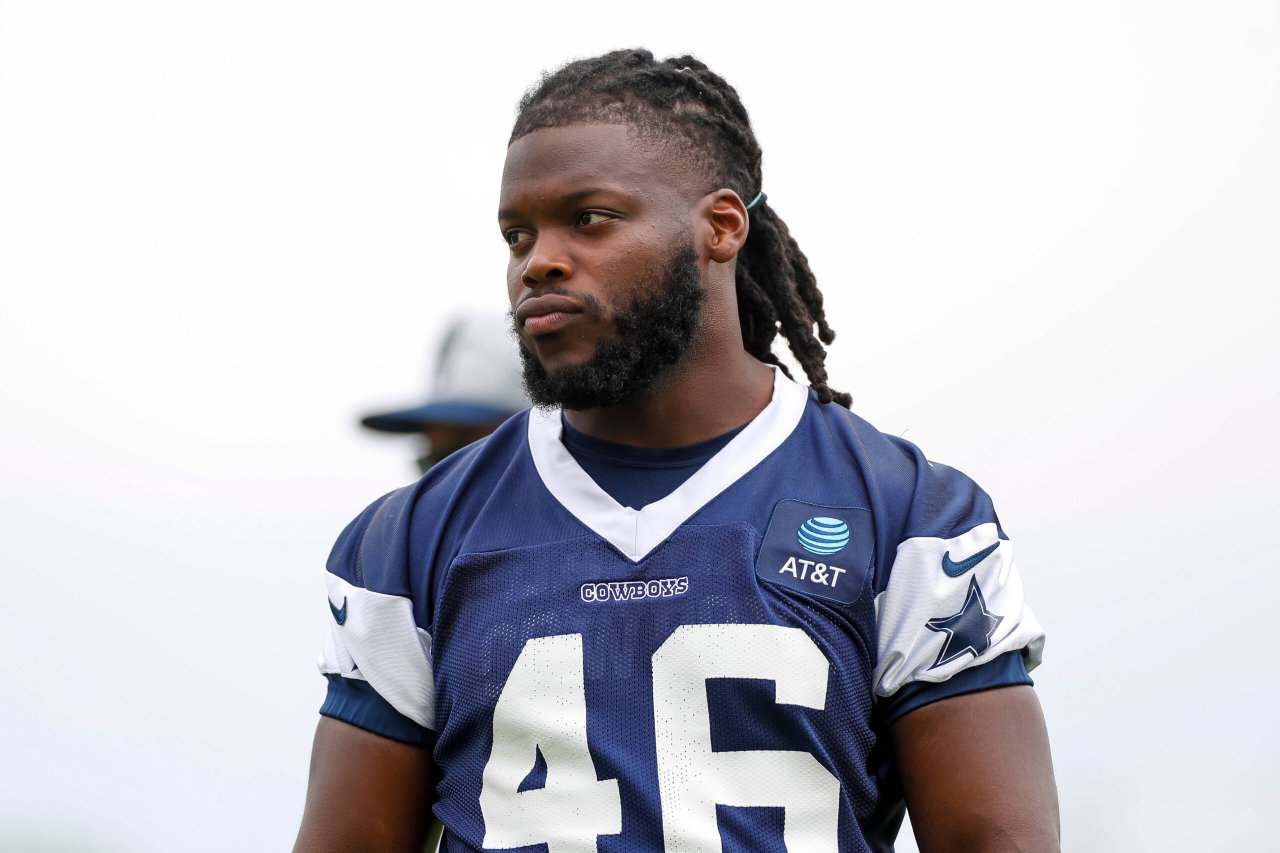
Malik Jefferson was once one of the most celebrated defensive recruits in Texas high school history. This week, the former Dallas Cowboys linebacker and seven-team NFL journeyman announced his retirement from football at 29, revealing a health battle he’d kept hidden for most of his professional career.
Watch What’s Trending Now!
Posting a lengthy tribute, Jefferson explained that a nerve and neck condition, one he didn’t even know he had for years, had quietly shaped the entire second half of his football life.
“For years, I didn’t know I was battling a nerve/neck issue,” Jefferson wrote on Instagram on September 28. “Constantly getting injuries, always in the training room, or doing extra rehab and mobility work. Towards the end of my career, I kept playing through the pain of my arm going numb on impact. I couldn’t handle the pain anymore; it was 10/10. Fast forward, I discovered my C5-C7 has been damaged. Today I still suffer from those injuries and still struggle with my day to day so I’d really appreciate prayers! It’s not said enough: get pictures of your spine and neck consistently players!!”
That damage to his C5-C7 vertebrae, the section of the cervical spine responsible for much of the sensation and movement in the arms, explains years of nagging setbacks that never had a clear diagnosis attached to them until his career was already ending.
Jefferson’s football journey began at Mesquite Poteet High School, where he was rated the No. 1 outside linebacker in the country and won the 2014 Butkus Award as the nation’s top high school linebacker. His decision to choose the Texas Longhorns over rival Texas A&M became a major recruiting moment for Texas, with fans later referring to it as “Malikmas.”
According to On3’s retrospective on the commitment, Jefferson’s decision also helped Texas land other in-state prospects, including future Longhorns defensive backs Kris Boyd and Holton Hill. The outlet also linked that recruiting momentum to later Texas stars such as wide receiver Devin Duvernay and running back Bijan Robinson.
Jefferson delivered on that hype at the college level. He played 33 games across three seasons in Austin, was named a Freshman All-American in 2015, and capped his final season by winning Big 12 Co-Defensive Player of the Year and earning second-team All-American honors in 2017, finishing his Longhorns career with 233 tackles and 12 sacks before declaring early for the draft.
The Cincinnati Bengals selected Jefferson 78th overall in the 2018 NFL Draft, making him the first Texas linebacker taken that high since Jordan Hicks in 2015. Before the draft, NFL Draft analyst Lance Zierlein had already pointed to a concern that would follow Jefferson into his NFL career.
“Jefferson has the desired combination of height, weight, speed that teams covet and draft, but his career production never matched his athletic traits,” Zierlein wrote.
The gap between Jefferson’s potential and production followed him throughout his NFL career. Across parts of seven seasons with the Bengals, Browns, Chargers, Titans, Colts, Cowboys, and Lions, he finished with just 19 total tackles in the league, a strikingly thin stat line for a player once considered one of the most complete linebacker prospects in the country. With this week’s announcement, that gap finally has a medical explanation attached to it.
From Blocking Out the Noise to Putting His Teammates First, Jefferson Stayed True to Himself
Jefferson’s NFL career took him from one roster to another, with a new team coming into the picture almost every year. His final NFL stop was the Detroit Lions, who released him from injured reserve through an injury settlement in August 2024 after he had spent the preseason trying to make the roster.
In his retirement post, Jefferson took the time to thank the teammates and organizations that had been part of his journey, reflecting on the people he met along the way and the role they played in shaping him throughout his career.
That focus on leadership and his teammates was not something new for Jefferson. Back in 2017, during a difficult stretch at Texas, he chose to delete Twitter and Instagram from his phone before a pivotal Red River Showdown week. He explained that getting rid of the outside noise helped him put his attention back on his teammates and what was happening around the team.
“It’s been very quiet, and I actually appreciate that peace,” Jefferson said at the time. “I need to focus on my teammates and what’s going on around here.”
Nearly a decade later, that same instinct shaped how he chose to close the book on his career, spending his final public message not on the stats he never put up, but on the people who stood beside him while he quietly played through pain no one else could see.