
Imago
Credits: IMAGO
Imago
Credits: IMAGO
Imago
Credits: IMAGO
Imago
Credits: IMAGO
Essentials Inside The Story
- Director Ken Rodgers on what made John Elway an exceptional athlete
- Elway director highlights John Elway’s resilience, pressure, and Denver identity
- Rare exclusive access reveals Broncos' legend’s humanity beyond Super Bowls
Denver Broncos legend John Elway is one of the most iconic and celebrated quarterbacks in NFL history, a winner of back-to-back Super Bowls to finish his Hall of Fame career, and one of the best general managers in football once his playing days came to an end.
Watch What’s Trending Now!
Earlier this month, an Elway documentary, aptly named Elway, was released on Netflix, and we here at EssentiallySports had the opportunity to speak with director Ken Rodgers about making the film.
Q.: I finished watching the screeners Netflix sent ahead of this interview, and I was quite impressed with what you put together.
Ken Rodgers: “It’s a story that not a lot of people remember. If you’re under don’t 30, remember watching John Elway play football, which, you know, as someone in their 50s, that always strikes me as a little odd. To not have seen John Elway play football, let alone the beginning of his career, which is now coming up on, what is it? 45 years ago when he started playing football, that’s, time moves on. And I think there’s a whole another generation that will appreciate this film who didn’t watch John play?”
Q.: I learned a great deal about Elway by watching this documentary. There’s a lot there I didn’t know.


Rodgers: “And it’s really easy to forget that hard road that he took. And in many ways, that is the story is the hard road. It’s not the last two Super Bowls, which by themselves would be an incredible story. No one has an exit from the National Football League as positively dramatic as John Elway. Hall of Famer, excuse me, won two straight Super Bowls as a quarterback and then walked away at the perfect time. I mean, it’s an incredible ending and has, I think, overshadowed the beginning and middle of his careers. I don’t think there’s many football fans who would be able to tell you about those three Super Bowls he lost. I didn’t know these. I didn’t know.”
Q.: While watching it, I didn’t realize he had gone to the Super Bowl that many times, and it kind of traumatized him, right? And his family. Like, what was that quote from his mom, saying something like, ‘Oh, do we have to go back to the Super Bowl?’
Rodgers: “I guess until you have to look this up, but I think until Tom Brady, he had the most Super Bowl appearances by a quarterback. Yeah, I guess that’s right. [Joe] Montana only went to four. [Terry] Bradshaw only went to four. So he was, when you looked up quarterback in the dictionary, the definition of an incredible quarterback. He was, when he retired, pretty much the most successful quarterback in history in many ways. Of course, that’s a debate you can have forever, and just as he goes out, Tom Brady comes into the league. And I think the Brady-Manning era now, you know, has gone on to [Patrick] Mahomes and Josh Allen, people sort of forget that when he ended, no one had come close to the overall career that he was able to put together.”
Q.: So what drew you to the idea of directing this documentary?
Rodgers: “I think I’m fascinated by the representation of a certain ideal that John has, that frontiersman attitude, that hard road that he talks about in the film of taking. That uniquely fits Colorado and the Denver area. That road isn’t the road that is taken in San Francisco or Miami Beach, where Dan Marino and Joe Montana were. That hard scrabble frontier attitude is Denver. And I was really fascinated to show how a town and a man came to redefine each other. I think in many ways, outside of Colorado, John Elway is the first person you would think of when you think of the state.”
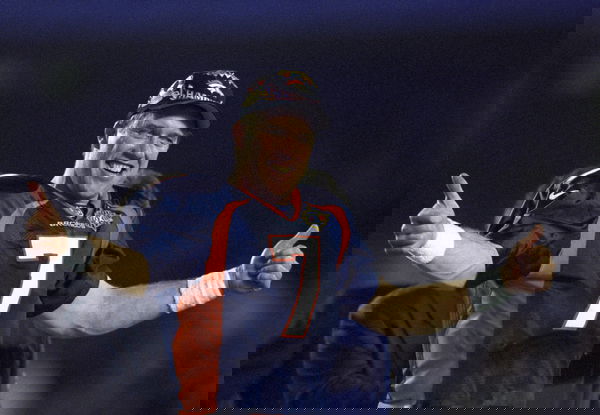
Imago
SUPER BOWL XXXII Jan 25, 1998 San Diego, CA, USA FILE PHOTO Denver Broncos quarterback John Elway 7 celebrates the victory over the Green Bay Packers in Super Bowl XXXII at Qualcomm Stadium. The Broncos defeated the Packers 31-24. San Diego California UNITED STATES, EDITORIAL USE ONLY PUBLICATIONxINxGERxSUIxAUTxONLY Copyright: xUSAxTODAYxSportsx 5099648
“In the other 49 states, if you asked to name someone from Colorado, or name someone, John Elway would probably win that contest of the person named most. Yet, they don’t know a lot about the story. And that’s sort of, I think, Denver. It’s kind of an isolated town when it comes to big cities. Even in the NFL, it’s pretty far away from any other NFL city compared to here on the East Coast.”
“I’m outside of Philadelphia, and we have the [New York] Jets, we have the [New York] Giants, we have Washington, we have Baltimore, we have Pittsburgh right across the state. We’re surrounded by other cities and other NFL teams and NFL players. John was on this island and represented that island perfectly. I’m not sure anyone else would have fit the Denver Broncos as well as John did.”
Q.: How much access did you have to Elway himself, his family, and teammates? You got plenty of interviews from what I saw.
Rodgers: “He’s pretty competitive, right? So when he realized that the access and the honesty and the openness is what would make this film successful, he was all in, allowing us to follow him, the Coeur d’Alene, Idaho, and his really private vacation home and where his family gets away from the world really spoke to his desire to open up his life, show who he was after a lifetime of you gotta remember he was a big deal at age 12.”
“He was John Elway as a teenager, which was the greatest high school prospect in history. Then goes to Stanford and is the biggest deal in college football and comes out as the number one pick. He’s always been a very public figure. Named John Elway, and he allowed us to visit with John, just the guy, John, who’s a father who went through personal times that he’s never spoken about. So the access wasn’t just about time spent, it was about topics covered.”
“He was very open about the tough times that came to his family life due to his commitment to football. And I think it’s something that I’m sure doctors and lawyers and people of all types of professions identify with, of that balance that we all try to find in life, that work-life balance. And the higher profile you are, the more difficult it becomes.”
“One of the most striking scenes to me was footage recaptured of him and, back in the day, of him and his family out at, I don’t know exactly, it’s sort of a Dave and Buster’s type of place, playing video games and having dinner. And there are two fans just sort of hanging out, talking to him. And you can tell John wants to say, we get out of here. Will you leave me alone? I’m having dinner with my family. But he doesn’t, he’s trying to be nice. And I found that very both unsettling and brave on his part to go through that. And not ever become an asshole, as he describes it. It takes just as much energy to be a nice guy as an asshole, so why not be a nice guy? I found that very encouraging.”
Q.: I was going to say, for some reason, Barry Bonds just popped in my head. Barry Bonds would probably handle it differently from John Elway.
Rodgers: “I don’t think a lot of people in the world would handle being someone like John Elway the way John did. I don’t think I could. I think I would vacillate between thinking I didn’t deserve it and being full of myself, and going back and forth, and I’d probably be a mess.”
“It’s really incredible how he dealt with the pressures that he was under. As he says early in the film, which I think is a great line, I never really felt pressure because I was always under pressure. It was always there, so I didn’t really know the difference between pressure and not pressure. Only now, out on his boat on a lake, does he realize, oh, I don’t have that pressure anymore and I can relax. His entire life, since he could remember, had the pressure of winning on his shoulder. And so he didn’t really know that there was another way to be. And that hurt his family, probably hurt his life work balance, but look what it led to on the field.”
Q.: What surprised you most about John Elway as a person? Perhaps even something Broncos fans might not expect.
Rodgers: “I’ll tell you one thing that’s surprised me, and I wish it were in the film. More on his ability as a baseball player. The fact that he could have been an all-time player in Major League Baseball. We looked and looked for footage of the 1978 All-City Championship game from Los Angeles where he his senior year came in as a pitcher and pitched to Darryl Strawberry and who was on the opposing team was on Crenshaw and Darryl took him to the warning track but he got Darryl out and got out of a pinch as a as a as a relief pitcher, and they won the state championship partly because he got Darryl Strawberry out. And that would have been a great story had we found the footage, but we just couldn’t find the footage.”

“I think even just seeing his swing in some of those clips as a Yankee, you say, ‘Whoa, he has that swing of an Aaron Judge, that kind of matches his solid throwing motion as a quarterback, is sort of, he’s both broad and long at the same time. He’s tall. He’s not packed with muscle, but he’s got this length that surely added to his ability as a quarterback. As a hitter in baseball. He was just a physical specimen that you don’t see very often.”
Q.: He was like an athlete made in a lab or something, right?
Rodgers: “You see people like that once in a while, but all around, I mean, he liked basketball the most. He really loved basketball. He probably could have played that professionally. It’s not often that you find, I mean, there are of examples of the Deion Sanders of the world that play both professionally, but I think John Elway, if he wanted to, could have done anything in the world athletically. He probably could have been an Olympic javelin thrower.”
Q.: He really loved football, and his dad wanted him to play football?
Rodgers: “He just carries that, and when you’re around him you realize that it’s not just physical ability, it’s his mental toughness and emotional fortitude. I’m not sure you could ever rattle John Elway in any situation. I can see a bear coming up to him and him saying, hey, and petting the bear, like he is that tough and calm at the same time.”
Q.: How intentional were you about weaving in the perspectives of, like, those close to Elway? Family and friends?
Rodgers: “I think it’s always important to get a fully rounded picture of your subject in a film, especially with someone who, as I said, has always been in the same position.”
“John’s always been under the microscope and always been incredible. So he doesn’t really know any different. He can talk about himself, but it’s hard for him to describe what he means to other people. He still felt odd, even at the film premiere at the Denver Film Festival, watching a movie about himself. I think he would be self-aware of his fame. And he still feels the way he felt when he came into the league, which is he’s a guy who likes to play football. And he became very famous that way, but he couldn’t really comment on what he meant to other people.”
“So his teammates and his family, most notably, have a completely objective look at him that he just doesn’t have. I don’t know that he knows just how much greatness he carries, because he’s always had it. So he doesn’t know the difference between having it and not having it. He never really described himself in glowing fashion, or his performances. To him, it’s just what he did. It’s just what he was called to do. It’s the other people who had a perspective that no one else could do what John Elway was doing.”
Q.: We spoke to Ed McCaffrey the other day, and he went on about John for a while. He really thinks highly of him, which I found interesting, especially after watching the documentary.
Rodgers: “A lot of people use that word, but he, he’s iconic, which to me means, in some way, beyond description. You compare other people to John, not John to other people. You don’t say John Elway was like blah, blah, blah. You say someone is like John Elway. That, to me, is what sets apart iconic figures is that others strive to be compared to them. They’re singular in the sports universe. And John is one of those people.”
Q.: It’s kind of like Michael Jordan, Tom Brady, Kobe Bryant, all those types, right?
Rodgers: “But I think circa 1998, that list would have included John Elway. Hopefully, this film will put him back up there a little bit. Well, I think it helps that the Broncos are killing it, too. It’s great timing for Broncos fans. I mean, it’s gotta be an incredible Christmas time for Broncos fans to have the team playing the way they are. John Elway’s film is finally hitting Netflix on the 22nd (December). They’re gonna be in their glory.”
Q.: With executive producers like Peyton Manning and teams in the NFL films and Omaha productions, how did that collaboration influence the direction of the documentary? How did Manning help you with this?
Rodgers: “Peyton Manning was very important in the trust factor. You know, John Elway had rejected offers for decades to make movies about himself, to make documentaries about himself. It’s not in his nature to open up. The trust factor of someone who has been where he is.”
“As a Super Bowl-winning quarterback, as a Denver quarterback, as an icon, as someone who doesn’t need more attention because they’ve gotten it their entire life. Peyton was able to give assurances to Elway that this was worth it, that people need to hear this.”
“John’s nature is more shy than most, more private than most. And I couldn’t say to him, ‘You should allow us to tell your full story,’ because I don’t know what it’s like to be him. When Peyton Manning knows exactly how you feel, but here’s why you should do it. He knows Peyton’s not lying. He’s been through everything. And so he was very crucial in the beginning stages of earning that trust. And then the more time we spent with John, the more he trusted the team behind it, which included people from many companies.”
“Most films are a collaborative process. If you want to work alone as an artist, you should write poetry or do sculpture. But if you want to make sports documentaries, it takes a lot of people. It takes a lot of people to work on it. And so it really was a complete partnership with a lot of different people, a lot of And most importantly, John, like you really have to have John committed to tell his story and not do a shallow interview.”
Q.: What does John Elway’s story resonate with today? Is there a favorite scene or moment that you got in the doc that resonated with you?
Rodgers: “I think the coolest moment was the Big Bad John montage, where we used that song.”
Q.: Oh, that old country song? Yeah, I never heard that before. Big Bad John.
Rodgers: “John Wayne was just himself. He was just singular. And editing them back and forth, you see that they sort of have the same walk. They have the same talk. They have the same attitude. They have the same masculinity.”
“It was really amazing. I think if they walked in the room together, you’d buy that they were relatives. And that really, that to me sums it up, is there’s a lot of different famous cowboys, but there’s only one John Wayne. Just like quarterbacks. You can argue forever whether Clint Eastwood or Cary Grant or John Wayne are the better actors, just like you can argue who’s the better quarterback. But there’s only one John Wayne that represents what he represents. And the only way to describe it is through his name. It’s just John Wayne. You know it when you see it.”
Q.: That scene in the bathroom, whenever he shoots through the door, and it’s, don’t take it personally or something like that. I was cracking up.
Rodgers: “That is a John Wayne and John Elway attitude. It’s very unique. You know it when you see it. And in many ways, defines American manhood, a certain version of American manhood. It’s very different.”
Related Newsletters