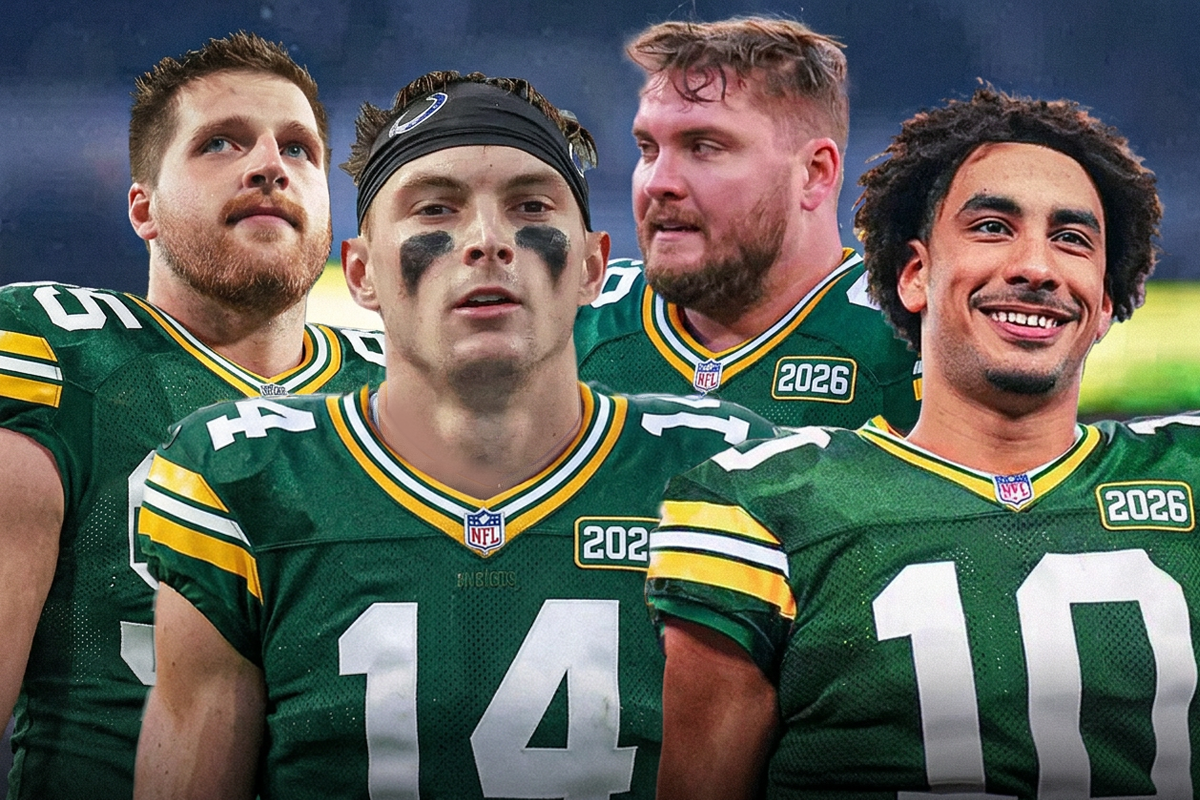
The Green Bay Packers are in purgatory. They’re good enough to sneak into the 7-seed every year, but they’re not good enough to do any damage in the playoffs. That needs to change in 2026 if Matt LaFleur is interested in keeping his job.
Thanks to StickToTheModel’s Be the GM tool, we’re able to create the perfect offseason for every team. We’ve already covered over half of the league, and now it’s time to turn the Packers into Super Bowl contenders with the perfect offseason.
Roster Management

Imago
NFL, American Football Herren, USA Washington Commanders at Green Bay Packers Sep 11, 2025 Green Bay, Wisconsin, USA Green Bay Packers tight end Tucker Kraft 85 looks on after the game against the Washington Commanders at Lambeau Field. Green Bay Lambeau Field Wisconsin USA, EDITORIAL USE ONLY PUBLICATIONxINxGERxSUIxAUTxONLY Copyright: xJeffxHanischx 20250911_lbm_sh5_064
The Packers enter the offseason with negative $4 million in cap space, but they can pretty easily clear north of $70 million with some cuts and restructures.
I started off by making two pretty big cuts at the interior of the offensive line. I let C Elgton Jenkins and OG Aaron Banks go. Both guys have underperformed recently, and they saved me a combined $37.2 million.
After that, it was a series of smaller cuts, which included WR Dontayvion Wicks, DT Karl Brooks, K Brandon McManus, CB Carrington Valentine and RB Pierre Strong. In total, they saved me another $15.8 million, bringing my total to $53 million before any restructures.
In most rebuilds, most of the money comes from restructures, but not with this one. There aren’t too many big contracts to deal with, so by moving money around in DE Rashan Gary, QB Jordan Love, RB Josh Jacobs and S Xavier McKinney’s contracts, I was able to raise another $39.7 million.
Before I entered free agency, though, I had to extended TE Tucker Kraft’s contract. I gave him a four-year deal worth $20.8 million per season, making him the highest-paid TE in the NFL. His extension only cost me $3.1 million in 2026, giving me a grand total of $89.6 million to spend in free agency.
Free Agency
Imago
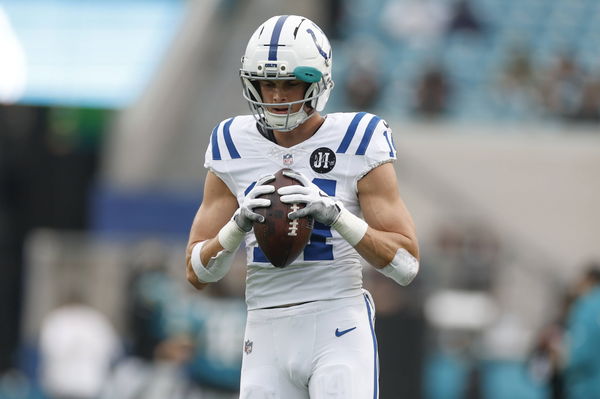
JACKSONVILLE, FL – DECEMBER 07: Indianapolis Colts wide receiver Alec Pierce 14 warms up before the game between the Jacksonville Jaguars and the Indianapolis Colts on December 7, 2025 at EverBank Stadium in Jacksonville, Fl. Photo by David Rosenblum/Icon Sportswire NFL, American Football Herren, USA DEC 07 Colts at Jaguars EDITORIAL USE ONLY Icon251207523916
Before I got to spending big money, I brought back four exclusive rights free agents – CB Kamal Hadden, WR Bo Melton, RT Donovan Jennings and C Lecitus Smith – to provide depth at their respective positions. I also re-signed DE Brenton Cox and OT Darian Kinnard. In total, these contracts cost me just $7.7 million.
Now, with just under $82 million to spend, this is where the fun begins.
First order of business was completely revamping the offensive line. After letting Rasheed Walker walk in FA and cutting my center and left guard, I had to go out and sign three players to replace them.
At tackle, I signed Braden Smith from Indianapolis. He’s a great player, but he’s struggled to stay on the field, so I brought him in on a two-year deal worth $14 million (backloaded, so it cost $11 in 2026).
At guard, I signed a seasoned veteran Isaac Seumalo. He comes over from Pittsburgh, where he’s been ultra reliable in the run and pass game, and he cost $9 million a year for two years. And next to him, I signed Tyler Biadasz from Washington to be my new center. There were better options out there, but he cost just $10 million per year, which I thought was pretty good value.
After making those changes up front, I wanted to bring in a true, dominant WR1. The Packers have a ton of WR2 on their roster, but they don’t have an alpha, and I believe Alec Pierce could be that. I gave him a four-year deal worth $26 million per season, but backloaded it so it cost $23 in 2026.
After those changes to the offense, there were three positions I wanted to target defensively: linebacker, cornerback and defensive tackle.
Starting at linebacker, I signed Nakobe Dean to a two-year, $7.5 million deal. He’s worked with Jonathan Gannon in the past and is one of the best pass rushing off-ball linebackers in the business when healthy.
At corner, I brought in Jamel Dean. He’s 29 years old and is coming off a season where he allowed less than half of his passes to be caught for just one touchdown with three picks. He will instantly upgrade the Packers’ secondary and cost about $12 million per year.
And finally, I spent fairly big at defensive tackle, since this class is so weak, bringing in John Franklin-Meyers on a three-year deal worth $10 million per season (backloaded, so I pay $7 in 2026). He’s a great pass rusher from the interior and can lineup next to Devonte Wyatt.
Finally, with Brandon McManus cut, I had to get another kicker, so I signed Daniel Carlson to a deal worth $2.5 million per year.
NFL Draft
Imago
Credits: via X @scoutdnfl
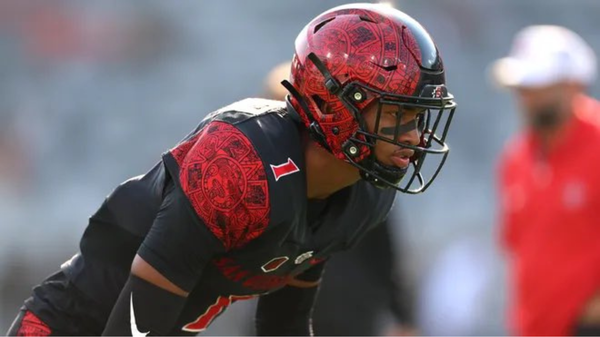
With no first round pick, I had to wait until pick 52 to make my first selection. I took CB Chris Johnson here, but I’m not exactly sure he’ll be available, so D’Angelo Ponds and Keith Abney could be other options here. Any of those three could step into a starting role as a rookie and be very solid.
In round three, I added some more help at off-ball linebacker by bringing in Kyle Louis. The Pitt standout ran a 4.53-second 40-yard dash with a 39.5-inch vertical and a 10-foot, 9-inch broad jump. He’s a great athlete with a lot of production at the college level.
In round four, I selected RB Mike Washington Jr., who may have had the best combine of anyone. He ran a blazing 4.33-second 40-yard dash an would be a perfect compliment to Josh Jacobs.
With my fifth-round pick, I decided to add to the receiver room with CJ Daniels. He’s an experienced, 6-foot-2 receiver who can play a pretty big role in this offense right away.
Finally, after trading all of my seventh-round picks to move into the sixth, I selected S Cole Wisniewski and IOL Jeremiah Wright. Both are high-upside picks that can provide depth at two key positions.
Starting Lineup
Imago
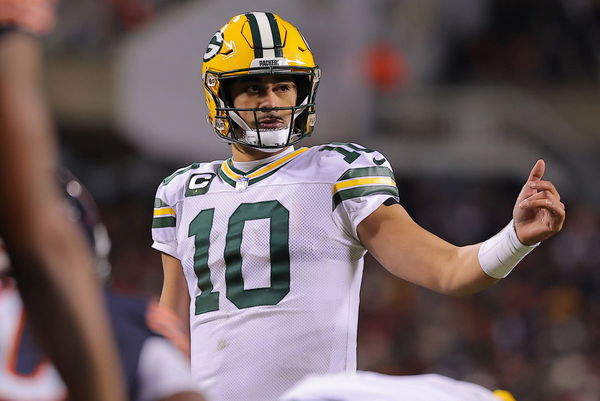
CHICAGO, IL – JANUARY 10: Jordan Love 10 of the Green Bay Packers during the first half of a NFC Wild Card Playoff game against the Chicago Bears on January 10, 2026 at Soldier Field in Chicago, Illinois. Photo by Melissa Tamez/Icon Sportswire NFL, American Football Herren, USA JAN 10 NFC Wildcard Packers at Bears EDITORIAL USE ONLY Icon260110100
Here’s what the Packers’ starting lineup would look like with the changes I made.
Offense
QB: Jordan Love
RB: Josh Jacobs, Mike Washington Jr.
WR: Alec Pierce, Christian Watson, Jayden Reed, CJ Daniels
TE: Tucker Kraft
OL: Braden Smith, Isaac Seumalo, Tyler Biadasz, Anthony Belton, Zach Tom
Offensively, I kept all of the key pieces in place while revamping the offensive line, adding a new center, left guard and left tackle, all of whom I believe are upgrades. I also brought in the best receiver in free agency and drafted an experienced veteran to fill out that room. And finally, I drafted a speedy running back to compliment Josh Jacobs.
Defense
DL: Micah Parsons, Rashan Gary, John Franklin-Meyers, Devonte Wyatt
LB: Edgerrin Cooper, Kyle Louis, Nakobe Dean
CB: Jamel Dean, Chris Johnson, Keisean Nixon
S: Xavier McKinney, Evan Williams
Defensively, I beefed up the front seven, adding the best free agent defensive tackle in John Franklin-Meyers and two great linebackers in Kyle Louis and Nakobe Dean. I also made big changes at cornerback by bringing in Jamel Dean and Chris Johnson. I would’ve liked to add another safety next to Xavier McKinney, but I didn’t have enough resources.
Overall, I think this is a team that could challenge for the NFC North title and possibly even a Super Bowl. Both sides of the ball got major upgrades at key positions, so the sky would be the limit for this team in 2026.