
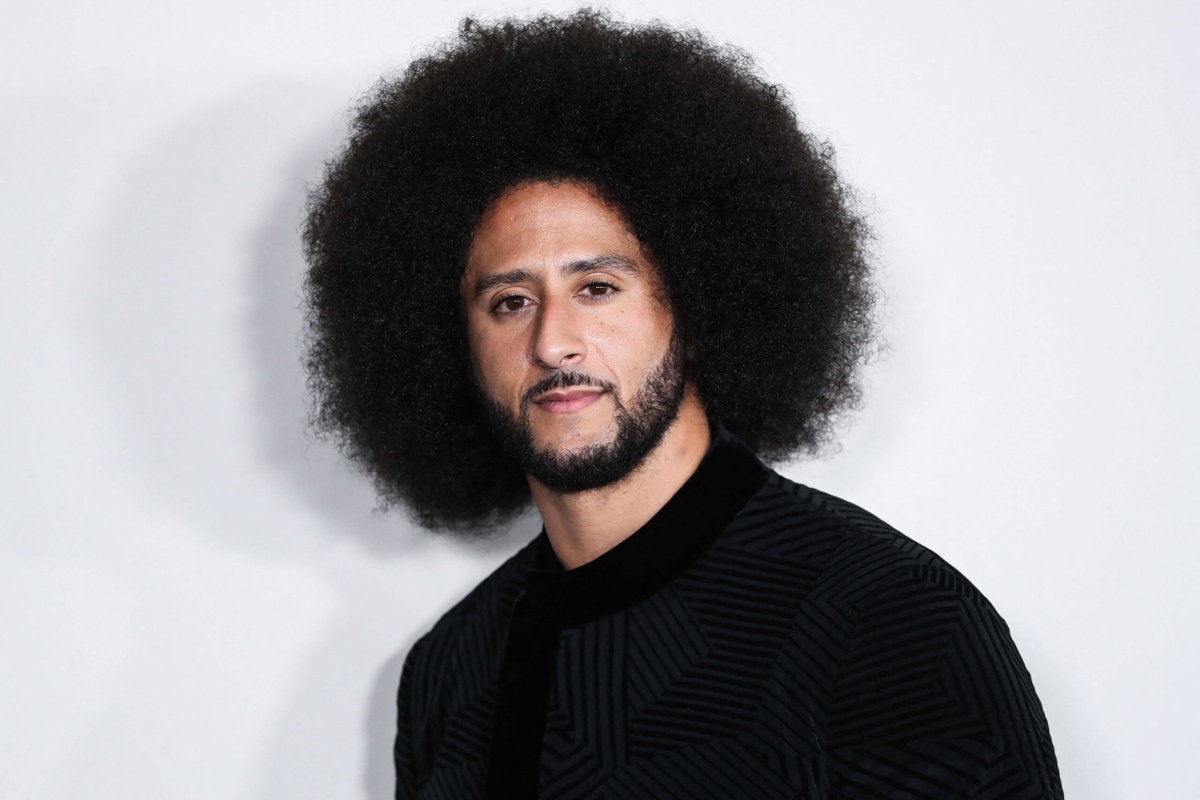
A decade has passed, but ex-NFL player Colin Kaepernick’s stance hasn’t changed. The former San Francisco 49ers quarterback has published a memoir titled ‘The Perilous Fight’, detailing the 2016 locker room protest that got him blacklisted from the league and generated massive backlash against him.
Watch What’s Trending Now!
On September 26, Bears legend Brian Urlacher joined Craig Carton on The Craig Carton Show, and Kaepernick’s demonstration naturally became a topic of discussion in light of his new book. Urlacher made it clear that he would not have put up with the former QB pulling a similar stunt in his team’s locker room.
“The thing with him taking a knee would have been really, really f****** hard for me to put up with in a locker room. That would have been something that would have probably been a line in the sand for me when it comes to stuff like that,” Urlacher said.
Urlacher’s biggest issue with Kaepernick’s protest was the time and place he chose, and how he felt it affected the team he was part of, which was something he did not approve of.
“You’re men, you’re on the same team, you’re trying to get the same goal, and you grew up in different backgrounds. That’s just the way it is. That’s the way it goes. When you’re put together to try and win games, you make it work,” Urlacher added.
The former Bears star, now a sports media personality, felt such a public display could cause a rift in the team’s unity, and as a quarterback, he felt it was Kaepernick’s duty to make sure it didn’t happen.
He further explained that even if two players on a team get into an argument, they would resolve it and make peace soon after. Since these players spend so much time together every season, communication and understanding between teammates is integral to a team’s smooth functioning.
So, taking a knee on the sidelines or in a locker room was, in Urlacher’s opinion, a deeply divisive move on the former 49ers QB’s part. In fact, he even made a comment on the Sage Steele Show last month that suggested that he was relieved to have retired in 2013, before ‘taking a knee’ gained traction.
For the uninitiated to understand why Kaepernick did so, we must look back at August 14, 2016. During the season’s first preseason game, the QB chose to remain seated instead of standing up during the national anthem as a form of silent protest against police brutality and oppression.
But after the action went unnoticed, he did so again during the 49ers’ second preseason game on August 20. By the third preseason game, his decision to remain seated did not go unnoticed by the media. Later, after speaking to former NFL player and U.S. Army Green Beret Nate Boyer, he changed his pose, taking a knee instead of simply refusing to stand up on September 1. He did so to protest racial inequality and police brutality in the United States.
Kaepernick continued to take a knee during the national anthem throughout the regular season, inspiring several other players to join him in solidarity. This led to NFL franchises seeing him as a highly polarizing figure. After he opted out of the final year of his contract with the Niners, the NFL refused to show any interest in the quarterback despite the promise his performance showed, pushing him into a hiatus.
In 2018, NFL team owners approved a new mandate, stating that while personnel on the field were required to stand for the national anthem, teams had the option to remain in the locker room if they did not wish to comply.
With no teams willing to sign him, Kaepernick’s hiatus evolved into retirement. The quarterback filed a lawsuit against the league in 2017, claiming that the NFL colluded against him and shut him out. After reaching a confidential settlement in 2019, Kaepernick shifted his attention towards publishing, civil rights activism, publishing, and collaborations with brands that stood by his personal convictions.
However, Kaepernick’s latest book has made it evident that he has not forgotten about his feud with the NFL. This has put him at odds with figures like Urlacher and Carton, who believe that the sport should remain free of real-world agendas, since for many, it acts as an escape from the stresses of life.