
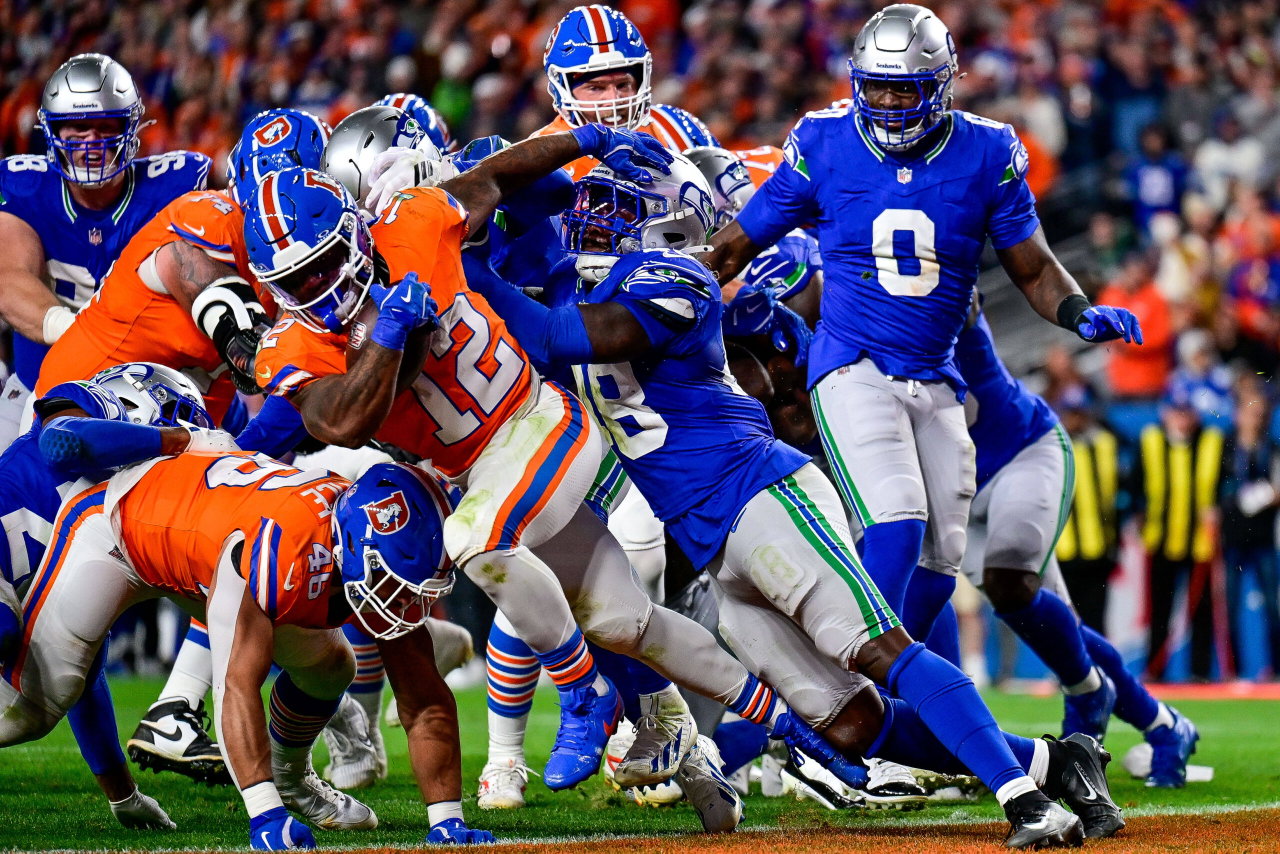
Before Thursday Night Football between the Denver Broncos and the Seattle Seahawks, NFL analyst Zack Kelberman warned the Broncos that they would need to “show up for all four quarters” to pull off the upset. Denver struggled to do that, as its offense stalled in the second half, a problem that has become all too familiar this season.
Watch What’s Trending Now!
Still, Denver’s defense carried the load yesterday when its offense couldn’t, forcing two turnovers to secure a 17-14 OT win. Their defense deserves much of the credit, forcing two interceptions from Sam Darnold. However, turnovers have become a recurring problem for the Seahawks’ quarterback this season.
Darnold has thrown seven interceptions over the last four games (taking him to the top of the interceptions thrown table). After Thursday’s loss, he took responsibility for his mistakes, but by then, the damage had been done. However, beating Seattle in overtime takes more than capitalizing on the Seahawks’ quarterback mistakes. We’ll break down the key factors behind Denver’s win. Despite securing an important victory and improving to 4-2, the injury-plagued Broncos also had to deal with a few more injury scares during the game.
After Pat Surtain II and Talanoa Hufanga, more injuries hit Denver
With 42 seconds remaining in the second quarter and the Denver Broncos backed up near their own goal line, wide receiver Jaylen Waddle headed toward the locker room with his helmet in hand.
Waddle was initially evaluated in the blue medical tent before being diagnosed with a shoulder injury. The initial concern was a possible AC joint sprain or rib issue. Fortunately for Denver, he received treatment and returned to the field in the third quarter, eventually finishing the game. Still, the scare added to the Broncos’ growing injury concerns during an already difficult stretch.
Meanwhile, defensive lineman Malcolm Roach briefly left the field before halftime and visited the medical tent and locker room because of an unspecified issue. He also returned for the second half. These concerns came as Denver was already missing key starters, including cornerback Patrick Surtain II and safety Talanoa Hufanga, who have both been sidelined with ankle injuries.
Despite those absences, Denver’s defense stepped up and made sure the missing starters weren’t missed as much on the field.
How did the Denver Broncos’ defense perform when the offense struggled?
The Broncos’ defense delivered a standout performance on Thursday night, carrying the team to an overtime victory while the offense struggled to get anything going. To understand just how important the defensive effort was, look at how little the offense produced for most of the game.
Bo Nix and the Denver offense managed just 168 total yards. Nix finished with only 107 passing yards, the second-lowest total of his career. Two of his three lowest single-game passing totals have now come within four days, as he threw for 123 yards against the Los Angeles Chargers earlier in the week.
After halftime, the Broncos’ offense struggled even more. The team went six consecutive drives without scoring, punting on each possession and failing to build any momentum. That left the defense with little room for error. Nix’s performance also drew criticism from NFL analysts, including Ryan Fitzpatrick, who spoke out during the live postgame show.
“Bo Nix is not playing competitively. It’s almost disrespectful to the quarterback position how he’s playing football,” Fitzpatrick said.
Nix was later asked about the offense’s struggles during his post-game press conference.
“We’re definitely capable [of better]; I don’t know where the disconnect is right now to be honest with you. I just think we’re really struggling to find those explosive plays and that’s what makes an offensive spectacular is explosive plays and right now we don’t have those,” Nix said.
Under normal circumstances, an offense that produces so little would put its team in serious trouble. However, Denver stayed in the game because its defense continued to hold firm.
Even when the offense left the defense in difficult field positions, coordinator Vance Joseph’s unit repeatedly bent without breaking, keeping Seattle out of the end zone during crucial moments.
The defining play came in overtime. With the offense still struggling, nickel cornerback Ja’Quan McMillian read Seattle’s play and came away with a crucial interception.
That turnover changed the game. McMillian not only stopped Seattle’s drive but also gave Denver possession in a favorable position. Kicker Wil Lutz then sealed the 17-14 victory with a 53-yard field goal.
Denver’s defense delivered this performance without key starters such as Patrick Surtain II and Talanoa Hufanga, both of whom were out with ankle injuries. The unit’s ability to step up highlighted its depth and resilience. However, Darnold’s mistakes also played a major role in the outcome.
Sam Darnold admitted his mistakes
Darnold’s struggles came down to ball security and decision-making under pressure. Although he moved the offense at times, his turnovers stalled Seattle’s momentum and gave Denver opportunities to stay in the game.
The biggest mistake came in overtime, when Darnold threw an interception to Broncos nickel cornerback Ja’Quan McMillian. The turnover gave Denver the ball back and set up the game-winning field goal.
ESPN’s research also highlighted how much pressure Darnold faced during the game.
According to ESPN, Darnold was pressured on nine of his 17 dropbacks in the first half, a pressure rate of 53%. That would be his highest pressure percentage in a game since joining the Seahawks. When under pressure, he completed just one of seven passes for five yards and took two sacks.
After the game, the 29-year-old California native took responsibility for his performance.
“No way to sugarcoat it. That one sucked. Can’t turn the ball over. That’s obviously at the forefront of my mind, but there’s just a lot that we can do better,” Darnold said.
Dontay Atkinson also weighed in.
“…at least Sam tries. He throws picks at terrible moments, but he looks like he at least understands football,” he wrote.
While the players and the game itself drew plenty of attention, Amazon Prime Video also faced criticism during Thursday night’s broadcast.
Amazon Prime Video came under fire from fans
During Thursday Night Football between the Denver Broncos and Seattle Seahawks, Amazon Prime Video faced backlash from viewers over streaming quality. Fans complained that the broadcast was blurry and pixelated, with frequent dropouts and persistent buffering. Some viewers also reported that other platforms, including Netflix and YouTube, were streaming smoothly at the same time.
The complaints added to the ongoing scrutiny of Amazon’s coverage. The company pays roughly $1 billion annually for exclusive Thursday Night Football rights, and fans expect a high-quality viewing experience in return. With games available through a streaming service rather than traditional broadcast television, technical problems can quickly frustrate viewers.
However, picture quality wasn’t the only issue fans discussed. Broadcaster Al Michaels also came under criticism.
Michaels is a legendary voice in sports broadcasting, but his recent work on Thursday Night Football has drawn increased scrutiny. Some fans have criticized missed player names, delayed reactions to major plays, and moments when his delivery seemed disengaged.
Critics have also compared his style unfavorably with younger broadcast teams on other networks. When technical problems are combined with on-air mistakes, dissatisfaction can grow quickly. For example, a reported mix-up in which Michaels called Marvin Mims Jr. “Marvin Jones” added to the frustration among some viewers.
Meanwhile, another trend has emerged across the NFL’s primetime schedule: several consecutive games have gone to overtime. The Ravens-Falcons matchup on Sunday Night Football, the Bills-Rams game on Monday Night Football, and the Broncos-Seahawks game on Thursday Night Football all needed extra time.
The next primetime matchup will feature the Cowboys and the Packers. Will that game also go to overtime? What do you think?