
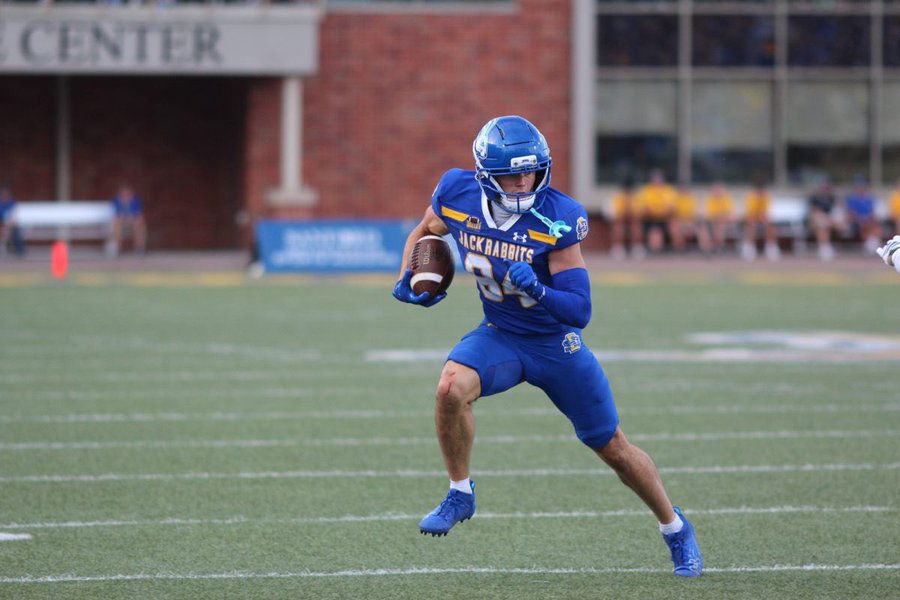
“Stacked every chip on myself, time to collect…” Alex Bullock wrote back in 2021, and his path lived up to that line ever since. The 6-foot-2, 205-pound Creighton Prep receiver made his name as a two-way force, then took the tougher road by walking on at Nebraska after drawing interest from other FBS programs and a scholarship offer from South Dakota State. He finished his Huskers run with 16 catches for 233 yards and one touchdown, then kept chasing the dream with Jacksonville.
Watch What’s Trending Now!
That grind paid off when the Jacksonville Jaguars signed him as an undrafted free agent to a three-year, $3 million deal. Bullock had bet on himself at every turn, moving from Nebraska to South Dakota State to keep the story moving, and the NFL finally answered. So when his name surfaced on a list just 23 days later, the shock hit harder because the climb had already felt so hard-earned.
“#Jaguars WR Alex Bullock, who they signed as an undrafted free agent out of South Dakota State, is retiring from the NFL, the team announced,” Ari Meirov shared on X. “This is now the third undrafted NFL rookie to retire in the last week.”
The Jaguars have placed Bullock on the reserve/retired list, a move that keeps his rights in-house while opening a spot on the 90-man offseason roster. The Jaguars have not yet detailed why he stepped away, and Bullock has not released a statement explaining his decision either.
The money attached to this exit feels different from most UDFA farewells. Spotrac lists Bullock’s contract at $3.103 million in total value, with only $3,000 guaranteed. That structure is typical for UDFAs, but the total value was still large enough to raise eyebrows, especially since he earned his change with the Jags.

#Jaguars WR Alex Bullock, who they signed as an undrafted free agent out of South Dakota State, is retiring from the NFL, the team announced. This is now the third undrafted NFL rookie to retire in the last week.
After transferring from Nebraska to South Dakota State, Bullock caught 71 passes for 936 yards and five touchdowns – productions that squarely fit the developmental-receiver bucket NFL teams pry open every spring. His college production line justified the shot, even if the odds of making the final 53-man roster may have remained slim.
What’s more, the Jaguars didn’t even get much time to evaluate him. Bullock signed and only lasted for the rookie-minicamp loop, the same window that has already swallowed two other undrafted rookies: Chicago Bears wide receiver Squirrel White and Miami Dolphins running back Le-Veon Moss.
White, a former Florida State product, left practice with a trainer during the minicamp and was placed on the reserve/retired list about 16 days after signing. Moss, a former Texas A&M running back, signed with Miami on May 8 and was placed on the reserve/retired list four days later, after just one camp session.
With the OTAs of the Jaguars set to start next week, the team will now have to bring in fresh talent to fill the roster spot. As for Alex Bullock, he cannot return to college football. His eligibility is gone after using his years at Nebraska and then a graduate season at South Dakota State, so the NCAA window is closed. The only way he plays now is in the NFL, and that path runs through the Jaguars deciding whether to rescind or release his rights while he remains on the reserve/retired list.
That reality is what turns Bullock’s move from a minor Jaguars roster tweak into something bigger. With three undrafted rookies walking away in the same week, the teams have lost their cheap, low-stakes UDFA pipeline, which has sustained practice squads and late-season depth chart reshuffles for years. That shift is what pushes the story beyond “he left” and into the question of how teams actually manage and protect these margins now.
The NFL needs tighter UDFA onboarding
The retirements hit franchises awkwardly, exposing just how lightly some teams treat UDFA onboarding. The first rookie weekend often becomes a paperwork exercise instead of a structural medical, mental-health, and life-circumstance check-in. Days before Alex Bullock retired, when the case was just limited to White and Moss, as the USA’s Jennifer Bubel was ringing the warning bells.
“Their abrupt retirement begs the question of whether the early pipeline into the league is becoming more fragile these days,” Bubel wrote. Teams rely heavily on undrafted free agents and late-round rookies to fill training camp rosters. If more players opt out early or reconsider their futures after brief exposure, it could reshape how teams evaluate depth and developmental pathways.”
The Kansas City Chiefs’ general manager, Brett Veach, had also said something similar in a February interview, noting that NIL-driven decisions to stay in college are shrinking the NFL’s talent pool at the top, and pushing the average age of draftees upwards. When asked about underclassmen opting back into school, Veach laid out the collateral damage:
“When the official decision date for the underclassmen came, I believe we moved over 25 guys off our board that we had Top 75, Top 100,” Veach noted. “So, it really impacts the draft, and then you’re getting older, older prospects as you go on. I don’t think that’s going to change any time soon, and I think that’s something we have to adapt to.”
That same logic spills down to the UDFA tier as well, and has been repeated by Baltimore Ravens EVP and General Manager Eric DeCosta. If NIL-era incentives keep underclassmen in school longer and push the draft pool older, they also make the post-draft market riskier because teams are signing players who still have college-level earning power. These players would be less financially motivated to grind through a 90-man roster battle.
The Jaguars are not the only franchise discovering this the hard way. The pattern of three undrafted rookies quitting in one week is small, but it does send a clear message: the NFL’s ability to hold onto fringe talent is now being tested. If the short-term risk of chasing a roster spot doesn’t always outweigh the security and earning potential the players already have, what can the league do to tip the scales back in its favor?