
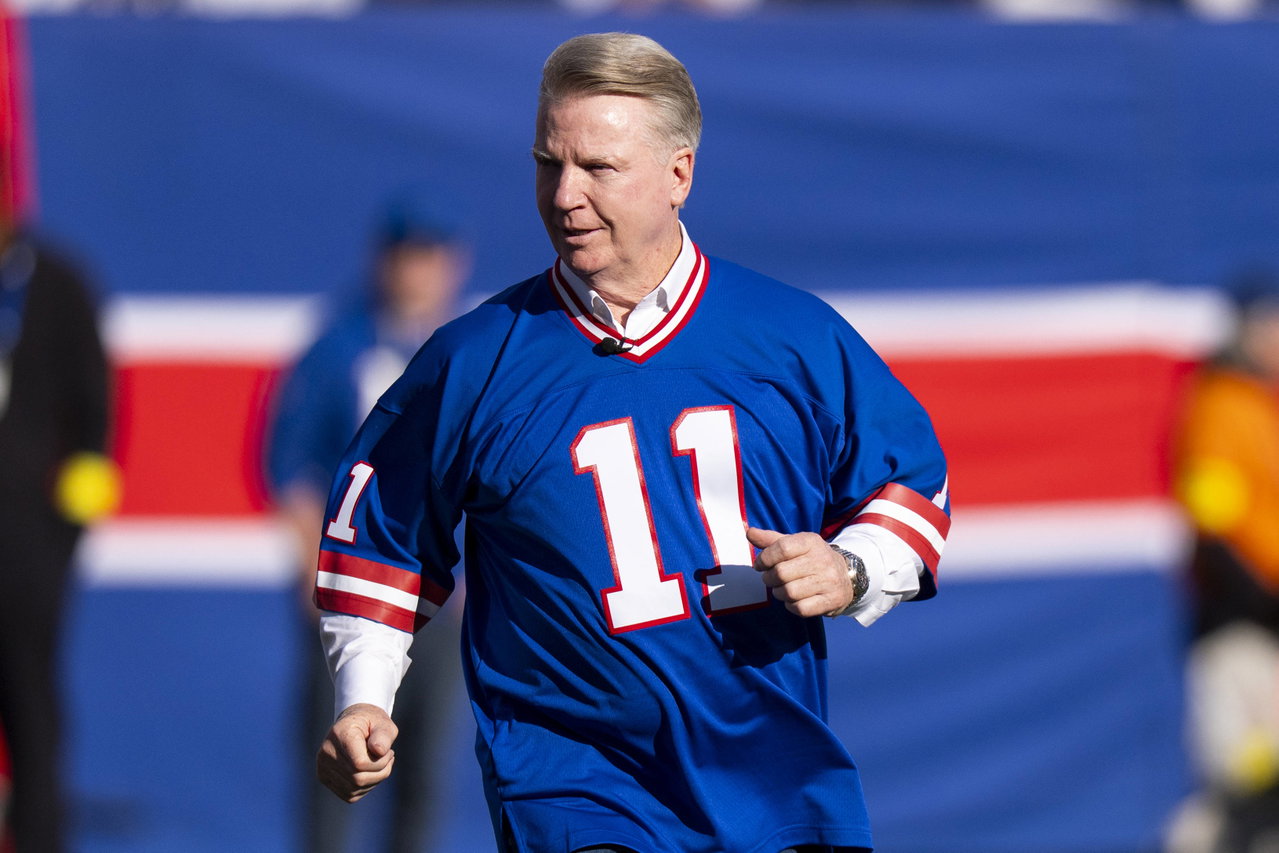
Phil Simms has questioned the NFLPA’s direction before, but this time he set it against a union he believes handled things differently. The Super Bowl XXI MVP said the players’ union has never taken a firm stand for its members, and he praised the MLBPAA instead. The history shows why the contrast stings.
“The NFL players, the association, it’s, I don’t even know what it is,” Phil Simms said on Iona University Graduate Program in Sports Media. “They’ve never stood up for anything. So, we’re going on strike. We got nothing out of it. I mean, it’s just—and, you know, we’d have a meeting. Well, you know, as I said, we’d have a meeting about what we wanted, and I, you know, I got up, and I never stood up in front of the team ever.
One time, during a strike. Health—let’s have insurance. Health insurance. So, when it’s over and you’re beat to death, we get you, and they do—it’s, there’s something there, but it’s not it. The football union is not even close to the baseball union. These guys are serious about it.”
For example, take 2011. When owners and players could not agree on a new CBA, the owners locked players out on March 12 and shut down league operations. The salary cap, safety, revenue sharing, rookie pay, and free agency were all in dispute. After two years of stalled talks, the NFLPA decertified, which let players file antitrust suits. Owners approved a settlement on July 21, 31 to 0, with the Raiders abstaining, and the lockout ended once Roger Goodell and DeMaurice Smith signed it.
In 2020, retired players raised complaints of their own. Attorney Ben Meiselas told the AP that his clients asked the NFLPA directly whether their Social Security disability payments would change under the new labor agreement, and they got no clear answers before or after the March 5 presentation.
They found out they would lose those benefits only after the deal passed on March 15 by 60 votes.
“The NFLPA not only refused to answer the questions but at times provided misleading information,” Meiselas said.
Meiselas says the emails also contradict the NFLPA’s claim that it explained the changes and how they would affect 400 players in a presentation to former players.
“It doesn’t just poke a hole in that; it makes a nuclear crater in their press statement, which was shown as a complete lie,” Meiselas said. “Unfortunately, but not surprisingly, it appears it’s a massive cover-up that detrimentally impacted hundreds of disabled families that rely on disability benefits to survive.”
The union says the change fixed an omission, and George Atallah called the allegations false. Meiselas wanted a re-vote.
The MLBPAA offers a different picture. Founded in 1982 and based in Colorado Springs, it is a nonprofit that promotes the game, raises money for charity, educates youth, and protects the game’s dignity through former players. It also helps them succeed once their careers end. With more than 9,500 members, including 6,500 alumni and active players, it has raised over $75 million for charities.
On its 40th anniversary, Jesse Sanchez credited that success to listening to its members and evolving with the times.
Side by side, it is easy to see why Simms drew the line he did. One organization keeps pointing to what it has done for its members, while the other keeps facing questions about whether it listened.