
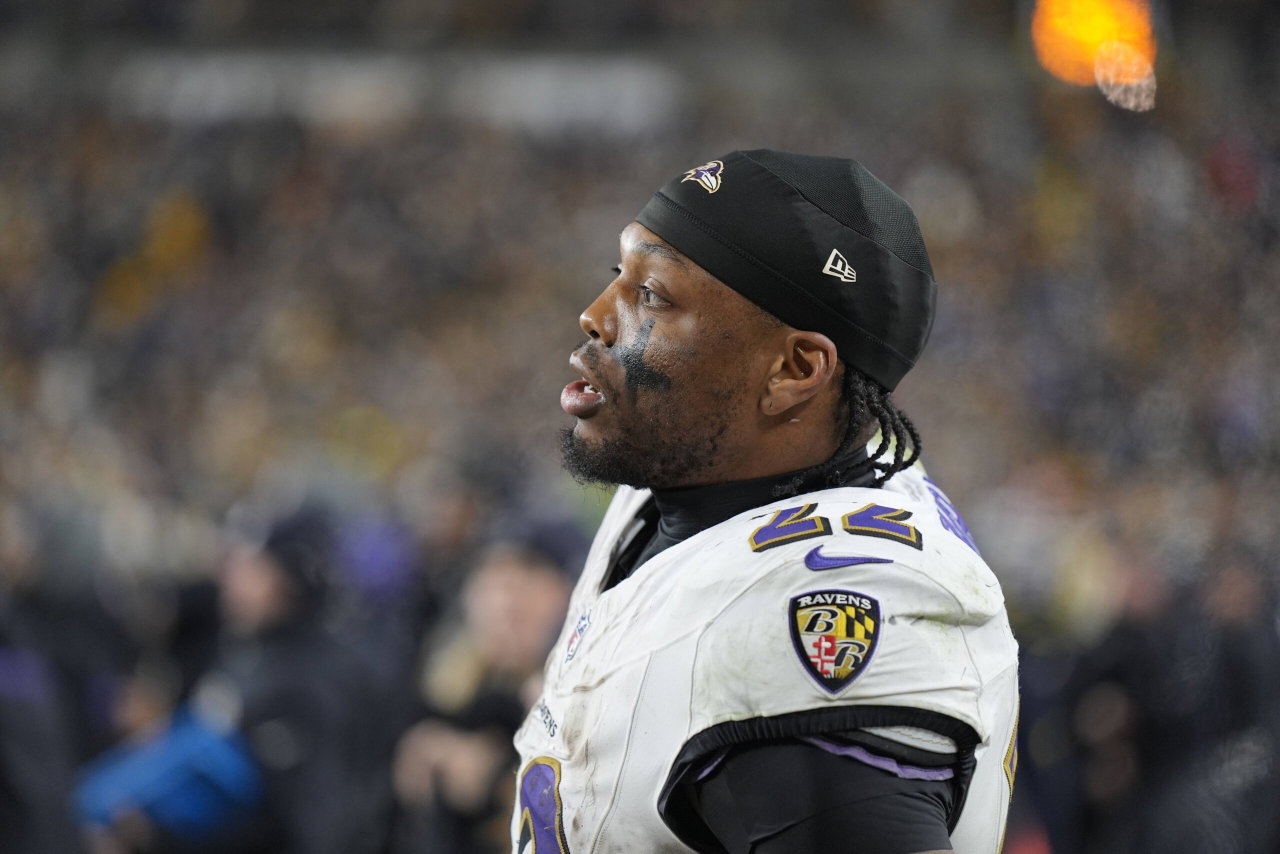
Derrick Henry’s return to Tennessee’s AFC South rivals was not the only moment to emerge from the Titans’ Week 4 loss. A brief exchange between the Baltimore Ravens running back and Titans defensive lineman John Franklin-Myers went unnoticed during the Oct. 4 broadcast, but footage later brought it into focus after Baltimore’s 24–18 win at M&T Bank Stadium.
Watch What’s Trending Now!
On October 10, the NFL’s Week 4 Accountability Report stated that Franklin-Myers had been fined $12,537 for unnecessary roughness after he kneed Henry in the midsection. The play occurred with 5:13 left in the second quarter, during a Ravens possession that ended with a three-yard touchdown pass from quarterback Lamar Jackson to tight end Mark Andrews. The fine came after the game, rather than through an on-field penalty.
NBC Sports’ Mike Florio’s account of the footage describes a sequence that began with Henry cut-blocking Franklin-Myers. After the ball was caught in the end zone, Henry was on all fours and looking away when the Titans defender stepped back and drove his knee into the running back’s midsection. The live broadcast did not show the contact, and no flag was thrown during the play.
Florio summed up the difference between the initial impression and what the footage showed in his report:
“The video paints a different picture.”
Florio questioned whether the punishment went far enough. With no flag thrown during the play, the incident only drew wider attention after the footage emerged. Florio felt the league could have taken a tougher stance, writing, “It’s somewhat surprising it didn’t lead to a suspension.”
The NFL and NFL Players Association have an agreed-upon list of fines for on-field misconduct, including striking, kicking, or kneeing an opponent. The league also reviews potential violations after games, meaning a lack of an on-field flag does not necessarily end the matter. Franklin-Myers’ fine illustrates how a play that was missed by the broadcast and not penalized in real time can still result in discipline after film review.
The incident unfolded during a game that had already swung heavily in Baltimore’s favor before halftime. Henry opened the scoring with a five-yard rushing touchdown, and Tennessee answered through Tony Pollard’s three-yard run. Jackson then threw touchdown passes to Zay Flowers and Andrews before kicker Tyler Loop added a 64-yard field goal as the half ended.
The Titans had a chance to cut into the deficit before Andrews’ touchdown, but four consecutive runs from first-and-goal at the Baltimore eight-yard line produced no points. Baltimore covered 98 yards on the drive that ended with Andrews’ touchdown.
“That was a big swing in momentum against us,” Pollard said. “But we have to be professionals, come out and respond.”
Lamar exited with an ankle injury in the second quarter, and Tyler Huntley stepped in at quarterback. Tennessee fought back late as Cam Ward threw a touchdown to Wan’Dale Robinson and completed the two-point conversion. The Ravens recovered the onside kick to seal their win.
John Franklin-Myers’ Fine Raises Questions About How the NFL Values Different Violations
Florio’s criticism went beyond Franklin-Myers’ fine itself. He questioned why conduct involving physical contact could draw a smaller penalty than other violations, including touchdown celebrations and equipment-related offenses.
“The end result doesn’t come close to matching the infraction. It’s less than the league fined Browns quarterback Deshaun Watson and Browns running back Quinshon Judkins for a celebration that mimed smoking a joint,” Florio wrote.
Cleveland Browns quarterback Deshaun Watson was fined $14,926, while running back Quinshon Judkins received a $14,397 fine for a touchdown celebration that mimicked smoking a joint. Baltimore Ravens wide receiver LaJohntay Wester, meanwhile, was fined $23,882 for wearing gloves displaying an unauthorized logo after the team’s Week 1 game against the Indianapolis Colts.
The bigger question is whether the NFL’s penalty system sends the message the league intends. With fines varying across on-field conduct and equipment violations, Franklin-Myers’ case gives the league another reason to explain how it weighs the circumstances of an incident against its established disciplinary guidelines.