
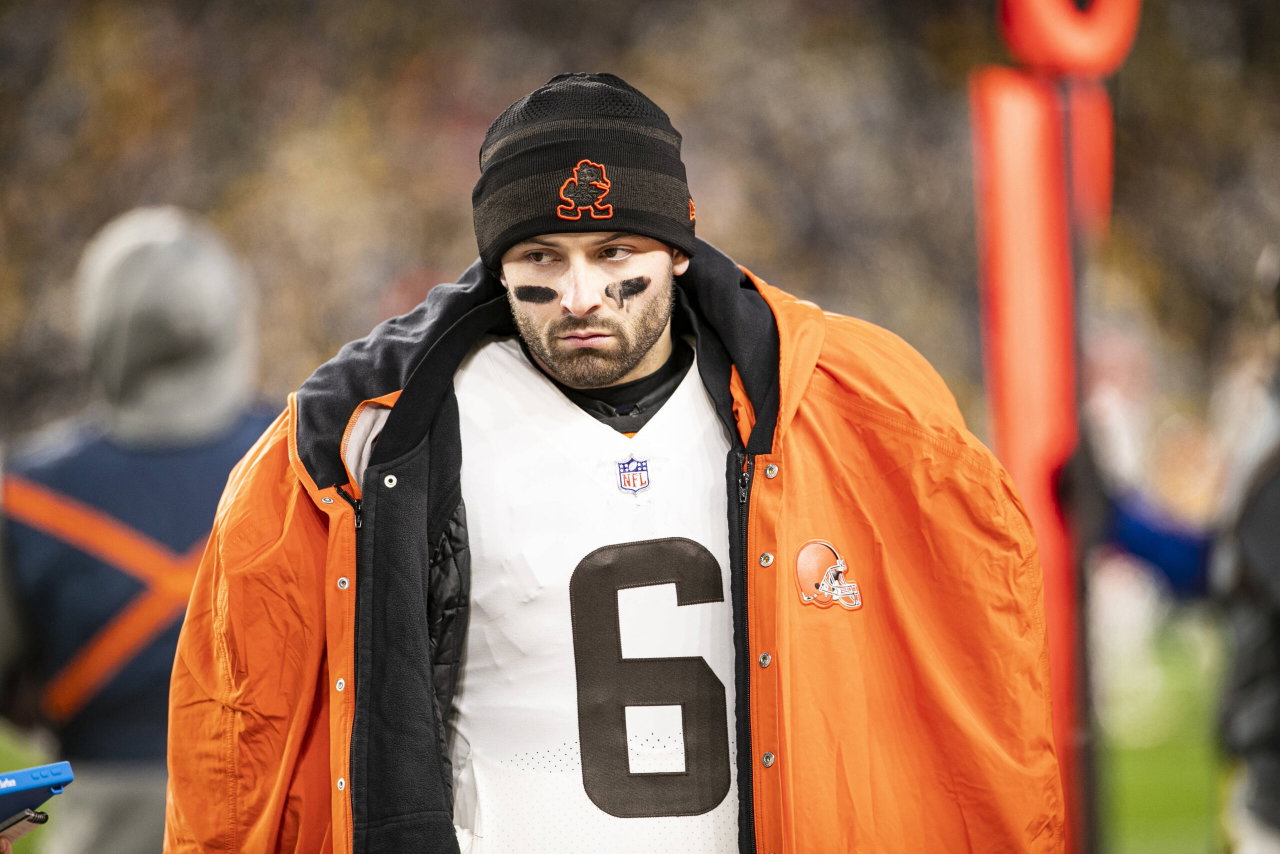
On a Monday morning in October 2018, Baker Mayfield’s first NFL season changed before he had even finished it. The Browns had just tied Pittsburgh 21-21 to fall to 2-5-1, and the next day, Hue Jackson was out. So was offensive coordinator Todd Haley. Gregg Williams, the defensive coordinator, was suddenly the interim head coach, while Freddie Kitchens, who had started the season coaching Cleveland’s running backs, took over the offense.
Watch What’s Trending Now!
For Mayfield, it meant another voice in a season already full of them. He had entered the league with Jackson as his head coach and Haley running his offense; eight games later, both were gone. Yet the strangest part came next. Kitchens simplified the passing game, got the ball out of Mayfield’s hands faster, and helped cut the pressure he was facing dramatically. Cleveland went 5-3 over its final eight games, and the rookie who had been dropped into the middle of the upheaval suddenly looked far more comfortable. Yet, for Mayfield, it was his first glimpse of how much could happen around a quarterback before he ever took a snap.
“It was eye-opening to see that it wasn’t just football for me going from college to the NFL,” Mayfield confessed on the 4th And South podcast. “It wasn’t just about how do we win. There was a lot of people that are involved in it and not everybody was trying to help us win. Not everybody was trying to do their part and do their role to do that. So, I think that was the most eye-opening part.”
Mayfield had seen the Browns change course. What he could not have known yet was how much the people making those decisions would shape his career. In 2018, he largely stayed out of the fight. When reporters asked him about the tension between Jackson and Haley, he said he was “invested in the game plan” and that the situation was “above my pay grade.” “When it comes down to it, we come out here and we have to play the game to win,” the rookie said at the time.
That hindsight is important because Mayfield was not describing a Browns organization where nobody cared about winning. In fact, he would go on to credit several people for trying to change it. His point was more complicated: Cleveland had people trying to fix the franchise while still struggling to get everyone inside it moving in the same direction.
The Browns drafted Mayfield with the No. 1 pick in the 2018 draft. But he arrived at the end of one of the most turbulent periods in franchise history. Cleveland had gone 1-15 in 2016 and 0-16 in 2017, then changed its football leadership. John Dorsey became general manager, while Eliot Wolf and Alonzo Highsmith joined the personnel operation. The franchise was trying to move away from the previous regime’s approach and build around a more traditional football structure. That change is exactly why Mayfield’s later praise for Dorsey, Wolf and Highsmith matters.
“There were ups and downs, for sure,” Mayfield went on. “The amount of high draft picks they had in the past couple of years, the free agent signings that we had before I got drafted, the culture was really starting to change. And that’s a credit to John Dorsey, Eliot Wolf, Alonzo Highsmith, for bringing in football guys to truly try and change it. Some things you can’t change in the building. But you can change the locker room and the makeup of that. And they did a good job of building that.”
The problem was that changing the roster was easier than making the football operation function as one unit. Jackson and Haley had been given different responsibilities, but their visions for the offense increasingly collided. Their disagreements went beyond play-calling. ESPN reported clashes over the offensive line, Josh Gordon’s role, Duke Johnson’s usage, Nick Chubb’s opportunities and, eventually, how the offense should be built around Mayfield. Sources told ESPN the two had not developed the mutual respect needed to work together for Mayfield’s development. That put Mayfield in an unusual position for a rookie quarterback.
The head coach wanted changes that could help him play faster. The offensive coordinator preferred his own approach. The front office was becoming increasingly concerned about the tension. And the quarterback those decisions were supposed to help was trying to learn an NFL offense at the same time. The October 2018 firings were the clearest sign that something inside the building was not working.
Cleveland removed both Jackson and Haley after the Steelers tie, with Gregg Williams taking over as interim head coach and Kitchens becoming offensive coordinator. It was not simply a reaction to the Browns’ 2-5-1 record; the internal conflict had become part of the problem. ESPN’s reporting at the time described the relationship between Jackson and Haley as a persistent power struggle that had begun affecting the team. And yet, the aftermath made the situation even more revealing.
Kitchens did not radically reinvent Haley’s offense. Instead, he simplified it in ways that suited Mayfield. The quarterback began getting the ball out faster, the Browns used their running backs more in the passing game, and the numbers changed almost immediately. Cleveland went 5-3 over its final eight games, while Mayfield finished his rookie season with 27 touchdown passes, then an NFL rookie record.
That was Mayfield’s first real glimpse of the distinction he is making now: the Browns could have talented players, ambitious coaches and people trying to improve the team, yet still lose efficiency when those people were not pulling in the same direction.
The Browns then made another bet on continuity, at least on paper. Kitchens was promoted from offensive coordinator to head coach after the 2018 season, a decision that made sense after the way the offense had responded to him. But the experiment lasted only one year. Cleveland went 6-10 in 2019, and Kitchens was fired.
Mayfield had now gone from Jackson to Kitchens in the space of two seasons, with another major coaching change waiting around the corner. By 2020, Kevin Stefanski became the third head coach of Mayfield’s first three NFL seasons.
That third regime finally showed Mayfield what the Browns looked like when the pieces did fit. Stefanski brought a clearer offensive identity, and Cleveland paired Mayfield with a strong run game, a rebuilt offensive line and a defense led by Myles Garrett. The Browns finished 11-5, reached the playoffs for the first time since 2002 and beat Pittsburgh in the wild-card round for their first playoff victory since 1994. Mayfield threw 26 touchdowns against eight interceptions that season.
That 2020 season is important to the story because it prevents Mayfield’s comments from being reduced to a simple indictment of Cleveland. The Browns had finally found a version of the organization that worked. The same quarterback who had experienced the chaos of 2018 was able to thrive when the coaching, roster and offensive philosophy were aligned. But that alignment did not hold.
Mayfield’s 2021 season became increasingly complicated by his shoulder injury, while the relationship between the quarterback and the organization deteriorated. The Odell Beckham Jr. situation added another layer. Mayfield and Beckham were not simply two teammates who disliked each other; ESPN’s reporting showed that the two had a genuine personal relationship, even as their on-field connection failed to develop as Cleveland expected.
When Beckham’s father posted a video highlighting plays in which his son appeared open, a football problem became a public one. Beckham was eventually released. By then, the problem was no longer just about whether Mayfield had the right play call or enough talent around him. Trust had become part of the equation. Then came 2022.
The Browns were exploring their options at quarterback. Mayfield’s camp knew Cleveland was looking at other quarterbacks, including possibilities such as Russell Wilson and Aaron Rodgers. But when the Browns pursued Deshaun Watson specifically, reports said Mayfield was not informed beforehand and learned that Cleveland had met with Watson through social media.
That distinction matters. It would be inaccurate to say Cleveland secretly explored every quarterback while Mayfield knew nothing. The Browns had indicated that they would investigate the market for elite quarterbacks. The breakdown was over how far that process had gone — and how Mayfield found out about the Watson pursuit.
A source told ESPN’s Jake Trotter at the time, “They didn’t inform Baker ahead of time, just as a courtesy. It played out so publicly, it was just very insulting. … It really angered Baker.”
The Browns eventually landed Watson, sending three first-round picks to Houston and giving him a fully guaranteed five-year, $230 million contract. Mayfield was traded to the Carolina Panthers that July.
By then, the rookie who once said the internal coaching battle was “above my pay grade” had spent four seasons watching the consequences of those battles from inside the building. He had seen a franchise change its football philosophy, cycle through coaches, assemble a talented roster, finally find a winning formula and then watch relationships inside that formula break down. That is why Mayfield’s wording now matters.
Mayfield’s Cleveland tenure was not a story of a franchise that never tried to get better. It was a story of a franchise that repeatedly tried to get better while still struggling to make all of its moving parts work together.