
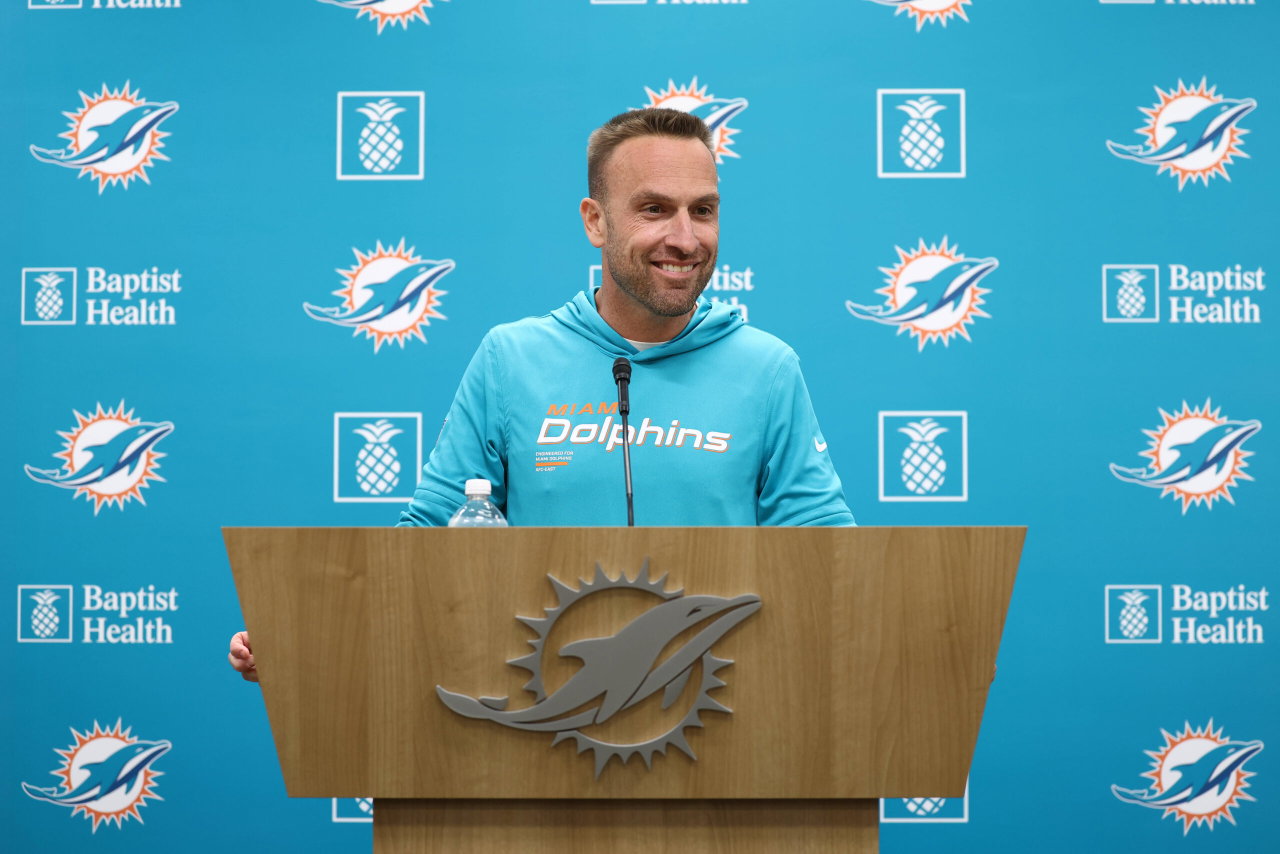
How would you feel if your viral social media post inadvertently handed your favourite team’s secret playbook to an opponent? That nightmare played out for Green Bay in 2024. Jeff Hafley’s Packers defense ranked 6th in points allowed, yet looked totally exposed against Philadelphia in Week 1 at São Paulo, Brazil. Hafley, now Miami’s head coach, revealed why: new Dolphins coach Kevin Patullo, then with the Eagles, admitted Philly got the best of the Packers with a little help from fans videotaping Green Bay’s training camp. That costly leak forced Green Bay into some necessary damage control.
Watch What’s Trending Now!
NFL insider Mike Clemens on X wrote, “The Packers have spent a lot of money to put up additional walls around their practice field and this year hired additional ushers to prevent fans (or scouts/spies) taking video of practice.”
According to Clemens, it’s directly tied to a story that just went public.
While Green Bay hasn’t completely banned fans from recording, it has drawn a strict line in the sand to safeguard its tactical secrets. Around Ray Nitschke Field, the franchise erected prominent “Protect Our Plays” banners targeting both eager fans and credentialed media members. To back up the signage, team staff members actively signal throughout practice to broadcast when photography and videography are strictly prohibited during designated periods.
Anyone refusing to put their phone away faces immediate ejection from the grounds. According to ESPN’s Rob Demovsky, these targeted blackouts, which shift dynamically from one session to the next, are the primary reason footage of 11-on-11 drills is nearly impossible to find online. The Packers still encourage fans to capture memories during open windows, but when the playbook opens up, the camera lenses must go down.
Hafley said he didn’t know how much damage that exposure did until he hired Kevin Patullo on the Dolphins’ coaching staff. Patullo told him directly how the Eagles’ staff had used the footage.
“I didn’t really think about it as much until we hired Kevin Patullo and he told me that before we played them in Brazil,” Hafley said. “He had half my pressures on tape from training camp from people that videoed it and put it online and on Twitter (X).
“We had a pressure I had never run, so there’s no way he could’ve known about it. And they knew it was coming, and he said that they saw that pressure on video, so yeah, I mean, it is kind of disappointing,” Hafley added.
In football, defensive success hinges almost entirely on disguise, and losing the element of surprise is fatal. When an offense knows exactly where a blitz is coming from, even the most aggressive pressure packages are instantly neutralized. That pre-game intelligence proved decisive in Philadelphia’s 34-29 Week 1 victory.
Imago
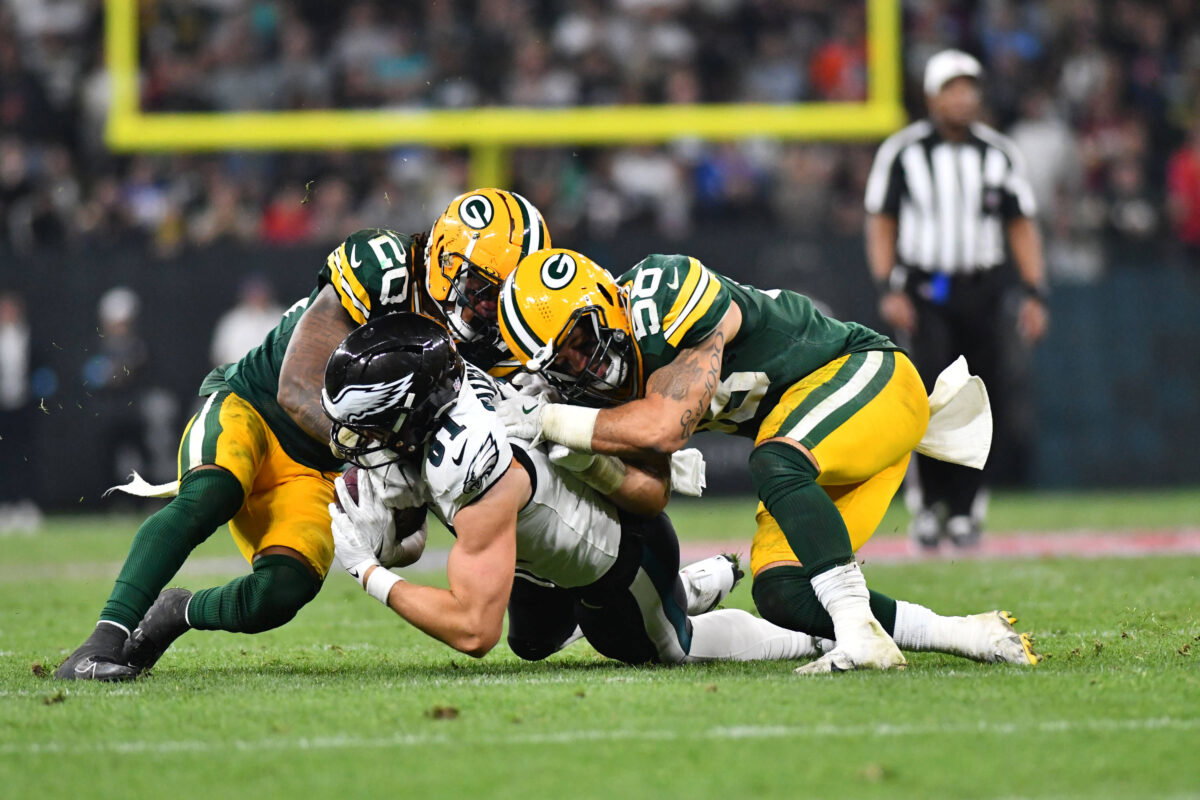
SoO PAULO, BRAZIL – SEPTEMBER 6: Philadelphia Eagles tight end Grant Calcaterra 81 is tackled by Green Bay Packers safety Javon Bullard 20 and Green Bay Packers linebacker Isaiah McDuffie 58 during an NFL, American Football Herren, USA game between the Green Bay Packers and the Philadelphia Eagles on September 6, 2024, at Arena Corinthians in Sao Paulo, Brazil. Photo by Leandro Bernardes/PxImages/Icon Sportswire NFL: SEP 06 Packers vs Eagles EDITORIAL USE ONLY Icon240906448
Equipped with Green Bay’s leaked schemes, the Eagles dictated the pace from the opening kickoff. Saquon Barkley exploited the disrupted defensive fronts to tear through for three touchdowns, while A.J. Brown and DeVonte Smith combined for 203 receiving yards. Jalen Hurts diced up the secondary for 278 yards and two scores through the air, leaving Green Bay’s defense gasping and unable to generate its signature pass rush.
That early blueprint set the tone for the entire season. When the two teams met again in the NFL Wild Card round, Philadelphia executed a similar tactical masterclass, handing the Packers a season-ending 22-10 loss.
The tragedy for Green Bay is that when Jeff Hafley’s defense actually had the element of surprise, it was lethal. The Packers led the NFL in pressure rates on blitzes (48.3%) and ranked 5th in stunts (46.7%). But as Hafley quickly learned, he wasn’t the only one flagging the issue.
Dallas Cowboys defensive coordinator Christian Parker, who was also on Philadelphia’s staff during that Brazil game, separately warned about the risks of allowing cameras near practice during a radio appearance around the same time as Hafley’s comments.
“Once you get past Game 3 or 4, everything is on tape,” Parker said. “When you’re in Week 1 or 2, you’re looking for things. So actually, I don’t know if people realize this, I was following some of our media members and stuff even before I got [to the Cowboys] because when I was in Green Bay and Denver and Philadelphia, I’ve played Dallas in all three spots, us kinda trying to look for things,” Parker said.
Hafley’s own reaction was telling: the problem is easy to understand, but much harder to solve completely. Fans are part of the atmosphere at public practices, while social media makes almost anything recorded in the stands instantly available. For teams trying to keep new ideas under wraps, that leaves a narrow line between opening camp to supporters and protecting what happens on the field.