Imago
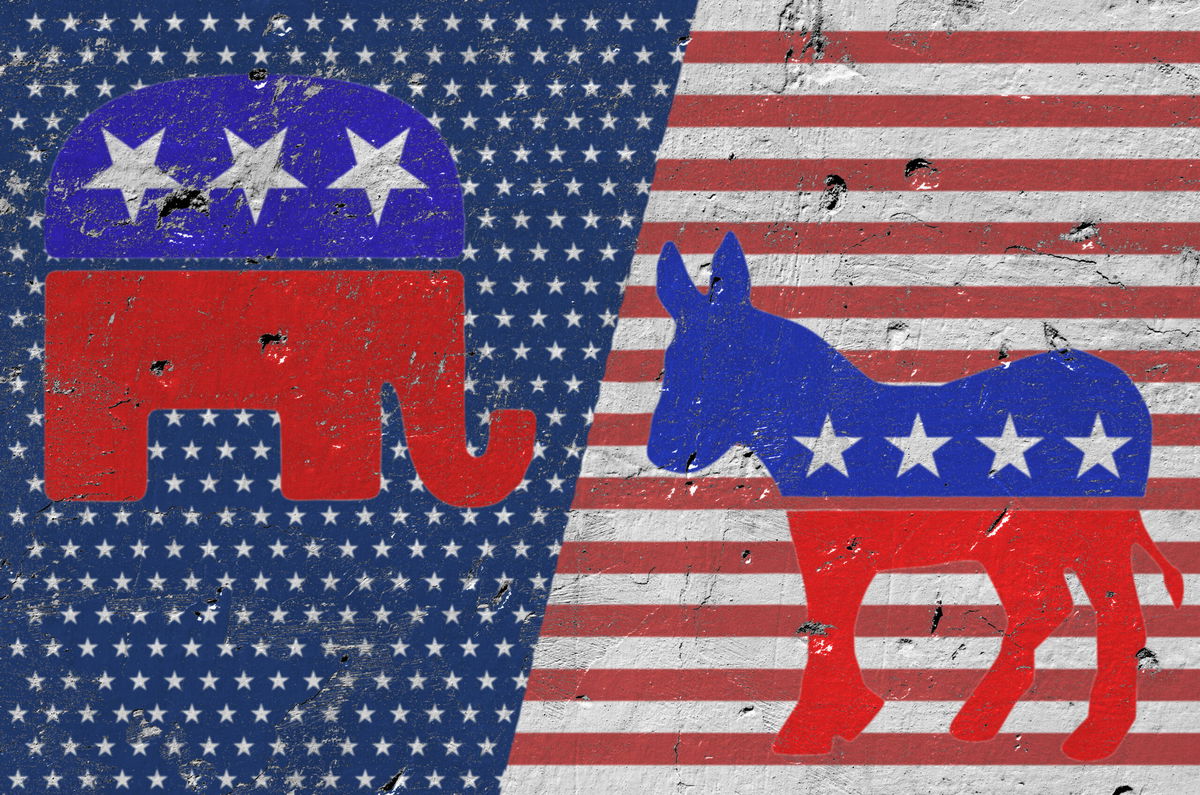
Das Symbol der Republikanischen Partei, ein roter Elefant, und das Symbol der Demokratischen Partei, ein blauer Esel, sind vor dem Hintergrund der Nationalflagge der Vereinigten Staaten von Amerika an die Wand gemalt. Das Symbol der Republikanischen Partei, ein roter Elefant, und das Symbol der Demokratischen Partei, ein blauer Esel, sind vor dem Hintergrund der Nationalflagge der Vereinigten Staaten von Amerika an die Wand gemalt. LicenseRF Copyright: xZoonar.com/SofiiaxPotaninax 24607286
Imago
Das Symbol der Republikanischen Partei, ein roter Elefant, und das Symbol der Demokratischen Partei, ein blauer Esel, sind vor dem Hintergrund der Nationalflagge der Vereinigten Staaten von Amerika an die Wand gemalt. Das Symbol der Republikanischen Partei, ein roter Elefant, und das Symbol der Demokratischen Partei, ein blauer Esel, sind vor dem Hintergrund der Nationalflagge der Vereinigten Staaten von Amerika an die Wand gemalt. LicenseRF Copyright: xZoonar.com/SofiiaxPotaninax 24607286
Essentials Inside The Story
- Senators Eric Schmitt and Maria Cantwell unveil bipartisan bill amending 1961 Sports Broadcasting Act.
- The proposal allows college conferences to pool media rights like NFL.
- Major conferences oppose the plan despite projected $9B revenue boost.
In September, Senate Democrats introduced the Student Athlete Fairness Enforcement (SAFE) Act, aiming to amend the Sports Broadcasting Act of 1961. The bill had a clear purpose: to allow college football conferences to pool their broadcasting rights and bring more money into college sports. But it stalled almost immediately. Senate Republicans were not even consulted before the bill dropped. Now, however, the scenario is changing.
Watch What’s Trending Now!
“Notable Congressional news: For the first time, a Republican and Democrat, Sens. Eric Schmitt (R-Mo.) and Maria Cantwell (D-Wa.), have agreed on legislation to amend the Sports Broadcasting Act of 1961 to permit conferences to pool media rights, their staffs tell @YahooSports,” Ross Dellenger of Yahoo Sports reported this Sunday.
Both parties are now pushing to amend the Act of 1961 together. On March 6, the two senators released a bipartisan discussion draft of the College Sports Competitiveness Act. The bill would allow college conferences to pool their media rights and negotiate broadcast deals collectively, just like the NFL does.
To understand why this bill matters, you need to go back to 1961. President John F. Kennedy signed the SBA into law. It was at a time when professional football was split between two competing leagues: the American Football League (AFL) and the National Football League (NFL).
The NFL had allowed its teams to sell their broadcasting rights collectively as a league, meaning the league held the final say over who broadcast its games and how the money was divided. That arrangement triggered a lawsuit.
Notable Congressional news:
For the first time, a Republican and Democrat, Sens. Eric Schmitt (R-Mo.) and Maria Cantwell (D-Wa), have agreed on legislation to amend the Sports Broadcasting Act of 1961 to permit conferences to pool media rights, their staffs tell @YahooSports. pic.twitter.com/oMgRLRc1oP
— Ross Dellenger (@RossDellenger) March 6, 2026
A federal court ruled that the NFL’s collective rights deal violated antitrust laws. Then, in 1960, the AFL signed a deal with ABC, and the NFL followed suit by signing with CBS. But the NFL was again blocked from doing so under the same antitrust rules.
That legal wall forced Congress to act quickly. President Kennedy signed the Act of 1961, which granted professional sports leagues a specific exemption from antitrust law. It allowed them to pool and sell their broadcasting rights as a single unit. Today, that is exactly why the NFL can sell one massive national TV package to multiple networks and then distribute that revenue equally among all 32 franchises.
While the NFL, the NBA, and other professional leagues have leveraged that exemption to build billion-dollar broadcast empires, college football never really received the same immunity. College conferences have been operating in a legal gray area, each negotiating its own separate deals with television networks. That system has made the richest conferences far wealthier than the rest.
This bill aims to change that, and its objectives are direct. The new discussion draft proposes to distribute new revenue through three goals, per the official press release:
- “Ensuring all schools receive more media rights revenue than they received in the 2024-2025 academic year;
- Giving all schools a percentage of new revenue; and,
- Allowing performance-based awards for schools that drive viewership revenue and succeed in reaching playoffs.”
The proposed change would reduce the financial gap between the wealthy power conferences and the smaller programs that have struggled to keep up. But not every school is celebrating.
A $9 billion promise that divides the most powerful conferences
Senator Maria Cantwell has argued that this proposed draft would reverse the financial damage college sports have suffered, including schools losing scholarships and cutting roster spots. Some estimates suggest that pooling media rights could generate more than $9 billion in new revenue for college sports.
The bill also proposes creating a 14-member board that would fairly represent the institutions generating the most revenue. That would also include athletes, media experts, and academic institutions.
Texas Tech Board of Regents Chairman Cody Campbell had also been pushing for the same outcome. Campbell, who founded the nonprofit Saving College Sports, has lobbied Congress directly on amending the SBA, arguing that the current model is broken and that smaller schools are being left behind.
“Our goal is to make sure that all the sports are preserved at all the schools. The only way you can do that is by getting more money into the system,” Campbell said. “In this case, we have a lever that we can pull that we have proven through empirical data, through deep study, that we can add an extra $7 billion per year in revenue to the system — and that solves all the problems.”
But not every conference agrees. The Southeastern Conference (SEC) and the Big Ten, the two wealthiest conferences in college football, have openly opposed the draft. The two conferences commissioned FTI Consulting to conduct an independent study.
According to their report, consolidating media rights under a single national structure “fails to produce more revenue than the current conference structure.”
The logistics behind that argument are worth understanding. The NFL pools rights across 32 franchises. FBS has 136 teams. Managing a centralized broadcast package across those many programs—with vastly different market sizes and brand values—is a fundamentally different challenge.
The SEC and Big Ten’s study pointed to historical evidence to back this up. The study cited an example from the ‘80s. When schools pooled games under the College Football Association, they generated just $43.6 million in revenue. That was significantly less than the $69.7 million they had earned under the old NCAA package
Despite the opposition, the pressure driving this bill is real and growing. The rise of NIL payments has dramatically increased the cost of competing at the highest level. The Schmitt-Cantwell bill is built on a straightforward argument: college sports cannot sustain themselves under the current financial model. And pooling media rights is the most practical lever available to change that.
Related Newsletters