
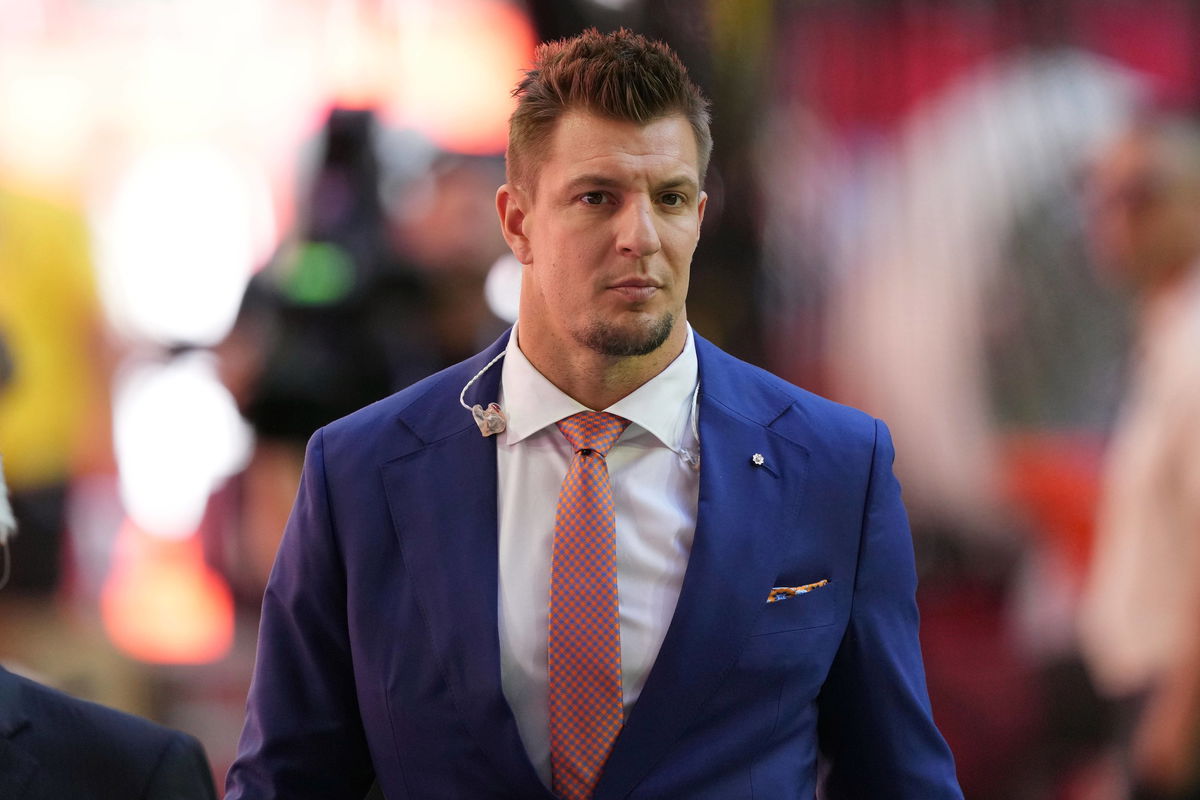
Well, if Gronk and Witten both get in, it would be the first time two tight ends are inducted into the Hall of Fame in the same class. One has the great numbers, the other has peak dominance, but in a crowded modern-era race, even a crazy résumé can leave you outside Canton. And that is what makes Gronk’s support so striking: he is publicly pushing Witten toward the same limited doorway he is trying to walk through himself.
Watch What’s Trending Now!
“[Witten] is a phenomenal player; he was such a consistent player,” Gronkowski told NBC. “That’s what makes a great football player great. It’s not just making a play every so often; it’s making a play every single time you need to make a play and be consistent out on the football field. And he was one of the most consistent tight ends. And not just a tight end, he’s one of the most consistent football players of all time, and he’s definitely deserving.”
Former New England Patriots tight end Rob Gronkowski is about as sure a Hall of Famer as they come. Four rings, four first-team All-Pro nods, and the third-most touchdown catches by a tight end make him a near-lock for Canton. Yet instead of focusing on his own case, Gronk is backing Dallas Cowboys great Jason Witten, who built a legendary career over nearly two decades but was passed over in his first Hall of Fame bid.
This was not Witten’s first shot at the Hall of Fame. In his first year of eligibility for the Class of 2026, he survived a field of 128 modern-era nominees and reached the final 15. But his run stopped there. The selectors cut the field from 15 to 10 and then to seven, and Witten was eliminated before the decisive final vote.
And that is where the Hall of Fame process gets complicated. It starts with a massive field of candidates and narrows it down to only a handful of inductees, meaning even players with elite résumés can be left waiting as they survive one brutal round of cuts after another.
- First, for the Class of 2026, the modern-era pool began with 128 nominees and was gradually reduced to 52 candidates, then 26 semifinalists, and finally 15 finalists before the Selection Committee held its annual meeting. From there, those 15 finalists were cut to 10 and then to seven.
- Second, only after reaching that final seven did candidates face the decisive vote. To be inducted, a candidate needed support from at least 80% of the selectors.
- Third, the Hall could elect between three and five modern-era players from that final group. Seniors, Coaches, and Contributors are considered through separate selection tracks, so they do not directly compete with modern-era players for those same spots.
In Witten’s case, simply reaching the final 15 already meant surviving several rounds of elimination, but he was cut before the field reached the final seven, showing just how difficult the path to Canton can be even for a player with Hall of Fame-level numbers and longevity.
The 2003 NFL draftee spent 16 seasons with the Dallas Cowboys and one with the Las Vegas Raiders, finishing his career in 2020. Witten appeared in 271 games, recording 1,228 receptions for 13,046 receiving yards and 74 touchdowns. He also earned two first-team All-Pro selections and was named the Walter Payton NFL Man of the Year in 2012.
That only makes the 2027 Hall of Fame race even tighter. The class is packed with elite talent, led by Texas native Adrian Peterson and Steelers legend Ben Roethlisberger, both viewed as strong first-ballot candidates. Add Witten and Gronkowski to that mix, and the competition for those limited spots gets crowded fast.
Adrian Peterson spent 15 NFL seasons, rushing for 14,918 yards and 120 touchdowns in 184 games. His peak came in 2012, when he ran for 2,097 yards after returning from a torn ACL and won league MVP. Ben Roethlisberger, meanwhile, played 18 seasons with the Pittsburgh Steelers, throwing for 64,088 yards and 418 touchdowns while winning two Super Bowls.
And the field only gets more crowded from there. The first-year pool also features names like Richard Sherman, Antonio Brown, Cam Newton, Andrew Whitworth, Eric Weddle, and Gerald McCoy, while returning candidates include Eli Manning, Frank Gore, Darren Woodson, Willie Anderson, Terrell Suggs, and Marshal Yanda.
And it is not just the players fighting for Canton. One of the biggest names hanging over the 2027 class is a coach whose absence last year caused plenty of noise.
Bill Belichick’s Hall of Fame Case Draws Attention
The 2027 class is also expected to include Bill Belichick, who remains eligible after falling short in his first Hall of Fame bid last year despite winning six Super Bowls as a head coach.
“I don’t have a vote, I don’t have a say, but there’s gonna be no doubt that Coach Belichick shall be in the Hall of Fame last year,” Rob Gronkowski on NBC. “He definitely got snubbed last year; he should’ve been in as a first ballot. For whatever reason he wasn’t, but 100% needs to go in this year coming up.”
Belichick’s snub came down to a brutal final vote. Despite entering as the lone Coach finalist with six Super Bowl titles as New England’s head coach, two more as a Giants assistant, and 333 career wins, he was placed in a five-person pool with contributor Robert Kraft and Senior finalists Ken Anderson, Roger Craig, and L.C. Greenwood. Voters could select only three of those five names, and each candidate needed at least 80% support to get in.
In the end, only Craig cleared that threshold, leaving Belichick outside Canton despite owning the second-most wins by a head coach in NFL history.
Gronkowski believes Belichick was hurt by the Hall’s tight voting structure. Coaches are voted on separately, and with only four to eight total inductees allowed, even a six-time Super Bowl-winning head coach was left out.
The endorsements from TE Rob Gronkowski carry weight, coming from a peer widely considered one of the position’s all-time greats. But with Gronkowski also entering the ballot for the first time, there’s a real chance the two could go into Canton together.
Something no two tight ends have ever done in the same class.