
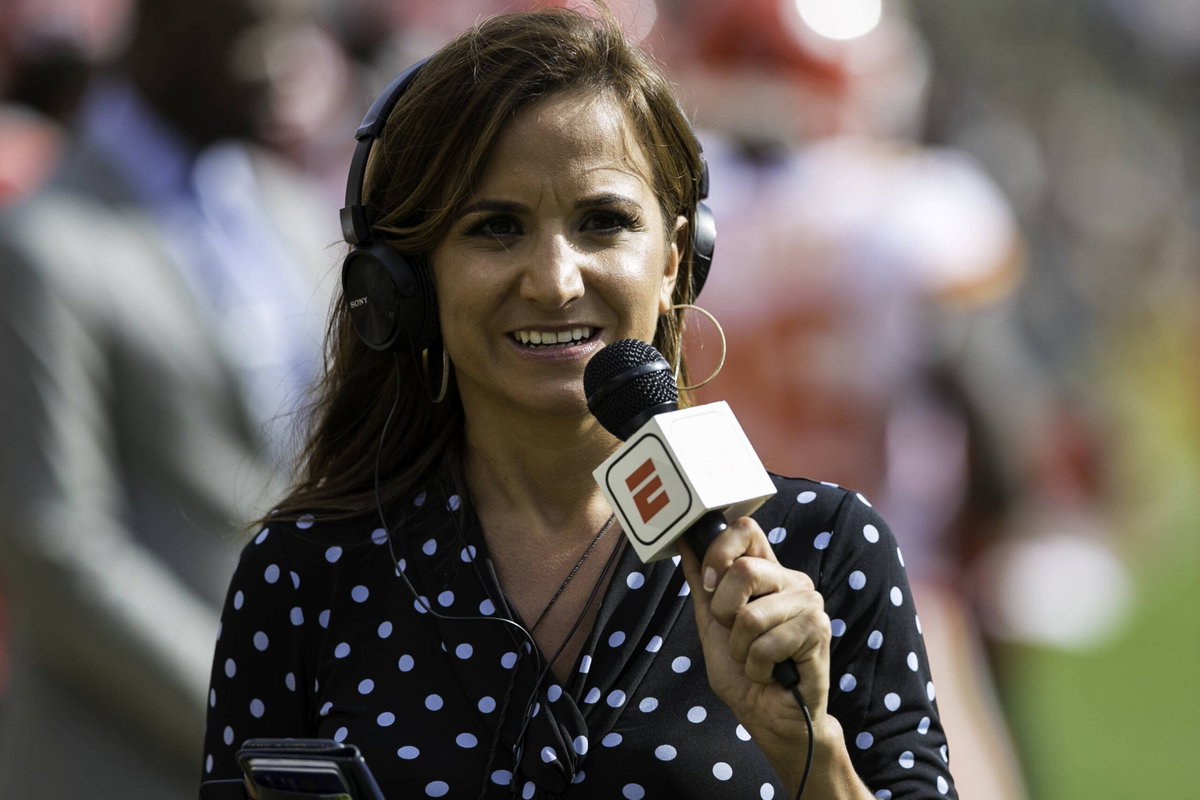
During a Patriots-Vikings joint practice in August 2025, Dianna Russini spent 50 seconds with Mike Vrabel for a video marking his 50th birthday. The questions were quick and light, the kind of offbeat exchange that can slip between practice updates and more serious NFL news. She followed it with another short video, this one asking, “What annoys Mike Vrabel?” There was nothing inherently unusual about either.
Watch What’s Trending Now!
You may want to call foul at that, but Russini did similar quick-hit content with other coaches, using the kind of access that came with her job as an NFL insider. On their own, the videos offered little reason to look twice. But the ease of those exchanges, and the access behind them, has taken on a different meaning months later, when Russini’s coverage came under scrutiny.
The Athletic released an internal report detailing an expansive audit led by Mike Semel, the outlet’s editorial director for standards and editorial quality. Semel and his team reportedly reviewed 903 articles, 204 podcast episodes, and 77 videos spanning Russini’s tenure, from August 2023 to April 2026. Here are the findings of that report:
“Specifically, when it comes to The Athletic’s standards, Russini was noncompliant,” The Athletic‘s investigation report read.
The conclusion was narrower, and more consequential, than a finding that Russini manipulated her coverage. The Athletic said her relationship with Vrabel created the appearance of a conflict of interest and should have been disclosed under its rules.
“Regardless of whether the relationship was romantic,” the report said, “it was a breach and should have been disclosed.”
That distinction runs through the entire review. The Athletic did not determine whether Russini and Vrabel had a romantic relationship, nor did it find a clear link showing that she used her platform to promote the Patriots coach or his teams. Instead, it found that the undisclosed relationship itself was enough to compromise the appearance of independence expected from a reporter covering the NFL.
Her departure also changed the scope of the investigation. Once Russini was no longer an employee, The Athletic stopped examining her personal conduct and continued with a review of her journalism. That distinction is why the report ultimately says nothing definitive about the nature of her relationship with Vrabel.
The review, led by Semel, was considerably broader than simply checking stories about Vrabel. He examined 903 pieces that Russini wrote, contributed to, or was mentioned in, 77 videos and 204 episodes of the podcast she hosted, along with roughly two dozen appearances on other platforms. He also interviewed about 14 Athletic employees who had worked closely with her and compared roughly 75 stories with coverage from other publications.
The numbers offered some important context. Of those 903 pieces, only about 46, roughly 5%, mentioned Vrabel or one of his teams. Most of those were routine news: trades, coaching hires, player moves or game-related coverage, and many were co-bylined. The review found no inaccuracies in those pieces.
That made the findings less straightforward than simply labeling Russini’s work as pro-Vrabel. Semel wrote that “the vast majority” of her work had nothing to do with Vrabel, the teams he coached or the players they were pursuing. He also found that Russini was well sourced throughout the league, with relationships involving owners, general managers, coaches, agents and players, not just Vrabel or the Patriots.
There was even an example where Russini’s access helped another Athletic reporter without her becoming part of the resulting story. For a detailed piece on Vrabel’s year between his firing by the Titans and his eventual return to coaching, Russini helped arrange a meeting between Vrabel and the reporter. She did not attend the meeting or contribute to the journalism itself, and the review found the finished story met The Athletic’s standards. Still, the example illustrates why disclosure mattered: editors were supposed to know enough about the relationship to decide what kinds of access and assignments were appropriate.
The review nevertheless identified a handful of moments that looked different in hindsight. Of Russini’s 77 videos, only three were specifically about Vrabel. Two were the lighthearted joint-practice pieces from August 2025, while the third involved a training-camp fight between the Patriots and Washington Commanders. Vrabel stepped in to break up the confrontation, and Semel wrote that he “comes out as somewhat heroic.”
Semel recommended that an editor’s note be added to those videos. He also flagged a 2023 column containing unusually insider-level detail about Vrabel discussing two-point-conversion scenarios over dinner before a game. The point was not that the information was false; rather, the access behind some of these pieces looked more consequential once the undisclosed relationship was known.
There were also examples of Russini writing about Vrabel in notably favorable terms. The report described some of that work as “gushing” and “effusive,” saying there were instances that were “awkward or even uncomfortable” in hindsight. But Semel stopped short of connecting that tone to deliberate favoritism.
“I’ve not found a clear link to conclude that Russini used her platform to help promote Vrabel or help his teams during her time at The Athletic,” Semel wrote.
That is perhaps the most important distinction in the report. The Athletic found a standards violation without finding a corresponding pattern of compromised reporting. Russini should have disclosed the relationship; the review did not establish that she then used her journalism to protect Vrabel, promote him or help his teams.
The report’s concern was therefore not only whether Russini’s stories were accurate. It was whether readers could reasonably trust that the reporter covering Vrabel had enough distance from him to make independent editorial judgments. The Athletic’s own standard says journalists should avoid even the appearance of a conflict and disclose sources or affiliations that could put their credibility into question.
That question of credibility had another, separate chapter earlier this year. In June, The New York Times reported on a speeding-ticket incident in which Russini had invoked her NFL connections while trying to persuade a police officer to let her off. She later said on a podcast that she had put the officer on a video call with his favorite head coach; body-camera footage subsequently showed that she had not actually called the coach. A Times spokeswoman described the conduct as “unacceptable.”
That episode was not part of The Athletic’s Vrabel journalism review, but it adds context to why questions about judgment, transparency and professional boundaries have followed Russini beyond the resort photographs.
The personal side of the Vrabel controversy also remains unresolved by The Athletic’s report. After the Sedona photographs surfaced, additional images emerged, including photographs of Russini and Vrabel at a New York bar in March 2020. Other reports later examined their interactions over the years. But none of that prompted The Athletic to declare what the relationship actually was.
That restraint matters. The Athletic explicitly said it “neither completed an investigation nor reached any conclusion about the nature of the full relationship between Vrabel and Russini.” Its finding rested instead on the “totality” of the public photographs and the resulting appearance of a conflict.
The controversy first came to light when Page Six published photos of the pair at the Ambiente Sedona adult luxury resort in Arizona on April 7, 2026. The New York Post’s Page Six reported that the photographs showed Russini and Vrabel holding hands, embracing and spending time together around the resort. Russini told The Athletic that the relationship was “close” but “strictly professional.” She also said the photographs lacked the context of a larger group gathering. Vrabel likewise rejected suggestions of impropriety.
But the way Russini handled the first confrontation became a separate issue in The Athletic’s review. According to Semel, she waited two days after being approached about the photographs before informing her editors and managers. The report then said she provided “a story to explain the photos that did not align with facts, raising issues of trust.”
The Athletic initially defended Russini. As more information emerged, however, the company’s position changed, and Russini was eventually sidelined from reporting before resigning on April 14. In her resignation letter, she maintained that she had covered the NFL “with professionalism and dedication throughout my career” and said, “I stand behind every story I have ever published.”
The Athletic’s response to the fallout also extends beyond Russini. The report recommended that new newsroom employees meet with the standards editor, that conflict-of-interest rules be clarified and enforced more strongly, and that editors pay closer attention when reporters repeatedly rely on the same sources. In other words, the publication treated the episode as a newsroom-process problem as well as an individual failure to disclose.
What remains uncertain is what Russini’s next chapter in NFL media looks like, and whether the credibility that made her one of the league’s most prominent insiders can be rebuilt after a controversy that ultimately became about more than the stories she published.