

Imago
NFL, American Football Herren, USA Washington Commanders at Dallas Cowboys Jan 5, 2025 Arlington, Texas, USA Dallas Cowboys owner Jerry Jones before the game against the Washington Commanders at AT&T Stadium. Arlington AT&T Stadium Texas USA, EDITORIAL USE ONLY PUBLICATIONxINxGERxSUIxAUTxONLY Copyright: xKevinxJairajx 20250105_krj_aj6_0000326
Imago
NFL, American Football Herren, USA Washington Commanders at Dallas Cowboys Jan 5, 2025 Arlington, Texas, USA Dallas Cowboys owner Jerry Jones before the game against the Washington Commanders at AT&T Stadium. Arlington AT&T Stadium Texas USA, EDITORIAL USE ONLY PUBLICATIONxINxGERxSUIxAUTxONLY Copyright: xKevinxJairajx 20250105_krj_aj6_0000326
Essentials Inside The Story
- Jerry Jones has famously ignored the team needs during the Draft
- Jones actually busted the budget for the first time in many years
- Dallas only has $6.5 million in effective cap space due to massive hits
On the very first press conference Jerry Jones hosted after buying the Dallas Cowboys in 1989, he was asked what his role within the organization would be. Jones looked right, where team president and general manager Tex Schramm was standing, and declared that he was taking Schramm’s job. No searching or shortlisting. Just Jerry Jones deciding that the only person qualified enough to run his team was himself. A couple of years back, he even declared himself the best GM.
Watch What’s Trending Now!
Maybe he wasn’t entirely wrong.
Since 2010, Jones has had a 67% hit rate on first-round All-Pro selections, the highest in the league. Micah Parsons, Zack Martin, DeMarcus Ware, and so many more have made All Pros. So, the numbers back up Jones’ claim that he can evaluate talent. The problem? It’s only half the job.
On the other end of that spectrum lies the 30-year Super Bowl drought, the single data point every critic reaches for. And they’re not wrong either. Finding great players and winning championships are two different jobs, and Jerry Jones seems to have mastered only one of them. This offseason, with picks 12 and 20 on the clock and April 23 just five days out, the most self-aware general manager in the league is about to take the test he keeps telling everyone he’s studied for. Unfortunately, thirty years of evidence prove otherwise.
The Well Documented Pattern
Jerry Jones walked into the 2024 NFL Draft war room with the kind of confidence only a man who believes in his own mythology can carry. Dallas needed a running back to shore up their offense. Their O-line had also been a revolving door for two seasons. The solution, apparently, was more doors.
Skipping a running back, Jones drafted three linemen in the first three picks: OL Tyler Guyton, DL Marshawn Kneeland, and OL Cooper Beebee. When asked about the running back need later, Jerry deflected in style, hinting he’d struck gold with his first three picks.
“Why do you rob banks?” Jerry asked. “Because that’s where the money is.”
Cowboys owner Jerry Jones while talking about Dallas drafting three offensive linemen in what they believe is a strong offensive line draft class: “Why do you rob banks? Because that’s where the money is.” pic.twitter.com/cxYWUfJR06
— Jon Machota (@jonmachota) April 27, 2024
But every time his father refused to answer, Cowboys EVP Stephen Jones had to field the running back question. Stephen explained that whenever a running back came up on the board, somebody better was available. He also said they’d probably address that need in free agency.
What Dallas actually did in free agency was re-sign Rico Dowdle, a backup with 89 carries the previous season. They also added Royce Freeman as depth, and brought back Ezekiel Elliot on a committee deal. No starters, no big investments. Jerry robbed the bank with his linemen in the draft and came away with loose change.
Dowdle, to his credit, delivered with a career-best 1,079 yards and carried the offense through a brutal stretch. Elliot underdelivered and got pushed to the Los Angeles Chargers’ practice squad by January. His contract expired two weeks later, and that was the end. Freeman never played a snap. The free agency fix turned into one good player and two footnotes.
By Week 9 against the Atlanta Falcons, Jerry’s bank vault of an offensive line had allowed 21 sacks on franchise quarterback Dak Prescott. Then Prescott snapped his hamstring. Cooper Rush took over and got sacked 13 more times. Trey Lance closed a 7-10 season, getting sacked four times in a single game. The offensive line Jones had bet the season on had dismantled the season instead. By December, Jones was in front of a different microphone, admitting he blew it.

Imago
OXNARD, CA – JULY 25: Dallas Cowboys owner Jerry Jones and head coach Mike McCarthy talk to the media during the team s training camp at River Ridge Playing Fields on July 25, 2024 in Oxnard, CA. Photo by Brandon Sloter/Icon Sportswire NFL, American Football Herren, USA JUL 25 Cowboys Training Camp EDITORIAL USE ONLY Icon240725012
“I probably got a little out over my skis, thinking just plug those guys in,” Jones said. “We’ve paid the price to some degree.”
If that admission had changed anything, April 2025 would have looked different. Dallas held pick 12, the same number they carry into this draft. The offense was hurting and needed weapons to take pressure off wide receiver CeeDee Lamb. Jones took Tyler Booker, another offensive lineman. Booker was the third offensive lineman Jerry had taken in three out of four of his first-round picks. Amusingly, all three were named Tyler (Booker, Guyton, and Smith). Jones had diagnosed the problem just four months earlier and prescribed the same treatment anyway.
Now, here’s what makes Jerry genuinely maddening to analyze.
The 2026 offseason has been different. Not perfectly, but different enough that you have to stop, give credit, and ask whether the pattern has finally broken or whether it’s just wearing a new outfit.
Jerry’s 2026 Course Correction?
Ahead of the 2026 free agency, Jones promised to “bust the budget,” and made us roll our eyes. We’ve heard this too many times before. The quotes change every year, the promises get bigger, the draft board turns, and the Cowboys can’t stop making mistakes. But something right actually happened this year.
Dallas had already traded for Quinnen Williams and Kenny Clark on the interior last season. This offseason, Rashan Gary arrived at edge rusher. Cobie Durant shored up the cornerback room, and Jalen Thompson reinforced safety. By any fair reading, this was the most aggressive defensive free agency investment the Cowboys had made in years. Jones didn’t just talk about fixing his defense; he went out and started fixing it. What’s more, he also brought on an entirely new defensive identity.
Under new defensive coordinator Christian Parker, Dallas is shifting from a 4-3 to a 3-4 base, the same overhaul they tried in 2005. Dallas had two first-round picks at the time (No. 11 and No. 20), and their rebuild worked. From 2005 to 2009, Dallas’ defense ranked in the top 10 four times in the league. But that demands very specific athlete profiles at every level.
Every Dallas Cowboys transaction so far:
Additions
• DL Rashan Gary (via GB trade)
• S Jalen Thompson (3 years, $36M)
• S P.J. Locke (1 year, $5M)
• DT Otito Ogbonnia (1 year, $3M)
• QB Sam Howell (1 year, $2.5M)
• DE Tyrus Wheat (1 year, $1.2M)
• OL Matt Hennessy (1… pic.twitter.com/bV8NOiWvuA— SleeperCowboys (@SleeperCowboys) March 29, 2026
To address that need in the 2005 Draft, Dallas had brought in linebacker DeMarcus Ware (pick no. 11) and defensive end Marcus Spears (pick no. 20). After Ware and Spears, head coach Bill Parcells had LB Kevin Burnett in round two, DE Chris Canty in round four, and DL Jay Ratliff in the seventh round. Five picks invested to fill out a new defensive scheme that showed immediate results.
Jones fixed what he could pay for this offseason. And for once, it does look like he paid for the right things. But here’s where 2026 stops looking like 2005.
This year, Jones has to choose which of his eight picks he wants to use on defense. There is no second-round pick; it went to the New York Jets for Quinnen Williams. Their third-round pick at 92 only exists because they shipped off DT Osa Odighizuwa to the San Francisco 49ers.
The linebacker room is still thin. The nickel corner spot is still open. Starting edge rusher Donovan Ezeiruaku is already limited by hip surgery heading into the offseason program. The draft can be a solution to all of these problems if Jerry plays his picks right.
Would Jones Look at the Biggest Needs and Possible Fixes this year?
The glaring hole is at linebacker. Parker’s 3-4 schemes will require a coverage-capable linebacker who can operate with flexibility. It’s a completely different profile from the 4-3 Dallas ran under Matt Eberflus last season. To help the new scheme, three names have surfaced consistently.
- Anthony Hill Jr. (Texas) – athletic profile fits the 3-4 coverage demands.
- Jacob Rodriguez (Texas Tech) – First round surprise, the Locked On Cowboys podcast noted that Dallas actually prefers him over Georgie’s CJ Allen, the linebacker most frequently linked to Dallas by analysts.
- Arvell Reese (Ohio State) – listed first in the Cowboys’ own official draft guide among all linebacker prospects.
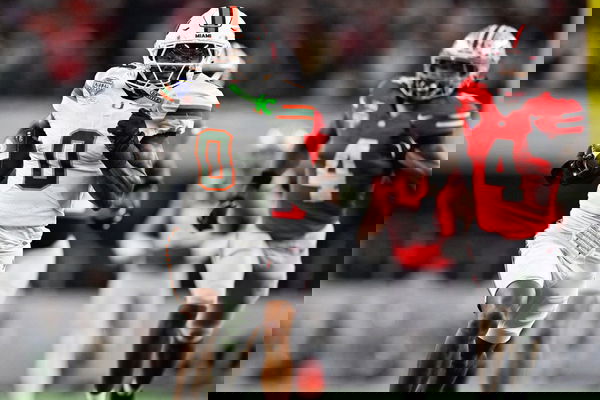
At the corner, the nickel spot is the problem. DaRon Bland isn’t the answer inside. Head coach Brian Schottenheimer has already said he prefers Bland on the outside. That leaves a slot hole ESPN’s Matt Bowen flagged specifically. His proposed fit: Miami’s Keionte Scott.
Last season, Scott led all cornerbacks with nine run stops, posted a 91.4 run defense grade, and recorded five sacks on blitzes. That’s the profile Parker’s scheme demands from a nickel corner. If Scott falls to pick 20, it’s the kind of value that makes the pick obvious. Whether Jerry Jones sees it that way, though, is a different question.
Imago
NCAA, College League, USA Football: Cotton Bowl-Miami at Ohio State Dec 31, 2025 Arlington, TX, USA Miami Hurricanes defensive back Keionte Scott 0 runs the ball for a touchdown after an interception against the Ohio State Buckeyes in the second quarter during the 2025 Cotton Bowl and quarterfinal game of the College Football Playoff at AT&T Stadium. Arlington AT&T Stadium TX USA, EDITORIAL USE ONLY PUBLICATIONxINxGERxSUIxAUTxONLY Copyright: xJeromexMironx 20251231_kdn_an4_073
At the edge, the issue is depth behind Rashan Gary and a rehabbing Ezeiruaku. The draft offers well-rounded solutions for this, too.
- David Bailey (Texas Tech) – logged 14.5 sacks last season, rated by many as the best fit at pick 12.
- Cashius Howell (Texas A&M) – SEC Defensive Player of the Year, 11.5 sacks, led his team with 14 tackles for loss, and fits the profile at 20 if Bailey is gone.
- Akheem Mesidor (Miami) – third option if both are off the board.
Three positions, and clear answers on the board for all three. Jones has had all winter to identify them. What he will have left in the bank after signing them all, though, sounds exactly like something Jerry might come to regret by December 2026.
$6.5 Million: That’s what’s left for Jones
The Cowboys enter this draft with $6.5 million in effective cap space, which is what remains after at least 51 players (including the rookie class) are already counted against the roster. That is the margin between solvency and going over the cap once the draft class signs. In other words, Jerry won’t have any cap space left to fix things if the rookie class disappoints. And the reason for this is Jerry’s past investments.
Prescott carries a $43.83 million cap hit in 2026. Lamb costs $19.65 million this season, and George Pickens sits on a $27.3 million franchise tag with a July 15 extension deadline. One quarterback, two wide receivers, and approximately $90 million before a single defensive starter is paid. That’s the roster Jones built. It wins games, but also leaves almost nothing to fix what’s broken.
Former Dallas quarterback Troy Aikman has also gone on record warning that Dallas’ offensive spending will leave permanent holes in this roster. He’s right, and the cap sheet proves it.
This draft is the only financially viable path left for fixing this defense. The picks this year don’t just have to hit; they have to contribute immediately, on a unit that finished dead last in points allowed, funded almost entirely on rookie minimum contracts. Then there’s the draft class itself.
According to Tony Pauline on the EssentiallySports Draftcast, only 12 players in the entire 2026 class carry “surefire first-round grades.” A typical draft has between 18 and 24. Dallas’ pick 12 sits at the edge of that legitimate talent pool, and pick 20 is already outside it. If Jones misses at 12, there’s no second round to recover. If pick 20 becomes a reach with a class thin at the top, the next meaningful selection is pick 92.
“I think there’s 103 picks in the first, second, and third round,” Pauline said on EssentiallySports’ DraftCast’s episode 14. “I only have 94 players with basically what would be top 100 first or second day grades.”
Pauline notes the class is “good in the middle rounds.” And with Dallas holding five picks from rounds 4 through 7 (three fifth-round picks), they seem positioned to make cheap, functional depth additions. But once again, it all depends on what Jerry Jones decides, and what he has been saying isn’t inspiring a lot of confidence.
Jerry Has Already Told Us His Intentions
You don’t have to guess what Jones might do on April 23rd. He’s already left a trail.
“I’ve looked at that mirror a lot, about how to go up and down and trade and do those kinds of things,” Jerry had said at the owners’ meetings in March. “Absolutely. We’ll entertain improving or an in-draft read on what gives us a better chance to get another player, and still have our pick and the red meat of top players. Now that has an on-the-board aspect to it, but it’s very doable.”
That confession is almost too self-aware, a man describing his own worst habit in the language of self-improvement, just days before the habit returns.
His stated draft approach for April 23 is to be “patient and aggressive.” Both, simultaneously. Instead of a sound strategy, this sounds like two opposing instincts in the same press conference suit. What makes all of this even worse is that Schottenheimer has publicly committed to a “draft pure” philosophy: best player available, regardless of the positional need.
Have the #Cowboys had discussion about trading one or both of their first-round picks to go higher in the draft, acquire more capital or a player?
Jerry Jones yesterday: “I’ve looked at that mirror a lot, about how to go up and down and trade and do those kinds of things. And… pic.twitter.com/ecsAVEhZL5
— Tommy Yarrish (@tommy_yarrish) April 1, 2026
He’s left the door open to taking an offensive player if one presents itself on the board. It’s not a reassuring philosophy at pick 12, the exact number where Jones took Tyler Booker twelve months ago. Rather, it’s a polite way of saying the same old mistakes are still on the table.
In 2016, Jones spent 67 minutes inside the draft war room calling nine teams, trying to trade up for quarterback Paxton Lynch. All nine teams declined. He stood pat, took running back Ezekiel Elliot at 4th overall, despite the room wanting a pass rusher. Elliot was great, but wasn’t what the team needed the most.
This year, Jones has real ammunition to help his defense. He has already hinted that he’s open to moving up in the draft to get a premium player. But there are no guarantees that those moves will be for the defense. And like I’ve dissected here, there are just too many reasons for skepticism.
Same Movie, New Cast
Now, I am not against the Dallas Cowboys. If you have followed our EssentiallySports Staff Picks last season or saw our Off the Rails podcast, you already know I support Dallas.
But I’ve seen the 90s dynasty crumble into grainy highlight reels, box scores, and interviews with legends who are now the very analysts who cover football (Tony Romo, Troy Aikman). Stepping into that kind of history has made me, like much of Cowboys Nation, pessimistically optimistic. It’s easier to absorb another loss when you’ve already prepared for it.
Thanks to Jerry Jones, there’s never a shortage of debate topics.
USA Today via Reuters
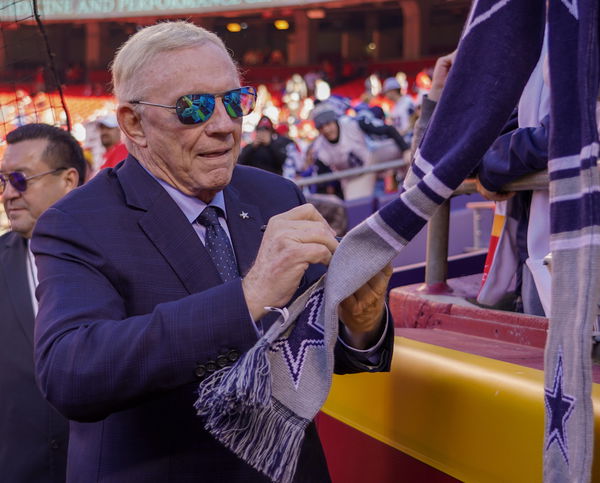
NFL, American Football Herren, USA Dallas Cowboys at Kansas City Chiefs, Nov 21, 2021 Kansas City, Missouri, USA Dallas Cowboys owner Jerry Jones signs autographs for fans before the game against the Kansas City Chiefs at GEHA Field at Arrowhead Stadium. Mandatory Credit: Denny Medley-USA TODAY Sports, 21.11.2021 14:26:44, 17254185, NFL, Kansas City Chiefs, Arrowhead Stadium, Jerry Jones, Dallas Cowboys PUBLICATIONxINxGERxSUIxAUTxONLY Copyright: xDennyxMedleyx 17254185
After Dallas shipped off Micah Parsons to the Green Bay Packers last season, his own fanbase labeled Jones the “worst GM in NFL history.” This April, NFL executives have also gone on record, blasting Jones for falling short on his offseason promise.
As an owner, Jerry Jones successfully turned the Dallas Cowboys into the world’s most expensive sports franchise. Jones, the general manager, isn’t bad either. But he’s something more specific and more frustrating: a great talent evaluator with a pattern he cannot override when the draft board goes live.
The 2026 free agency haul proved he can act on past lessons. He fixed the defensive line and changed the scheme. What he’s yet to prove in 30 years is that he can override his instincts and draft players he actually needs.
The “mirror” Jones keeps looking into has been showing him the same reflection since 1996. The bank robbery quote, the December admission, the April 2025 repeat, and the January 2026 promise. He sees it. He’s always seen it all firsthand.
But the Cowboys Nation doesn’t need him to see it anymore. They need him to look away from it and make the right call anyway. And right now, as of April 18th, he has five days to figure out what that call is.
Written by

Edited by

Antra Koul