
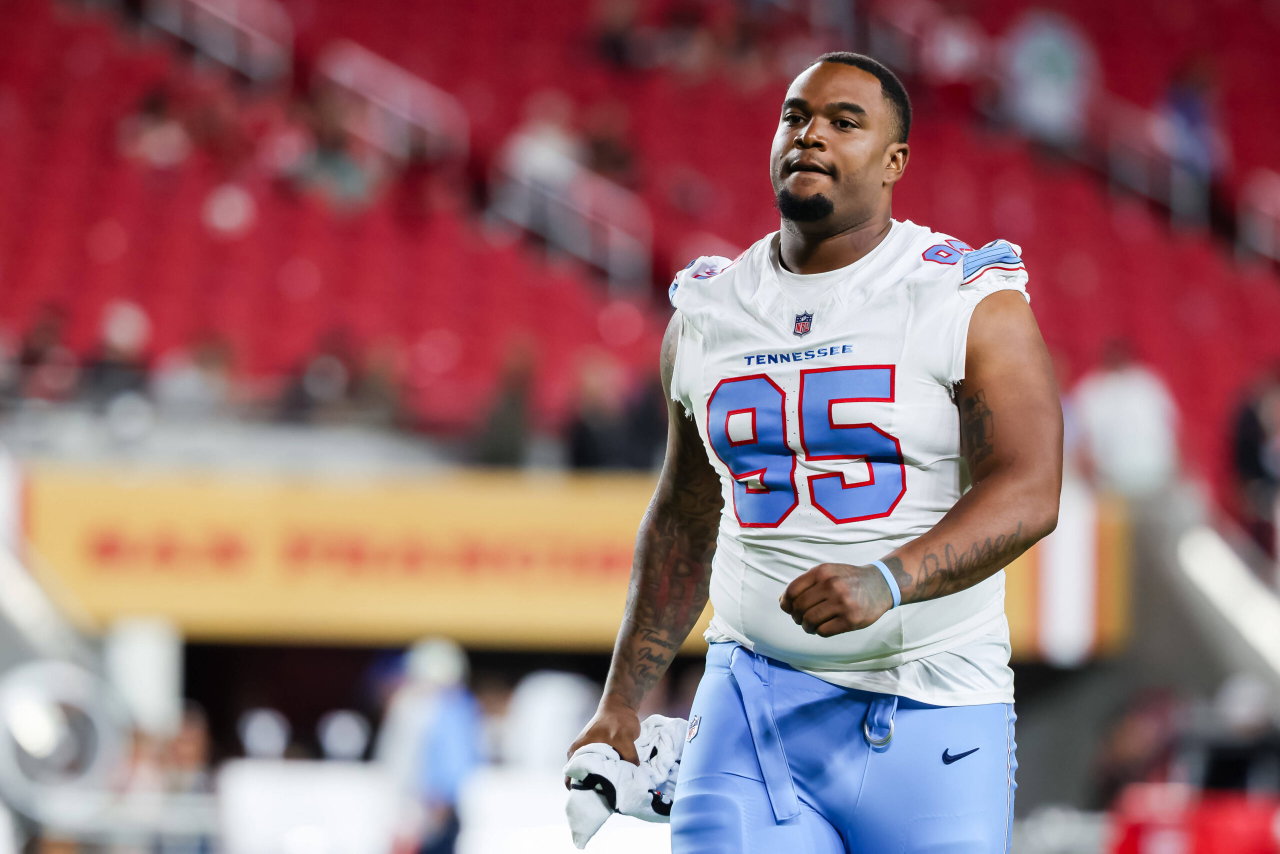
Tennessee Titans HC Robert Saleh used a media session to push back on the rush to judge the defensive tackle, Jordan Elliott, who was released after an incident involving a firearm in a parking lot. Saleh did not dispute that rules were broken, but he urged the public to look beyond the headline and ask a harder question.
Watch What’s Trending Now!
Defending Elliott, HC Robert Saleh said, “And the reason why I think the NFL and the organization did an outstanding job is because this is a man who’s a father, a great husband. He’s never committed a crime in his entire life. And he pulled a gun in the parking lot.”
Saleh then turned to what he believes is the question being overlooked.
“And the first question that I think everyone forgets to ask is why would a great man, a great father, a man who shows up on time every day, works his ass off every day, contributes the way he’s supposed to contribute, and is well-liked in the locker room. Why did he go off the rails and grab a gun? And to me, those are small signs of a cry for help. If you, in terms of, obviously, there’s something greater happening.”
Saleh praised how the Titans and the NFL handled the situation, especially their decision to pause rather than react immediately. In his view, that pause was what allowed the right questions to be asked. The defensive tackle pulled out his firearm after an altercation that happened on the field with his teammate, OT JC Latham.
The coaches asked him to leave the field. After the practice, the incident spilled over into the locker room, and Elliott was spotted on camera going to his car and retrieving a firearm, which reportedly never left his parking spot.
For the head coach, the franchise’s priority was to ensure Elliott received the support he needed, and he credited the team and the league with “checking every single box” in that regard.
“On Thursday, October 15, there was an incident at our team facility involving Jordan Elliott,” the Titans stated. “Following our review of the incident, we have made the decision to release Elliott from our roster. We will have no further comment on the matter.”
Saleh did not give any excuse for the act. He acknowledged that rules about firearms on team property are strict, and the consequences were unavoidable. He tied his comments to a broader concern, as he noted that in the past year, the NFL has lost two young men to suicide, and suggested they may have been crying out for help, but the signs may have been missed or ignored by people around them.
Saleh was careful not to claim that Elliott was in that place. But he mentioned that young players carry pressures that outsiders rarely see.
“But these kids go through a lot, a lot.”
Yet, he said he would stand for Elliott.
“And like I said, I thought I will stand on the table for Jordan’s character. Unfortunately, rules are rules with regard to guns on property. And sometimes it’s far greater than the knee-jerk reaction of kicking somebody and kicking somebody when they’re down,” Saleh added.
According to Saleh, it was a call for help more than a criminal act, while acknowledging how unfortunate the situation was. He closed with a pitch to the other 31 teams.
“My message to 31 other teams would be, if you need a hell of a run-stopping D tackle that can help you on a playoff run, give me a call. I’ll tell you everything you need to know about him. He’s a good man.”
It is uncertain whether Elliott lands with another team. Saleh’s comments have shifted the conversation toward a question the NFL continues to grapple with: how to recognize struggle in players who seem fine on the outside and how to respond before a crisis arises.